
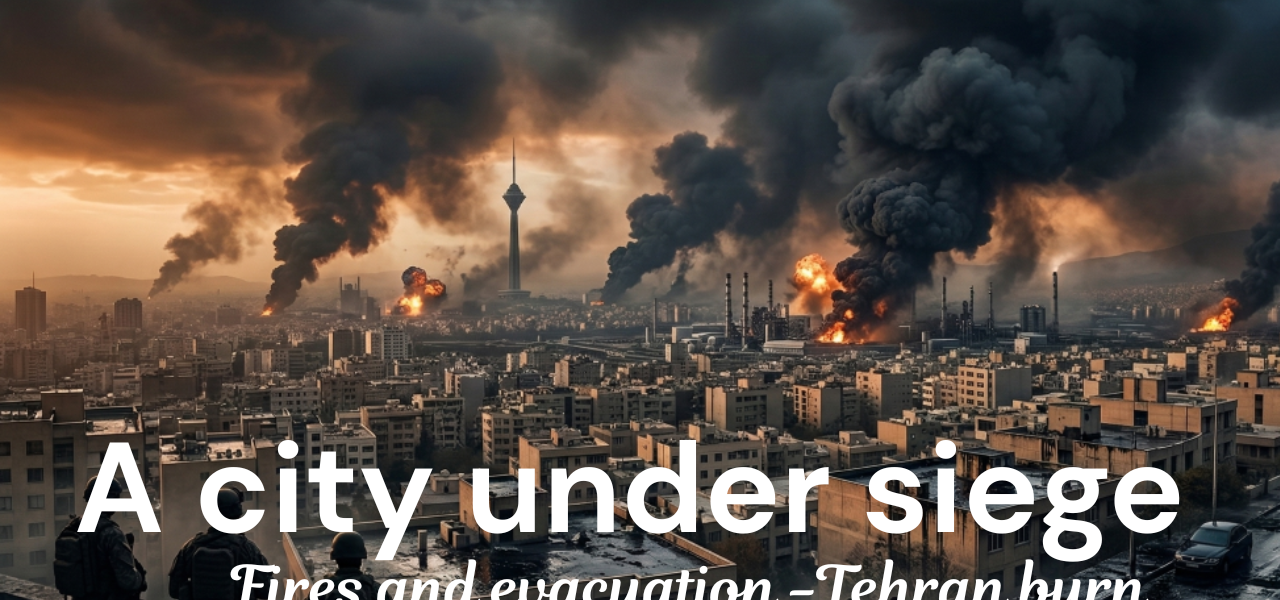
US Israel Military Campaign in Iran: Tehran Under Siege and Global Crisis


US Israel Military Campaign in Iran: Tehran Under Siege as Global Crisis Deepens
The geopolitical landscape of the Middle East has completely fractured following the launch of a coordinated, large-scale US-Israel military campaign in Iran. Dubbed “Operation Epic Fury” by the United States and “Operation Roaring Lion” by Israel, this unprecedented offensive aims to fundamentally neutralise Iran’s nuclear infrastructure and systematically dismantle its senior political and military leadership. Entering its tenth day on March 10, 2026, the conflict has rapidly devolved from targeted strikes into brutal urban warfare, plunging Tehran into a historic humanitarian and macroeconomic catastrophe.
The Decapitation Strike and a New Supreme Leader
The defining moment of the US Israel military campaign in Iran occurred on February 28, 2026, when a precision joint strike assassinated Supreme Leader Ayatollah Ali Khamenei within his heavily guarded Tehran compound. The strike, reportedly supported by deep intelligence penetration from the CIA, also eliminated several high-ranking Islamic Revolutionary Guard Corps (IRGC) commanders.
Rather than triggering the regime’s immediate collapse, the power vacuum rapidly accelerated the IRGC’s total monopolisation of the state. On March 8, under immense military pressure, the Assembly of Experts selected Mojtaba Khamenei—the late Ayatollah’s second-eldest son—as the new Supreme Leader. This highly irregular transition guarantees hardline continuity, indicating that Iran will adopt an even more autocratic domestic stance and an aggressively asymmetric foreign policy.
Tehran Under Siege: Infrastructure Collapse and “Black Rain”
As the US Israel military campaign in Iran intensifies, Tehran has transformed into a primary theatre of war. Coalition forces have launched unrelenting airstrikes, destroying the IRGC General Headquarters and paralysing the nation’s air defence networks.
However, the expansion of the target matrix to include vital energy infrastructure has triggered an apocalyptic environmental disaster. Coordinated strikes on the Shahran oil depot and the Tehran refinery ignited millions of litres of stored fuel, overwhelming local emergency services. The incineration of these massive fuel reserves has resulted in what environmental experts are explicitly classifying as an act of “ecocide”.
The skies over Tehran are now choked with toxic black smoke, producing a terrifying meteorological phenomenon known as “black rain”—precipitation saturated with oil residue and acidic compounds. This toxic fallout is actively contaminating the city’s soil and municipal water supplies, creating a catastrophic public health emergency that the collapsing Iranian healthcare system cannot handle. Coupled with synchronised water and power outages lasting several hours each day, the capital city of 10 million people is teetering on the edge of being virtually uninhabitable.
The Humanitarian Crisis and Digital Darkness
The human cost of the US Israel military campaign in Iran is staggering. Conservative estimates suggest over 1,200 civilians have been killed nationwide, with children comprising nearly 30 percent of the victims due to catastrophic collateral events. Hospitals face insurmountable logistical hurdles, running critically short on trauma supplies, antibiotics, and generator fuel for life-saving continuous treatments.
Compounding the terror is an unprecedented digital blackout. The Iranian government has throttled international internet connectivity to roughly 1 percent of normal levels, effectively trapping 90 million citizens in digital darkness. This isolation prevents civilians from receiving critical evacuation warnings issued by the IDF on social media platforms, trapping them in the blast radius of precision strikes and allowing the regime to obscure the true scale of the domestic crisis.
Global Economic Shockwaves
The ramifications of the US Israel military campaign in Iran have spilt over into global markets. In retaliation for the strikes, Iran executed its long-standing threat to effectively close the Strait of Hormuz—a vital maritime chokepoint handling roughly 20 percent of the world’s crude oil transit. Asymmetric naval swarming and anti-ship missile deployments have created a de facto blockade, sending global energy markets into a panic.
On March 9, the price of Brent crude oil surged to nearly $120 per barrel, igniting severe fears of global stagflation. While markets experienced temporary whiplash on March 10—retreating to approximately $85 per barrel following statements from US President Donald Trump indicating the campaign was progressing ahead of schedule and nearing its conclusion—the IRGC quickly countered that Iran, not the Americans, would determine the end of the war.
Geopolitical Repercussions and Diplomatic Strain
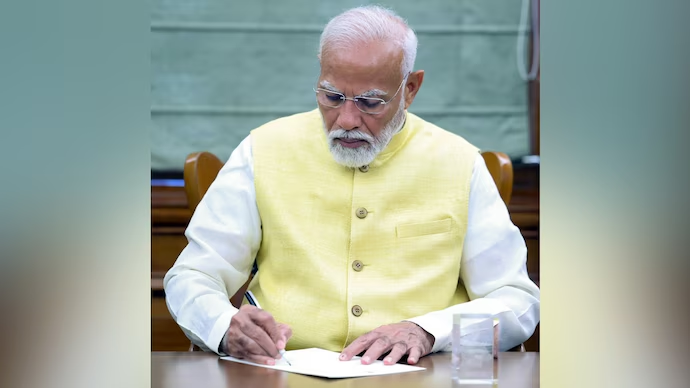
The rapid escalation of hostilities has placed immense diplomatic strain on global powers. India, the world’s second-largest crude importer, finds itself in a precarious diplomatic balancing act. Relying heavily on the Persian Gulf for energy and hosting an expatriate workforce of roughly 10 million citizens in the region, the Indian government has so far managed the situation under the leadership of PM Narendra Modi. While India has firmly advocated for de-escalation and prioritised the safety of its diaspora, its strategic silence underscores the immense complexities generated by this conflict.
As the military campaign enters its second week, the localised devastation in Tehran and the sweeping global economic disruptions highlight the dire consequences of this war. With a new, hardline Supreme Leader in power and global trade arteries severed, the path to peace remains alarmingly elusive.
Read the comprehensive research report on US Israel Military Campaign in Iran here
US Israel Military Campaign in Iran
Discover more from
Subscribe to get the latest posts sent to your email.






3 COMMENTS