

Top 50 CBSE Schools in India (2025–26): Inside an Evidence-Based Education Research Study


At a time when parents are flooded with online “best school” lists, sponsored rankings, and perception-driven claims, a new education research study has attempted to change the conversation—by focusing strictly on verifiable evidence rather than popularity.
The Top 50 Private CBSE Schools in India (2025–26) study, published by CCLP Worldwide, positions itself not as an admission guide or promotional ranking, but as a structured academic evaluation of institutional quality within India’s private CBSE school ecosystem.
Moving Beyond Hype-Driven School Rankings
Unlike many school lists circulating online, this research deliberately avoids surveys, reviews, school submissions, or paid participation. According to the publishers, only publicly available and verifiable information was used to evaluate schools.
The study also makes clear what it does not include. Government-run institutions such as Kendriya Vidyalayas, Navodaya Vidyalayas, Sainik Schools, Army Public Schools, and other government schools have been excluded, with the focus remaining solely on private schools affiliated with the Central Board of Secondary Education (CBSE).
This sharply defined scope, researchers argue, helps prevent misleading comparisons and keeps the analysis institutionally consistent.
What Public Evidence Really Reveals About India’s Private CBSE Schools
The Good School Rating Framework: How Schools Were Evaluated
At the core of the research lies the Good School Rating Framework, a structured evaluation model developed by CCLP Worldwide. Instead of relying on a single metric, the framework assesses schools across eight weighted parameters, designed to capture how modern schools actually function as institutions.
The parameters include:
- Academic Excellence
- Faculty Quality
- Infrastructure
- Governance and Compliance
- Innovation and Co-curricular Integration
- International Exposure
- Community Engagement
- Digital Integration
By distributing weightages across these dimensions, the framework aims to ensure that no school is elevated solely due to infrastructure scale, branding, or examination performance alone.
Why a Tier System Replaced “Best School” Labels
One of the notable features of the study is its tier-based classification system. Instead of amplifying marginal score differences, schools are grouped into Gold, Silver, and Bronze tiers, based on overall balance, consistency, and strength of evidence across parameters.
Education researchers involved in the project note that this approach avoids what they describe as “artificial ranking inflation” and offers a more realistic picture of institutional maturity, rather than headline-friendly claims of absolute superiority.
Why CBSE School Rankings Are Often Misread—and How to Read Them Better
National-Level Patterns in Private CBSE Education
Beyond the list itself, the research highlights several broader trends shaping private CBSE education in India:
- Urban and peri-urban concentration: High-performing private CBSE schools continue to cluster around urban centres, where governance capacity and faculty availability are stronger.
- Rise of semi-urban institutions: A gradual expansion into semi-urban regions reflects the widening geographic footprint of CBSE academic quality.
- Governance as a stabiliser: Schools with strong statutory compliance and transparent governance tend to show more consistent performance across parameters.
- Infrastructure isn’t everything: While facilities matter, the study finds that leadership quality and academic systems play a more decisive role in sustained excellence.
- Digital integration as a quiet equaliser: Technology increasingly supports consistency and academic continuity rather than surface-level visibility.
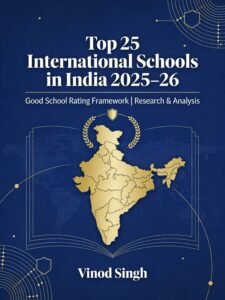
Top 25 International Schools in India Announced Under Good School Rating 2025–26
Important Caveats for Parents and Educators
The publishers have also emphasised clear limitations. The CBSE Schools in India ranking is time-bound to the 2025–26 academic cycle and does not predict future performance, guarantee admission outcomes, or replace on-ground due diligence by parents.
All observations are described as interpretative, based exclusively on publicly verifiable information available at the time of research.
A Broader Push for Transparency in Indian Education
According to CCLP Worldwide, the CBSE Schools in India (2025–26) project forms part of a longer-term effort to promote transparent, evidence-based evaluation in Indian education, at a time when families are increasingly seeking clarity amid competing claims.
Full details of the methodology, analytical chapters, and official publication material are available on the organisation’s website.
Why This Study Matters
In an education landscape crowded with rankings, the Top 50 Private CBSE Schools in India (2025–26) study stands out not because it claims to identify the “best” schools—but because it attempts to show how schools can be evaluated responsibly, using evidence, structure, and restraint.
For parents, educators, and policymakers alike, that shift in approach may prove just as important as the list itself.
top 50 private cbse schools india, private cbse schools ranking 2025, cbse schools india research, cbse school evaluation framework, education research india, private schools cbse india
Discover more from
Subscribe to get the latest posts sent to your email.







1 COMMENTS