Ram Navami 2026 | Sri Ram’s Civilisational Legacy | Kolkata Howrah Shobha Yatra | News24Media


Ram Navami 2026:
The Eternal Soul of Sanatan Civilisation
Sri Ram — Maryada Purushottam, Pillar of Dharma, and the Living Spirit of a Civilisation that Conquered Time
“Ramahi kewal prem piyara, jani lehu jo jan nihara” — Lord Rama loves only pure devotion. Whoever understands this as a true devotee, his every wish is fulfilled.
— Goswami Tulsidas, RamcharitmanasThe Birth of an Epoch — What Is Ram Navami?
There are festivals, and then there are civilisational events. Ram Navami is the latter. Celebrated on the ninth day (Navami Tithi) of the Shukla Paksha in the Hindu month of Chaitra, it marks the birth anniversary of Maryada Purushottam Shri Ram — the seventh avatar of Lord Vishnu, the ideal son, the ideal king, the ideal human being. In 2026, Ram Navami fell on Thursday, March 26, with the Madhyahna Muhurat — the most sacred window aligned with the hour of Ram Lalla’s birth — running from 11:13 AM to 1:41 PM, with the divine apex moment at 12:27 PM.
But to confine Ram Navami to a calendar date is to miss its cosmic dimension entirely. This is the day the Sanatan civilisation — the oldest continuously living culture on Earth — pauses, breathes deeply, and renews its covenant with its own foundational ideal. The ideal of a man who was also God, who chose the path of duty and righteousness over comfort and convenience, who showed that civilisation is not built with weapons alone, but with the quiet, unbreakable spine of Dharma.
The festival is the grand culmination of the nine-day Chaitra Navratri, a period of fasting, spiritual purification, and devotion. On the tenth hour of the ninth day, when the sun climbs to its zenith, the chants of “Jai Shri Ram” erupt from over a billion throats across the subcontinent and its diaspora — from Ayodhya’s newly consecrated Ram Mandir to the crowded lanes of Howrah, from the temples of Tamil Nadu to the Ramleela grounds of Fiji and Trinidad.
Sri Ram — The Architecture of an Ideal
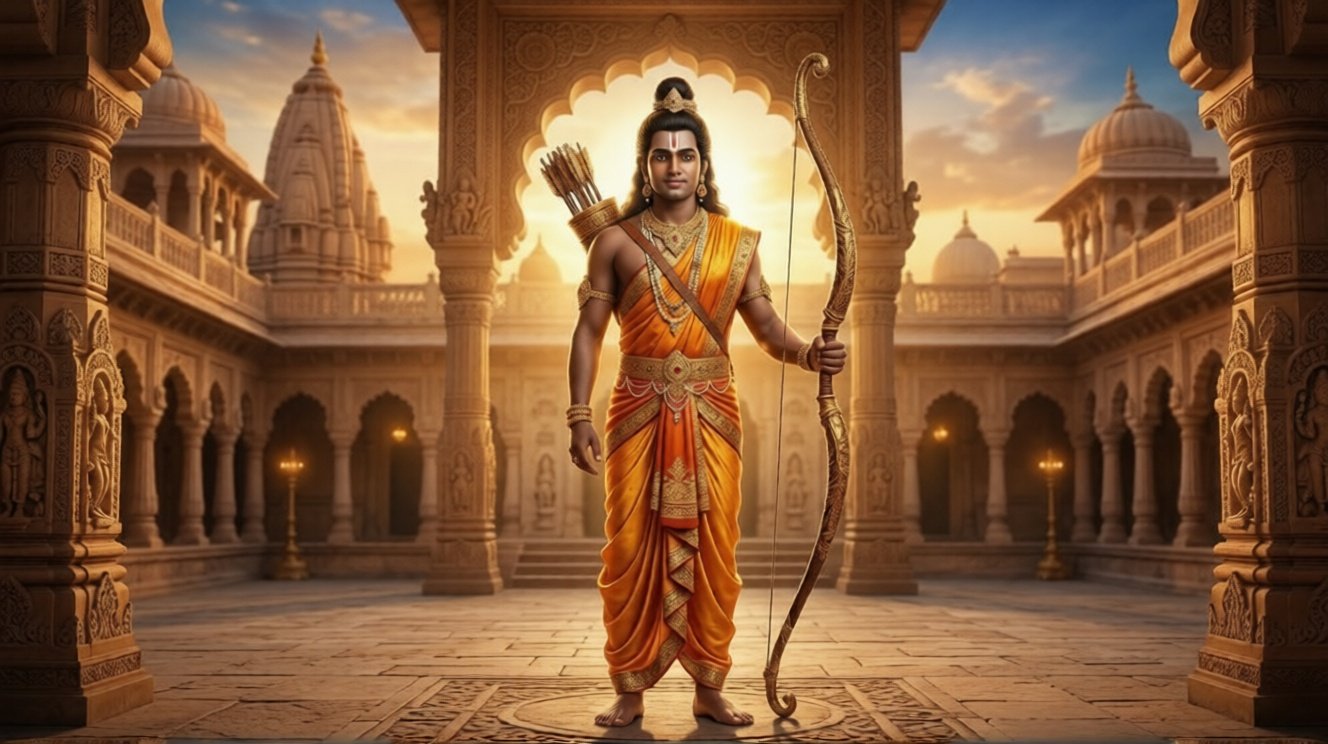
Sri Ram is not merely a deity in the Hindu pantheon. He is the blueprint for what a human being can and must aspire to be — the living answer to the question: what does it look like when a man perfectly fulfils his dharma?
Encyclopaedia Britannica describes Rama as “one of the most widely worshipped Hindu deities, considered the epitome of moral virtue and royal conduct.” This is true, but it remains incomplete. Sri Ram’s significance transcends theology. He is a civilisational archetype — the way that Homer’s heroes shaped the Greek world, or Confucius’s gentleman shaped Chinese culture. But while those traditions faded or transformed beyond recognition, Sri Ram continues to breathe, to inspire, and to govern the moral grammar of over a billion people after millennia.
The core of Ram’s identity rests on five pillars that define the Sanatan conception of the ideal person. First, Maryada — the discipline of boundaries, the graceful acceptance of constraints imposed by duty, family, and society, even at profound personal cost. When Ram accepted his exile not with bitterness but with serene obedience, he did not submit to injustice; he demonstrated that the highest freedom is the freedom to choose righteousness. Second, Satya — truth, absolute and unswerving, even when the universe conspires against it. Third, Parakrama — the martial valour and courage to defend Dharma against Adharma, symbolised in his legendary battle against Ravana, the demon king of Lanka. Fourth, Karuna — a compassion that extended even to enemies and outcasts, exemplified by his embrace of Shabari’s berries, his alliance with the vanara tribes, and his treatment of the surrendered Vibhishana. Fifth, Neetishastrata — the science of just governance, the ideal of Ram Rajya, a polity so just and fair that suffering was banished from the kingdom.
- The discipline of righteous boundaries and duty — choosing obligation over desire, even at immense personal cost.
- Absolute, unswerving truth — the pillar upon which all personal and social relationships must rest.
- Martial courage in the service of Dharma — the warrior’s willingness to stand between the world and evil.
- Boundless compassion that transcended caste, tribe, gender, and even enmity — the human heart at its most expansive.
- The vision of a governance so just that it became the founding aspiration of every Indian leader from Valmiki to Mahatma Gandhi.
The Ramayana — A Civilisational Document, Not Merely an Epic
The Ramayana is one of the most important literary works of ancient India, and its impact on art, culture, governance, and ethics across the Indian subcontinent and Southeast Asia is unparalleled in scope and depth. Composed by Maharishi Valmiki, believed to have been written around the 5th century BCE, its nearly 24,000 shlokas represent not just a narrative but a compendium of philosophy, statecraft, ethics, and aesthetics that has shaped civilisations for thousands of years.
What makes the Ramayana uniquely extraordinary is its geographic and cultural migration. The story of Ram crossed the Himalayas, sailed across seas, and took root in cultures as far flung as Indonesia, Thailand, Cambodia, and Japan. The Prambanan Shiva temple in Central Java, built in the 9th century AD during the Sailendra dynasty, carries 42 panels narrating the Ramayana. The Thai classical dance drama Khon is centred on the Ramakien, their version of the Ramayana. Cambodia’s Angkor Wat is adorned with Ramayana bas-reliefs that stretch for hundreds of metres. From the Philippines to Vietnam — the Indosphere was, and in many ways remains, a Rama-centric cultural world.
Valmiki Ramayana (Sanskrit)
The Adi Kavya — the first poem. 24,000 verses in seven Kandas. The foundational text from which all regional traditions spring, composed in the Treta Yuga by the sage Valmiki.
Ramcharitmanas (Awadhi)
Goswami Tulsidas’s 16th-century masterpiece — the most widely read scripture in North India. Its language democratised the Rama story and brought it into every household across Hindi-speaking India.
Kambaramayanam (Tamil)
The 12th-century Tamil retelling by Kamban — a literary marvel that expanded the story with extraordinary poetic depth. Ram Navami in South India draws heavily from this tradition.
Krittivasi Ramayan (Bengali)
The 15th-century Bengali retelling by Krittibas Ojha. This version has shaped the spiritual and cultural imagination of Bengal for six centuries — making Bengal’s connection to Ram ancient and profound.
Adhyathmaramayanam (Malayalam)
Thunchaththu Ezhuthachan’s 16th-century Malayalam version — so influential that Ezhuthachan is considered the father of the Malayalam language itself.
Saptakanda Ramayana (Assamese)
Madhava Kandali’s 14th-century Assamese version — the first translation of the Valmiki Ramayana into a modern Indian language of Aryan origin, testament to the story’s pan-subcontinent reach.
The Pillar That Did Not Break — Sri Ram and Sanatan Civilisation’s Survival
The Indian subcontinent endured one of the most prolonged, brutal, and systematic cultural assaults in human history — over a thousand years of invasions, desecrations, forced conversions, destruction of temples, suppression of knowledge systems, and deliberate dismantling of civilisational memory. Turkish, Mongol, Persian, British, Portuguese, Danish, Dutch, and French — wave upon wave, century upon century. By any historical logic, the Sanatan civilisation should not have survived. And yet, it did.
How? The answer, in significant part, is Sri Ram.
Unlike written laws, buildings, or political institutions — all of which can be destroyed — the values embodied in Sri Ram lived in stories told at firesides, in lullabies sung to children, in the bhajans of wandering saints, in the Ramleela performances enacted in village squares across the length and breadth of the subcontinent. Colonisers could burn libraries; they could not burn memory.
The Bhakti movement saints — from Kabir to Tulsidas, from Meerabai to Surdas — kept the flame of the Rama tradition alive through the darkest centuries. Tulsidas’s Ramcharitmanas was composed in the 16th century, during the height of Mughal rule, and it functioned not merely as a devotional text but as an act of civilisational resistance. By writing in Awadhi — the language of the common people rather than the Persian of the court — Tulsidas ensured that the story of Ram would remain accessible to every ploughman, every weaver, every mother rocking her child to sleep.
The majestic aura of Prabhu Shri Ram, epitomising both moral rectitude and martial valour, inspired monarchs from the Gupta Empire to the Gahadavalas, the Paramaras, and the Vijayanagara kingdom. Chhatrapati Shivaji Maharaj, whose Maratha Empire stretched from Attock to Cuttack, explicitly modelled his governance on the principles of Ram Rajya — protecting the people, honouring women, respecting all faiths while standing firm in his own, dispensing justice with compassion and courage. Gandhi invoked Ram Rajya as the political vision for independent India. Nehru, despite his agnosticism, acknowledged the Ramayana as the emotional constitution of the Indian people.
From Ayodhya to the World — Ram Navami’s Global Celebration
Ram Navami is simultaneously one of the most intimate and one of the most expansive festivals in the Hindu calendar. At its most intimate, it is a mother placing flowers before a small brass idol in the corner of her kitchen, fasting through the day, and singing a bhajan at noon while imagining the birth cry of the divine child. At its most expansive, it is the transformation of entire cities — Ayodhya, Bhadrachalam, Nashik, Kolkata — into throbbing centres of devotion, their streets filled with processions, their air trembling with “Jai Shri Ram.”
Ayodhya remains the undisputed spiritual heart of the festival. With the newly consecrated Ram Mandir — inaugurated in January 2024 — Ram Navami 2026 drew millions of pilgrims to the sacred city. The Surya Tilak ceremony at noon, where a precisely engineered ray of sunlight falls on Ram Lalla’s forehead through an architectural marvel of lenses and mirrors, has become one of the most extraordinary ritual spectacles of the modern age. The temple remained open for nearly 20 hours, accommodating an extraordinary influx of devotees with suspended VIP darshan so that all could stand in equal line before their Lord.
Bhadrachalam in Telangana, on the banks of the Godavari, witnesses the world-famous Rama Navami Kalyanam — the celestial wedding ceremony of Lord Rama and Goddess Sita — sponsored by the state government and witnessed by tens of thousands. South India broadly celebrates Sri Rama Navami with Thyagaraja Kritis, Harikatha sessions, and elaborate Kalyanam ceremonies that stretch deep into the night. Maharashtra sees Shobha Yatras with decorated raths carrying idols of Lord Ram through city streets.
In Jaipur, one of the most moving dimensions of Ram Navami 2026 was witnessed — a Shobha Yatra that passed through the Muslim-dominated Hasanpura area was traditionally welcomed by the local Muslim community, with members lining the streets in a display of inter-community respect that transcended the political noise around the festival. This is the India that Ram Rajya dreamed of — a society where righteousness is the common ground upon which all communities meet.
Bengal’s Sacred Fire — The Kolkata–Howrah Shobha Yatra of 2026
The Procession That Stopped a Narrative — Kolkata & Howrah Rise
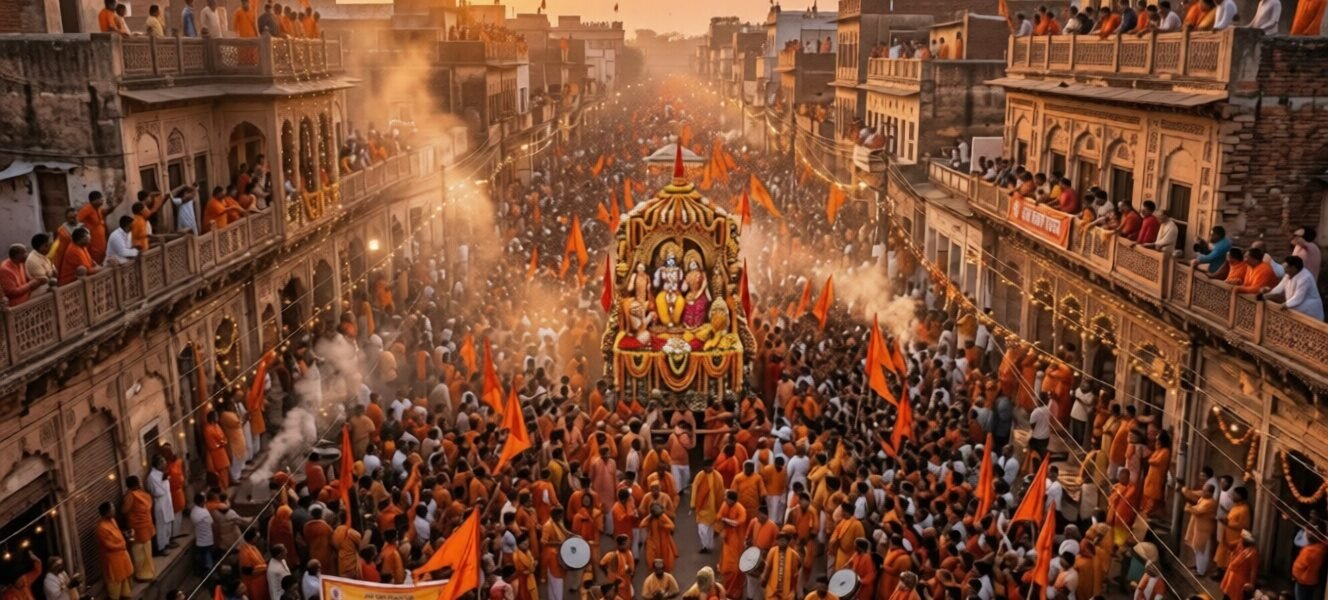
What unfolded on the streets of Kolkata and Howrah on March 26, 2026 was not merely a religious procession. It was a civilisational statement — a declaration by the people of Bengal that the living tradition of Sanatan Dharma pulses as vigorously on the banks of the Hooghly as it does on the banks of the Sarayu.
More than 60 rallies, large and small, were scheduled across Kolkata alone, with similar processions filling the lanes of Howrah, Hooghly, Birbhum, and Uttar Dinajpur. Saffron flags fluttered over historic streets. The chant “Jai Shri Ram” rolled through Bhabanipur, through the old lanes of north Kolkata, through the industrial heartland of Howrah. All sections of society — men, women, the elderly, the young, traders, teachers, labourers — poured into the Shobha Yatras in numbers that confounded all predictions.
The processions brought together political leaders from both the ruling TMC and the opposition BJP — a remarkable convergence in a pre-election atmosphere that underscored the point: Sri Ram does not belong to any political party. He belongs to everyone. As Chief Minister Mamata Banerjee herself acknowledged, “Ram does not belong to any political party. He belongs to everyone.”
The Kolkata–Howrah Ram Navami story of 2026 is remarkable on multiple layers. First, the sheer scale. Over 3,000 police personnel were deployed across West Bengal’s districts, with 1,000 focused on Kolkata alone, alongside drone surveillance, CCTV monitoring, and plain-clothes officers — a security apparatus of a scale that speaks eloquently to the magnitude of participation expected and delivered. An emergency virtual meeting was convened the night before at the state secretariat, chaired by the Chief Secretary himself, with the home secretary, the Director General of Police, and all district magistrates attending — testimony to the fact that the festival’s mobilising power had crossed from the realm of the religious into the realm of the momentous.
Second, the legal battles that preceded the celebration — and their resolution — are themselves a chapter in the story of Sanatan civilisation’s persistence. The Calcutta High Court, responding to a petition by Anjani Putra Sena, granted permission for the Howrah Shobha Yatra with firm conditions: no more than 500 participants at any time, no weapons, only PVC flags and symbolic items. The petitioner had established 25 years of unbroken tradition for this procession. The court’s decision, authored by Justice Saugata Bhattacharyya, upheld the right to celebration while ensuring public order — an outcome that mirrored the very values of Ram Rajya: firmness in righteousness, moderation in means.
Third, Bengal’s deep indigenous Rama tradition makes this moment especially significant. The Krittivasi Ramayan — the beloved Bengali retelling of the epic by 15th-century poet Krittibas Ojha — has been part of Bengal’s spiritual DNA for six centuries. Ram Navami in Bengal is also associated with Surya Puja. The day connects a deeply educated, culturally sophisticated people with their most ancient spiritual roots. When the crowds filled the streets of Howrah in 2026, they were not imitating a North Indian tradition. They were reclaiming their own.
What was once a relatively modest religious observance in Bengal has, over the past decade, evolved into one of the most powerful expressions of civilisational consciousness in Eastern India. Ram Navami 2026 in Kolkata and Howrah was not an event. It was an awakening.
Ram Rajya — The Civilisational Dream That Refuses to Die
The concept of Ram Rajya — literally, “the rule of Ram” — is arguably the most powerful political ideal in the history of the Indian subcontinent. It is not a theocratic vision. It is a vision of governance defined by compassion, justice, equality before the law, welfare of the poorest citizen, transparency of the monarch, and the subordination of personal desire to public duty. In Ram Rajya, no subject suffers — not a widow, not an orphan, not the humblest of beings. The prosperity of the kingdom is the direct expression of the righteousness of its ruler.
Mahatma Gandhi drew inspiration from Ram’s unwavering devotion and adherence to truth for his non-violent struggle against British colonialism. His vision of a free India was explicitly framed as Ram Rajya — not as a Hindu state, but as a state of righteousness, where every person regardless of faith, caste, or gender would find justice, dignity, and protection. The concept of Ram Rajya has been invoked by leaders across the spectrum as a blueprint for just governance and societal harmony.
This is the genius of the Ramayana as a civilisational document. Its ideals are not sectarian. Compassion is not Hindu. Justice is not Hindu. Courage in the face of evil is not Hindu. These are human values, articulated through an Indian story, preserved through an Indian tradition, but belonging to all humanity. Which is precisely why the Ramayana has taken root from Indonesia to Japan, from Trinidad to South Africa, wherever the Indian people have carried their culture and their hearts.
The Living Ram — Ideology for the 21st Century
In an age of atomised individualism, collapsing families, ecological recklessness, and the erosion of civic virtue, Sri Ram’s ideology is not nostalgic — it is urgently relevant. His model of leadership — the leader who serves his people above his own comfort, who walks into exile without bitterness, who builds bridges (literally and metaphorically) across differences, who forgives without weakness and fights without hatred — is precisely the model that the 21st century desperately needs.
His treatment of the vanaras — the tribal forest peoples who became his greatest allies — speaks to a politics of inclusion that transcended the social hierarchies of his time. His elevation of Hanuman — a servant, a being from the margins of society — to the status of the greatest devotee in cosmic history, carries a message about the dignity of service that resonates with deep urgency today.
Sita’s agency, her strength, her refusal to surrender her integrity even in captivity — these qualities make her not a passive figure but an icon of moral courage. Their partnership — Ram and Sita — represents not a relationship of domination but of complementary strength, of two complete beings choosing each other and their shared values.
Sri Ram’s life does not merely tell us what to worship. It tells us how to live — with discipline, with compassion, with the courage to do what is right when the easier path is available, and with the humility to know that even a god, when he walks this earth, must submit to the rule of Dharma.
As Ram Navami 2026 drew millions to temples and processions across the subcontinent, the meaning of the festival was ultimately this: a civilisation choosing to remember itself. Choosing, in an age of distractions, to stand still for a moment at the midday hour when the sun is at its peak, and to say — we come from something extraordinary. We carry something extraordinary. And we intend to pass it on.
जय श्री राम | Jai Shri Ram
Ram Navami 2026, Sri RamShobha Yatra Kolkata Howrah, Sanatan Dharma, Ramayana, Ram Rajya, Maryada Purushottam, Ayodhya, Indian Civilisation, Hindu Festival, West Bengal, Chaitra Navratri, Anjani Putra Sena
Ram Navami 2024 Celebrations: A Global Tapestry of Devotion and Joy
Discover more from
Subscribe to get the latest posts sent to your email.