
Orbiting Compute: Why Space Data Centers Are the Next Billion-Dollar AI Revolution in 2025


Orbiting Compute: How SpaceX, Google, Nvidia, and Others Are Taking space Data Centers Beyond Earth—and What It Means for AI’s Future
By News24Media — 2025 Feature Analysis
A Satellite Humming in the Dark
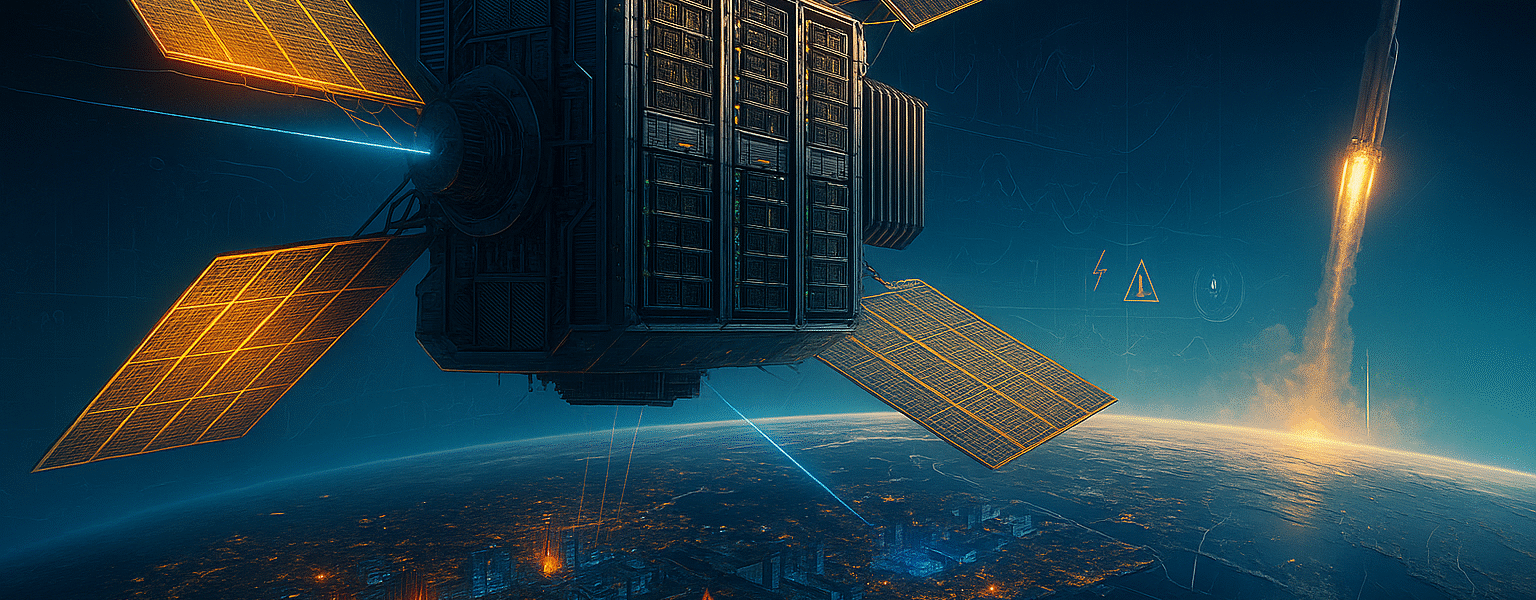
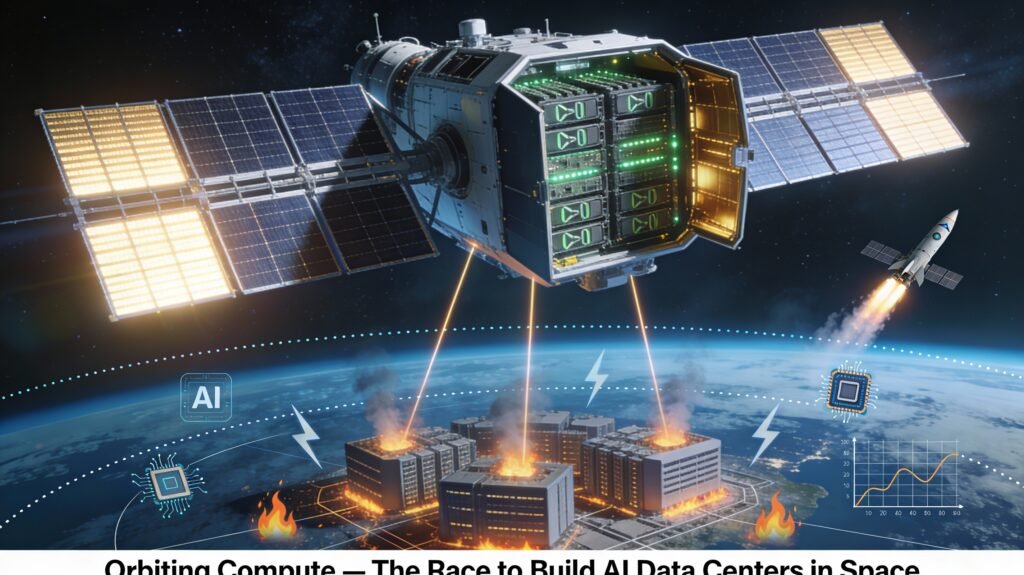
In the cold silence of low Earth orbit (LEO), a satellite glides above the Pacific Rim. Its solar wings glow gold as they harvest uninterrupted sunlight—no clouds, no nights, no power cuts—while inside, radiation-hardened GPUs hum at full throttle. Here, far from the heat and carbon footprint of Earth’s gigantic server farms, the satellite is training a multimodal AI model in microgravity.
Meanwhile, back on Earth, datacenters in Phoenix, Bangalore, Dublin, and Tokyo wrestle with energy caps, water shortages, blackout risks, and growing regulatory pressure. The contrast is stunning: while Earth-bound AI infrastructure is running into physical limits, a new frontier has quietly opened above our heads.
That frontier is space data centres, and 2025 marks the year the race truly ignited.
The Mega-Shift: Why AI Compute Is Leaving Earth
Artificial intelligence is devouring compute at an unprecedented rate. According to Goldman Sachs (2025) forecasts, AI-driven electricity consumption could surge 165% by 2030, turning data centres into one of the world’s fastest-growing power sinks. With large-scale models doubling in size every 3–4 months and training runs requiring thousands of GPUs for weeks, hyperscalers are facing constraints:
- Land scarcity near major metros
- Massive freshwater use for cooling
- Blackout events linked to grid overloads
- Environmental and ESG scrutiny on carbon-heavy energy usage
- Gigawatt-scale power demands projected for AGI-era computing
Space offers compelling answers:
Why space data centers may work
| Space Advantage | Explanation |
|---|---|
| 24/7 solar power | No atmosphere → no interruptions → cheap, abundant energy. |
| Vacuum cooling | Radiative cooling reduces need for water; hardware runs cooler. |
| No land or heat constraints | Infinite “real estate” in orbit. |
| Lower long-term energy cost | Solar availability pushes electricity cost near zero. |
| Physical cyber-security | Off-world storage is inherently hard to breach. |
“The energy-to-compute ratio just flips in space,” says an engineer at ESA’s Orbital Compute Initiative. “Suddenly you’re not fighting physics—you’re using it.”
The Big Players — And Their 2025 Breakthroughs in space data centers
1. Starcloud (Nvidia-backed) — The First True Orbital AI Training Run
November 2025 will be remembered as the month Starcloud-1, the world’s first AI-dedicated orbital space data centers, launched aboard a SpaceX Falcon 9 from Vandenberg.
- First successful AI model trained in orbit using radiation-resistant Nvidia GPUs.
- Goal: gigawatt-scale orbital compute clusters by 2030.
- Claim: Space-based electricity costs could be 90% lower than Earth’s grid.
- Architecture: Autonomous cooling panels, laser downlinks, robotic maintenance arms.
Starcloud wants to be the “AWS of LEO,” offering orbital compute on demand to enterprises that hit energy caps.
Industry leaders increasingly argue that Earth-based constraints on energy and cooling could limit the next wave of AI innovation, prompting many to explore space-based computing solutions.
2. Google’s Project Suncatcher — The 2027 Solar Behemoth
If Starcloud is the scrappy pioneer, Google is the moonshot visionary. In mid-2025, Sundar Pichai quietly greenlit Project Suncatcher, a radical initiative to build satellite racks positioned closer to the Sun than traditional LEO orbits.
- Operational target: 2027
- Focus: massive solar yield, ultra-dense compute racks
- Motivation: support Gemini Ultra and future AGI-scale models
“Project Suncatcher … exploring how an interconnected network of solar-powered satellites … could harness the full power of the Sun.” — research.google/blog (Nov 2025)
“One of our moonshots is: how do we one day have space data centers so that we can better harness the energy from the sun, which is one hundred trillion times more energy than what we produce on all of Earth today,” Sundar Pichai said in discussing Google’s Project Suncatcher and the company’s long-term vision for space-based AI compute
Suncatcher may become the largest space-energy harvesting network in history.
3. SpaceX — Turning Starlink Into the World’s Cheapest AI Compute Fabric
Elon Musk has long predicted AI and robotics would expand beyond Earth. But 2025 marks his boldest move yet: integrating AI compute modules directly into next-gen Starlink satellites.
- Goal: orbital space data centres functionality within 5 years
- Edge AI inference running across 20,000+ satellites
- Cost advantage: Falcon 9 and Starship launch costs push price per satellite to nearly $10 million, the lowest in history
Musk’s pitch:
At a U.S.–Saudi investment forum in 2025, Elon Musk argued that solar-powered satellites in orbit could become the lowest-cost option for AI compute within a few years, highlighting how continuous space-based solar power and cooling advantages could outpace Earth’s infrastructure constraints.
If successful, Starlink could become the lowest-cost inference network on the planet—and above it.
4. Axiom Space & Red Hat — The ISS Prototype
In spring 2025, Axiom Space partnered with Red Hat to deploy AxDCU-1, an experimental AI/cloud unit on the ISS.
- Purpose: test virtualisation, Kubernetes, and edge AI workloads in microgravity
- Outcome: stable performance under radiation spikes
- Next phase: a dedicated Axiom Station module in 2026 for commercial orbital cloud services
This is the practical bridge between today’s cloud and tomorrow’s off-world hyperscaler.
5. Lonestar Data Holdings — The Moon as a Digital Vault
While others focus on LEO, Lonestar is going lunar. In 2025, the company advanced its plan to build:
- Lunar data vaults are buried under regolith for natural radiation shielding
- A 15-petabyte Earth-Moon archival satellite
- Sovereign off-Earth storage services aimed at governments and Fortune 500 clients
The message: If Earth burns, floods, or gets hacked—your data survives.
6. OrbitsEdge, HPE, IBM, ESA, and More
Other players are quietly building the ecosystem:
- OrbitsEdge/HPE: LEO edge computing pods for on-satellite real-time analytics
- IBM-ESA: joint radiation-tolerant computing project
- NVIDIA-Europe: partnerships enabling GPU clusters in microgravity testbeds
In short, the supply chain is forming.
Why This Is Happening Now: The Perfect Storm
AI demand alone doesn’t explain the surge. It’s a convergence of forces.
1. The AI Power Crunch Is Real
Analysts predict 50% annual growth in compute demand through 2030. Earth’s grids cannot keep up.
2. Sustainability Pressures
Hyperscalers are under pressure to hit net-zero by 2035. Orbital compute avoids:
- Carbon output
- Water consumption
- Local heat islands
3. Physical Security
State-backed cyberattacks and ransomware surged in 2024–2025. Space is the ultimate air-gapped system.
4. Falling Launch Costs
SpaceX, Rocket Lab, and Blue Origin have collectively pushed launch economics down dramatically.
| Year | Cost to LEO (avg) | Impact |
|---|---|---|
| 2010 | ~$60,000/kg | Space compute impossible |
| 2025 | <$2,000/kg | Space compute commercially viable |
5. Latency and Global Networks
LEO compute clusters paired with 6G and optical interlinks offer:
- Sub-20-ms global routing
- Real-time analytics for finance, defence, and robotics
- Seamless AI inference at planetary scale
This is the dawn of the interplanetary internet.
The Obstacles: Not Every Problem Vanishes in Orbit
1. Radiation
GPUs must be radiation-hardened, often sacrificing density. Starcloud uses specialised shielding and self-repairing firmware.
2. Space Debris
Thousands of satellites add orbital congestion. Regulators demand deorbit plans and debris mitigation.
3. Maintenance
Human servicing is expensive; thus:
- Robotic arms
- Self-healing software
- Modular hot-swap compute racks
will become standard.
4. Regulatory Hurdles
Spectrum allocation, orbital rights, and international treaties remain murky. Who “owns” an orbital hyperscaler?
5. Capex
The upfront cost is massive—though amortised by near-zero operating energy.
What This Means: The Coming Paradigm Shift
1. AI Training Goes Supersonic
With gigawatt-scale orbital farms, analysts project:
- 10x–100x more GPU power by 2035
- AI training that costs 70–90% less per parameter
- Ability to train trillion-parameter models routinely
AGI research will leave Earth’s constraints behind.
2. Carbon-Free Hyperscalers
Microsoft, Amazon, and Google have pledged net-zero operations by the 2030s. Space makes these commitments realistic.
Imagine space data centers clusters that consume zero land, zero water, and zero grid energy.
3. The Interplanetary Cloud
6G HAPS + LEO + lunar relays = a planetary mesh.
Latency becomes a design choice.
Compute becomes location-agnostic.
4. A New Tech-Space Economy
Experts estimate the orbital compute market could hit $40–60B by 2035.
This includes:
- Launch services
- Orbital assembly
- AI-hardware manufacturing in microgravity
- Cislunar internet nodes
Space becomes the new Silicon Valley.
5. Geo-Politics: The Space AI Cold War
The U.S. currently leads due to:
- SpaceX’s dominance
- NASA partnerships
- Nvidia’s hardware ecosystem
China’s Tiangong platform and EU-ESA collaborations will intensify competition.
Control of orbital compute = control of global AI.
Future Surprises: Beyond the Horizon
Over the next decade, expect developments once thought impossible:
• Quantum orbital computing
Cryogenic temperatures in deep space could benefit superconducting qubits.
• Mars data relays
Essential for autonomous rovers and pre-colonisation missions.
• Self-directed AI clusters
AI managing itself across LEO and cislunar space—no humans in the loop.
• Space manufacturing of GPUs
Microgravity allows near-perfect crystal formation.
We may soon train models on servers circling the Moon.
Timeline: How We Got Here (2020–2030)
| Year | Milestone |
|---|---|
| 2020 | HPE’s Spaceborne Computer-2 runs basic workloads on ISS |
| 2023 | OrbitsEdge tests LEO edge compute pods |
| 2025 | Starcloud-1 launches; Axiom’s AxDCU-1 succeeds |
| 2026 | Axiom Station adds commercial compute modules |
| 2027 | Google Suncatcher comes online |
| 2030 | First gigawatt-scale orbital hyperscaler |
The future is arriving fast.
Conclusion: A Digital Frontier Beyond Earth
The 2025 race to build space data centers marks one of the biggest pivots in the history of global computing. Driven by AI’s insatiable power needs and Earth’s growing limitations, tech giants are looking upward—literally—for the next leap in innovation.
Orbiting hyperscalers promise:
- Sustainable, carbon-neutral AI
- Exponential computational growth
- A secure off-world data layer
- The birth of the interplanetary internet
But they also raise profound questions about governance, militarisation, and centralisation of planetary computing power.
**As we push AI beyond Earth, the real question is this:
Will orbiting space data centers save AI—or redefine humanity’s digital frontier?
space data centers 2025, orbital AI computing, SpaceX AI compute, Starcloud Nvidia, Google space data centers, LEO AI clusters, AI power crisis, satellite data centers, space-based compute 2030, orbital hyperscalers, Axiom ISS AI, lunar data vaults
Discover more from
Subscribe to get the latest posts sent to your email.









2 COMMENTS