

IndiGo Flight Meltdown: New DGCA Fatigue Rules Trigger Nationwide Cancellations & Airport Chaos


India’s Skies in Turbulence: IndiGo Flight Cancellations Surge as New Pilot Fatigue Rules Take Effect
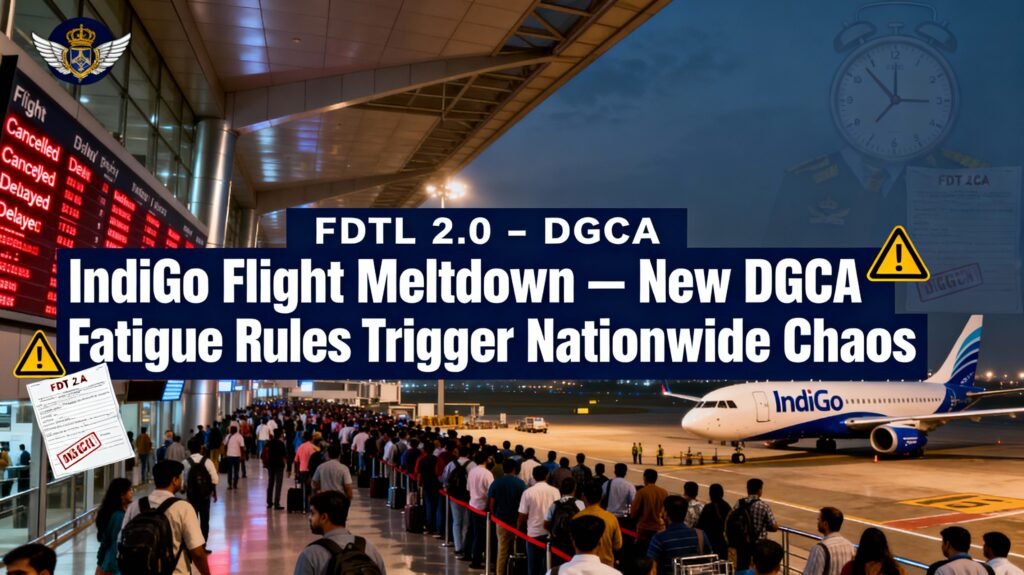
India’s air travel network has been thrown into widespread disruption after hundreds of IndiGo flights were delayed or cancelled over the past few days, triggering airport chaos, long queues, missed connections, and mounting passenger frustration.
Major hubs — Delhi, Mumbai, Bengaluru, Hyderabad, Kolkata, and Chennai — reported the worst bottlenecks, with operational data over the last 72 hours indicating that IndiGo Flights cancelled between 12% and 18% of its scheduled flights daily, far above the national average.
The trigger: the enforcement of the revised Flight Duty Time Limitation (FDTL) rules by India’s aviation regulator, the Directorate General of Civil Aviation (DGCA) — norms designed to curb pilot fatigue but now testing the operational resilience of the country’s largest airline.
What Triggered the Meltdown?
The current crisis follows DGCA’s confirmation that the long-pending FDTL 2.0 rules, first proposed in early 2023, will be fully enforced from 1 November 2025, following two earlier extensions sought by airline operators.
IndiGo Flights Network, which alone carries over 60% of India’s domestic passengers, has been disproportionately affected. Its network, structured around high-frequency turnarounds, dense scheduling, and extensive red-eye operations, struggled to adjust overnight to the new rest-and-duty constraints.
A senior Civil Aviation Ministry official, speaking on background, said:
“The rules apply to everyone, but the impact is uneven because IndiGo Flights’s network is uniquely lean on pilot reserves. When rest requirements increase suddenly, the first cracks appear where scheduling is stretched the tightest.”
The fallout has been swift and severe — cascading delays spreading across the country, aircraft stranded without available crew, passengers missing onward international connections, and social media filling with images of overcrowded terminals and chaotic queues at airline counters.
What Exactly Are the New Rules?
The revised Flight Duty Time Limitation (FDTL) norms are India’s first major overhaul of fatigue-management in more than a decade, aligning the country with global safety practices used in the U.S., EU, and advanced Asian markets.
Key Changes in the FDTL 2.0 Framework
| Area of Rule | Earlier Norm | Revised Norm | Why It Matters |
|---|---|---|---|
| Weekly Rest | Minimum 36 hours | Minimum 48 hours | Extends the definition of “biological night” to match circadian science |
| Night Duty Window | 0000–0500 hrs | 2200–0600 hrs | Stricter limits on the number of night landings per pilot |
| Night Landings | Higher permissible count | Stricter limits on the number of night landings per pilot | Prevents cognitive overload during high-risk flight phases |
| Cumulative Duty Hours | More flexible | Tighter weekly/monthly caps | Reduces stress accumulation over roster cycles |
The DGCA has justified these changes on scientific grounds, pointing to multiple pilot fatigue studies, including those conducted jointly with Indian airline pilot associations in 2022–23.
A DGCA spokesperson reiterated:
“The DGCA has said in its notifications that the revised FDTL norms are intended to reduce pilot fatigue by aligning India’s duty-time regulations with international safety standards and scientific understanding of circadian rhythms. The regulator has emphasised that airlines were given more than a year’s notice to prepare for the transition.”
Why IndiGo Flight Is Hit Hardest
Although the rules apply equally across all carriers, experts say IndiGo Flights’ operational model makes it uniquely vulnerable to abrupt increases in pilot rest obligations.
1. Heavy Dependence on Red-Eye Operations
IndiGo Flight operates more late-night domestic and regional flights than any other Indian carrier, particularly on the Middle East–India sectors that follow tight turnaround schedules. Extending the “night” window from 10 PM to 6 AM instantly pushed many of its pilots into higher rest categories.
2. Lean Crew Planning and Slim Pilot Reserves
IndiGo Flights Network’s rapid growth — it has added over 70 aircraft in 18 months — outpaced its ability to train and deploy pilots. Industry insiders say the airline historically ran with thinner buffer crews than network carriers like Air India.
3. Training Pipeline Bottlenecks
Several pilot batches are still undergoing simulator training for the new A321neo and XLR variants, limiting the availability of ready-to-fly crew.
4. High Utilisation Scheduling
IndiGo Flights Network’s business model relies on ultra-short turnaround times and aircraft utilisation that averages 12–13 hours per day, among the highest globally. Stricter fatigue rules compress this even further.
The Federation of Indian Pilots (FIP), while supporting FDTL enforcement, noted:
“Pilot bodies, including the Federation of Indian Pilots (FIP), have long warned that many Indian pilots operate close to fatigue thresholds due to dense scheduling and high utilisation rates. They argue that the new FDTL rules simply reveal structural crew shortages that airlines had previously managed to mask.”
Meanwhile, aviation analysts familiar with India’s aviation market say:
“IndiGo’s scale means even a 5% crew shortfall sparks nationwide ripple effects. Other airlines have more slack built into their systems.”
Operational Fallout Across India
Widespread Cancellations and Delays
Industry sources estimate that up to 220 IndiGo flights were either cancelled or severely delayed over the last 48 hours, forcing tens of thousands of travellers to rebook or seek refunds.
Airport Congestion
At Delhi and Mumbai airports, passengers reported:
- 2–4 hour check-in delays
- Long queues for rebooking
- Confusing gate changes
- Shortage of customer-relations staff
Missed International Connections
Passengers connecting via IndiGo flight’s codeshare partners faced missed flights to Dubai, Doha, Singapore, and Istanbul.
Government Intervention
The DGCA and Civil Aviation Ministry held back-to-back meetings with IndiGo, seeking:
- A detailed disruption report
- A plan to temporarily rationalise schedules
- Assurance that passenger compensation norms will be honoured
- Contingency plans to avoid recurrence
Officials have not ruled out a phased rollout waiver if the situation does not stabilise, though the DGCA insists safety cannot be compromised.
IndiGo, in a statement, said it is “proactively reducing flight schedules for the next few weeks” to bring operations in line with crew availability.
What It Means for Flyers Now
Short-Term Impact: Expect More Disruptions
Aviation experts say it may take at least 7–10 days for schedules to stabilise as IndiGo Flights Network redistributes crew, accelerates training, and cancels some low-yield flights.
What Travellers Should Do
1. Check flight status frequently
Airlines must notify passengers of delays ≥2 hours.
2. Know your entitlements under DGCA CAR Section 3, Series M, Part IV:
- Refund or free rebooking for cancellations
- Meals and refreshments during long delays
- Hotel accommodation if delay > 6 hours and occurs post check-in
- Full fare refund if delay exceeds 3 hours and the passenger chooses not to travel
3. For connecting journeys:
Seek written confirmation of missed-connection rebooking options.
4. For urgent travel:
Consider alternative carriers for the next few days where feasible.
Long-Term Passenger Outlook
Consumer-rights advocates argue that once airlines adapt to FDTL 2.0:
- Operations may become more predictable
- Pilots will be less fatigued, improving safety
- Rescheduling chaos will reduce over time
As an aviation safety expert notes:
“Short-term pain, long-term gain. India is finally recognising fatigue as a safety hazard. Once airlines realign their crew strength, passengers will benefit from fewer last-minute disruptions.”
Understanding the Big Picture: Why the Rules Matter
India is one of the world’s fastest-growing aviation markets, with passenger traffic expected to double by 2030. But this growth has pressured airlines to push aircraft and pilots to maximum utilisation.
The DGCA’s FDTL overhaul aims to rebalance the system by:
- Enforcing rested pilots over tightly packed schedules
- Enhancing safety during high-risk night operations
- Bringing India closer to FAA/EASA fatigue standards
- Reducing chronic fatigue complaints documented by Indian pilots over the past decade
Aviation governance expert explains:
“This is more than a rule change — it’s a cultural shift. India is moving away from volume-at-any-cost aviation toward safety-centric aviation.”
Timeline: How FDTL 2.0 Came Into Force
- Jan 2023: DGCA begins consultations on fatigue regulations
- Aug 2023: Draft rules released; airlines request more time
- Mar 2024: First deadline extended
- Jul 2024: Partial rollout — night duty limits implemented
- Nov 2024: Second extension requested by airlines
- 1 Nov 2025: Full enforcement of FDTL 2.0 begins
- Dec 2025: IndiGo flight disruptions escalate into nationwide cancellations
This staggered rollout reflects the regulator’s attempt to balance safety goals with operational realities.
IndiGo Flights Network’s Dominance Makes This a Systemic Risk
IndiGo operates 1,900+ daily flights and controls 60% of the domestic market share. When such a carrier faces structural crew shortages, the entire aviation ecosystem feels the tremors:
- Airport slot utilisation drops
- Passengers shift to other carriers, causing price spikes
- International hubs face pressure due to missed connections
- Smaller airlines lack the capacity to absorb sudden demand surges
DGCA officials quietly acknowledge that any instability at IndiGo Flights Network automatically becomes a national aviation issue.
How India’s Skies Could Change: The “New Order”
Experts say the FDTL enforcement could reshape Indian aviation in significant ways:
1. Airlines May Need Larger Pilot Pools
Expect aggressive hiring by IndiGo, Air India, Akasa, and the coming Tata-Air India group fleets.
2. Slot Reallocations Possible
If IndiGo Flights Network cuts schedules in the long term, other carriers could gain access to premium metro slots.
3. Rise of Safety-Centric Scheduling
Airlines may design networks with:
- Longer turnarounds
- Fewer red-eyes
- Lower aircraft utilisation but higher reliability
4. Improved Passenger Experience
Over time, reduced fatigue-related operational errors may lead to fewer cancellations.
5. Competitive Shifts
Air India’s expanding international network and Akasa’s disciplined crew planning could allow them to capture disillusioned IndiGo flyers.
Aviation strategist predicts:
“IndiGo will recover, but its monopoly-like dominance will face its first real test. This is a turning point for Indian aviation.”
Conclusion: Turbulence Today, Stability Tomorrow?
India’s aviation sector is navigating one of its most significant structural shifts in years. IndiGo’s ongoing meltdown reflects the immediate strain of adapting to scientifically grounded safety norms that were long overdue.
The next few days will remain unpredictable for travellers, but the long-term trajectory — if the sector adapts effectively — points to safer skies, rested pilots, and more resilient airline schedules.
As the DGCA moves firmly to enforce fatigue rules, airlines will be forced to rethink their business models, crew strength, and scheduling philosophy.
This moment of disruption may well signal the beginning of a new era in Indian aviation, where safety finally takes precedence over hyper-efficiency — and where passengers, in the long run, stand to benefit the most.
Scottish Vlogger Exposes the Truth About ‘India’s Worst Airline’—What He Found Will Shock You!
IndiGo flight cancellations, DGCA FDTL rules, pilot fatigue India, IndiGo delays today, India flight disruption news, DGCA new rules for pilots, IndiGo crisis 2025, aviation safety India
#IndiGo #DGCA #FDTL #AviationSafety #IndiaTravel #FlightCancellations #TravelAlert #PilotFatigue #AviationNews #BreakingNews
Discover more from
Subscribe to get the latest posts sent to your email.







2 COMMENTS