

India’s Pralay Missile Passes Salvo User Trials, Boosting Tactical Deterrence


India’s Pralay Missile Crosses a Crucial Threshold: What the Salvo User-Trials Mean for Future War-Fighting and Deterrence
India’s quest to build a credible, indigenous and flexible conventional strike capability received a major boost this week as the Defence Research and Development Organisation (DRDO) successfully conducted two back-to-back user-evaluation flight tests and a salvo launch of the Pralay missile from Dr APJ Abdul Kalam Island off the Odisha coast.
The trials, conducted in the presence of service users, were not routine developmental exercises. They were User Evaluation Trials, designed to validate minimum and maximum range envelopes, accuracy and—most significantly—the missile’s rapid-fire, salvo-launch capability. According to official statements from the Ministry of Defence and DRDO leadership, both missiles followed their planned trajectories and struck their designated targets with high precision, clearing the path for early induction of Pralay into the Indian Army’s tactical missile inventory.
For India’s armed forces, this moment marks more than just another successful test. It signals the arrival of a new class of conventional, theatre-level strike weapon—one that could reshape how India plans and fights future conflicts on both the western and northern fronts.
What is Pralay Missile? India’s New Quasi-Ballistic Workhorse
At its core, Pralay Missile is an indigenously developed, all-weather, surface-to-surface short-range quasi-ballistic missile, designed to deliver high-precision conventional strikes deep behind enemy lines.
Key technical features in simple terms
- Type: Quasi-ballistic tactical missile, optimised for conventional warfare.
- Range: Approximately 150–500 kilometres, giving Indian commanders the ability to hit targets far beyond the reach of traditional artillery and rocket systems.
- Propulsion: A solid-propellant rocket motor using advanced materials and high-energy propellants, ensuring quick launch readiness and high reliability.
- Payload: Between 500 and 1,000 kg of conventional warheads. This includes fragmentation, penetration-cum-blast, runway-denial and sub-munition options—allowing mission-specific tailoring.
- Guidance & accuracy: Inertial navigation supported by state-of-the-art guidance systems. Open-source assessments place its circular error probable (CEP) in the ~10-metre class, making it accurate enough to neutralise hardened or point targets.
- Flight profile: Unlike classic ballistic missiles that follow predictable arcs, Pralay flies on a quasi-ballistic trajectory. It performs mid-course manoeuvres and uses a manoeuvrable re-entry vehicle (MaRV-like behaviour), reaching terminal speeds reportedly in the Mach 5–6 range. This makes it far harder for enemy air-defence systems to track and intercept.
Technologically, Pralay is the product of DRDO’s Research Centre Imarat, developed in close collaboration with multiple DRDO laboratories and Indian industry partners such as Bharat Dynamics Limited and Bharat Electronics Limited. The programme is a flagship example of Atmanirbhar Bharat in the most demanding segment of defence technology: advanced missile systems.
Unstoppable Shield: DRDO’s Anti Drone System Obliterates Pakistan’s Drone Blitz in Operation Sindoor
Why Pralay Missile Is Being Called a “Game Changer”
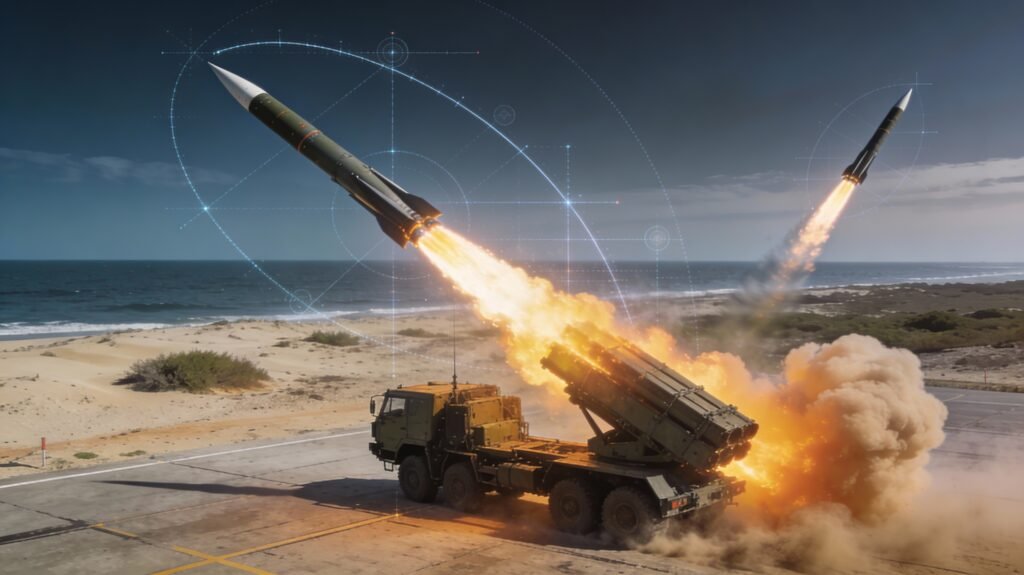
Defence analysts increasingly describe Pralay as a game changer—not because it replaces existing systems, but because it fills a long-standing capability gap.
A missing rung in India’s strike ladder
Until now, India’s conventional strike options fell into two broad categories:
- Short-range systems like artillery rockets (e.g., Pinaka), effective but limited in reach and survivability against defended targets.
- High-end weapons like BrahMos, extremely fast and precise but relatively expensive and used selectively.
Pralay Missile sits squarely in between. It provides the Indian Army with a non-nuclear, deep-strike precision option that can hit airbases, command centres, logistics hubs, radar sites and bridges at distances previously reachable only by aircraft or cruise missiles.
Harder to stop, faster to fire
Its quasi-ballistic, manoeuvring profile makes Pralay significantly more difficult to intercept than traditional ballistic missiles with predictable trajectories. Combined with mobile launchers and rapid salvo capability, Pralay can be fired in quick succession, overwhelming enemy air defences through saturation—especially in the opening hours of a conflict.
Conceptually, Pralay Missile places India in the same operational category as countries that deploy theatre-level conventional ballistic missiles, such as China’s DF‑12 (also known as M20). For the first time, India possesses a comparable indigenous capability optimised specifically for conventional war-fighting.
Reshaping China–Pakistan Contingency Planning
The real significance of Pralay Missile becomes clear when viewed through the prism of India’s two-front security challenge.
Against Pakistan: A stronger conventional deterrent
On the western front, the Pralay Missile gives India a powerful tool for a punitive conventional response. Its range allows the Army to strike high-value military and infrastructure targets deep inside Pakistani territory—without crossing the nuclear threshold.
In practical terms, this strengthens India’s ability to respond to provocation swiftly and decisively, below the level of strategic escalation, while still imposing meaningful military costs.
Against China: Holding depth targets at risk
On the northern front, the implications are even more striking. Many PLA airbases, logistics nodes and missile sites in Tibet and Xinjiang lie within 500 km of the Line of Actual Control (LAC). Pralay Missile can now threaten these assets directly, challenging the logistical and air-power advantages China has enjoyed due to superior infrastructure on its side of the border.
Analysts note that Pralay complicates PLA war planning by forcing dispersion, hardening and increased air-defence deployment—all of which raise costs and reduce operational flexibility.
Towards an Integrated Rocket Force
These developments feed into discussions around a future Integrated Rocket Force for India—where systems like Pralay, BrahMos, Pinaka and next-generation cruise missiles operate together as a layered, conventional missile arm. Such a force would give India rapid, scalable strike options across theatres, reducing dependence on manned aircraft in high-risk environments.
Strategic and Doctrinal Significance
Beyond the battlefield, Pralay’s successful user trials point to deeper doctrinal shifts.
- Conventional stand-off warfare: Pralay supports a move away from risky deep-penetration air sorties towards stand-off precision strikes against heavily defended targets.
- Theatre-level deterrence: The ability to credibly hold adversary airbases, ports and logistics hubs at risk in the opening phase of conflict strengthens deterrence and complicates enemy planning.
- Indigenous credibility: Pralay reinforces India’s position as a designer and producer of advanced missile systems, with potential future variants and even export possibilities aligned with evolving policy.
What Officials and Experts Are Saying
Senior government leaders have framed the successful tests as a milestone for India’s armed forces. The Defence Minister and DRDO leadership have underlined that Pralay “provides a further technological boost to the Armed Forces” and represents a major step toward self-reliance in advanced missile capabilities.
Military analysts echo this assessment, calling Pralay a “game changer” for tactical deterrence, particularly in response to China’s growing missile deployments along the LAC. At the same time, they caution that key questions remain: how many missiles will be inducted, how quickly units will be raised, and how doctrine, training and logistics will adapt to fully exploit the system’s potential.
A Quiet but Profound Shift
The successful user trials and salvo launch of Pralay Missile may not grab headlines like a hypersonic breakthrough, but their impact could be just as profound. By giving India a credible, conventional, deep-strike missile that is accurate, survivable and indigenous, Pralay Missile quietly reshapes the country’s war-fighting calculus.
As India looks ahead to an era defined by contested borders, dense air defences and rapid escalation risks, Pralay stands out as a weapon designed not just to deter war but to give policymakers and commanders more options if deterrence fails.
Pralay missile, DRDO Pralay missile test, Pralay missile user trials, India tactical ballistic missile, DRDO missile development, Pralay missile salvo launch, India quasi ballistic missile, Pralay missile range and accuracy, India conventional deterrence China Pakistan, DRDO missiles Atmanirbhar Bharat, Indian Army tactical missile induction, India vs China missile capability, India defence technology news
Discover more from
Subscribe to get the latest posts sent to your email.