
India Israel Strategy 2026: Inside Modi’s Knesset Speech, Gaza Peace Plan & Middle East Power Shift


India Israel Strategy 2026 at a Crucial Hour: What Modi’s February 2026 Knesset Speech Really Signals
On 25 February 2026, Prime Minister Narendra Modi addressed Israel’s parliament during a two-day state visit — the first such address by an Indian Prime Minister to the Knesset.
At face value, it was a high-symbolism diplomatic moment. But beneath the ceremonial optics lies a far more consequential geopolitical recalibration — one that connects Gaza’s uncertain post-war framework, rising US–Iran tensions, defence-industrial integration, energy security risks, and India’s multi-aligned global strategy.
This was not merely a solidarity visit. It was strategic positioning during a volatile Middle Eastern inflexion point.
The Timing: A Region on Edge
📌 Context & Verified Sources
- PM Narendra Modi addressed the Knesset on 25 February 2026 – first by an Indian PM. (MEA)
- India attended the “Board of Peace” meeting in Washington (19 Feb 2026) as an observer. (MEA briefing)
- UN Security Council Resolution 2803 endorsed a US-led Gaza stabilisation framework. (UN Docs)
- India is the largest importer of Israeli arms (34% of Israeli exports 2020–24). (SIPRI)
- India received ~$129 billion in remittances in 2024 – highest globally. (World Bank)
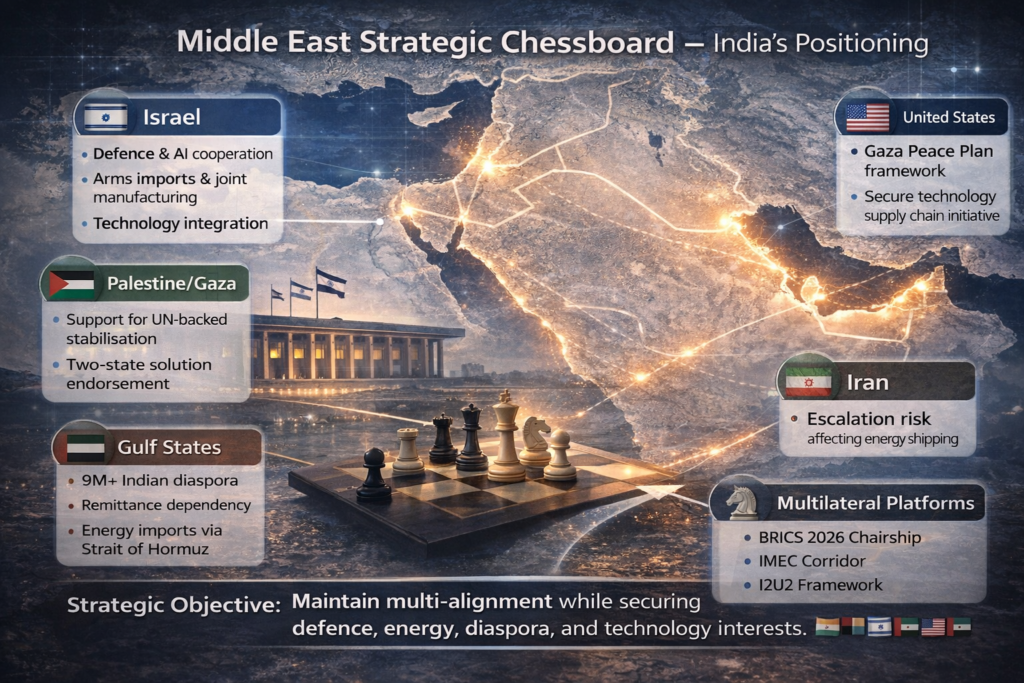
- Over 9 million Indians live in Arab countries. (India–Arab Declaration 2026)
- India–Israel launched first round of FTA talks (23–26 Feb 2026). (Economic reporting)
Editorial Note: This analysis is based on publicly available official statements, UN documents, SIPRI data, and international news reporting.
The speech occurred against two overlapping crises:
- Diplomatic fallout from the Gaza war (ongoing since October 2023)
- Escalating US–Iran tensions raising fears of wider regional confrontation
Shipping insurance costs in the Middle East were surging amid fears of escalation, particularly around the Strait of Hormuz — a chokepoint critical to India’s energy imports.
More importantly, India has structural exposure to the Gulf region:
- Over 9 million Indians live and work in Arab countries.
- India received approximately $129 billion in remittances in 2024 — the highest globally.
A regional conflict involving Iran, Israel, or US assets in Gulf states could directly impact Indian citizens, remittance flows, and energy security.
Diplomatic absence was not an option.
The Dual Messaging Strategy
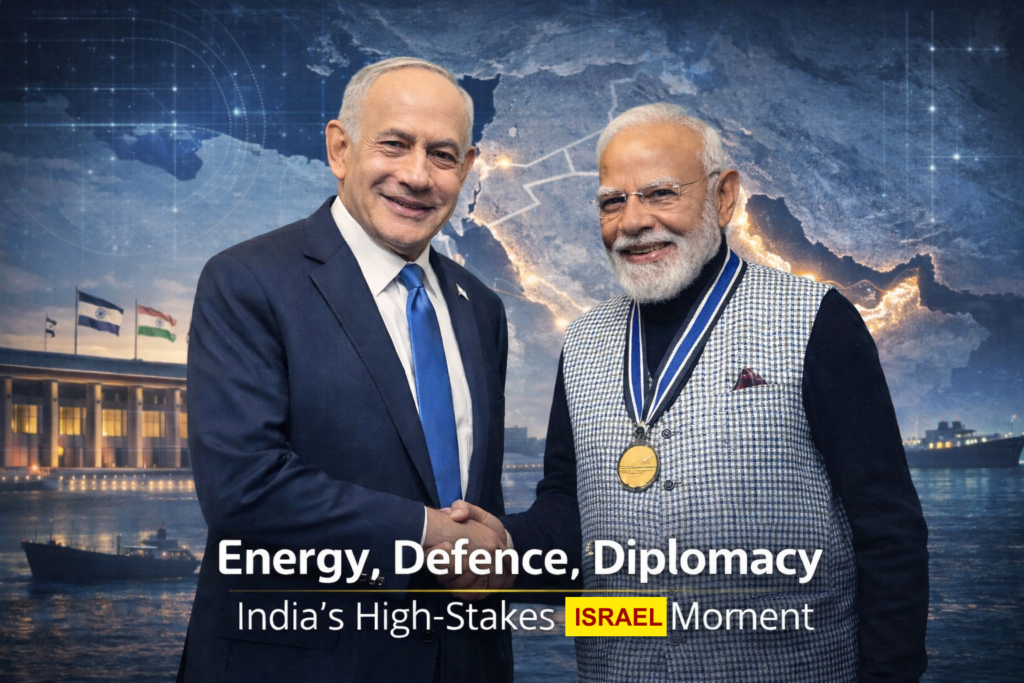
The Knesset speech followed a carefully structured dual-track approach:
- Firm support for Israel’s security concerns
- Condemnation of the 7 October Hamas attack
- “Zero tolerance” against terrorism.
- Explicit endorsement of a diplomacy-based Gaza end-state
- Support for the UN Security Council–endorsed “Gaza Peace Initiative”.
- Reference to addressing the Palestine issue within that framework.
This balancing posture is consistent with India’s long-standing support for a two-state solution while expanding strategic ties with Israel.
The Gaza Peace Plan and “Board of Peace” Factor
The most significant structural driver behind the visit appears linked to the UN-endorsed Gaza framework.
In November 2025, the UN Security Council adopted Resolution 2803, endorsing a US-drafted Gaza plan including transitional governance and an international stabilisation force.
On 19 February 2026 — just days before the Israel visit — India attended a “Board of Peace” meeting in Washington as an observer and publicly supported the Gaza Peace Plan initiative.
Then came the Knesset endorsement on 25 February.
The sequencing suggests coordinated implementation of diplomacy rather than symbolism. India appears to be positioning itself as:
- A credible interlocutor with Israel
- An acceptable partner to Arab states
- A constructive participant in a UN-backed stabilisation process
This is “seat-at-the-table” geopolitics.
Defence and Technology: The Hard Backbone
Beyond Gaza politics lies the durable structural layer of India–Israel ties: defence and high technology.
- India is the largest importer of Israeli arms (34% of Israel’s exports in 2020–24).
- Israeli exports to India were reportedly unaffected by the Gaza war.
During the visit, the Indian Prime Minister toured a technology exhibition highlighting:
- AI
- Cybersecurity
- Agri-tech
- Water technology
- Quantum systems
- Space capabilities Behind the February 2026 Knesse…
The defence-industrial and AI cooperation track was explicitly expected to advance during leader-level talks.
This signals long-term integration — not transactional procurement.
Geo-Economic Synchronisation: FTA and Investment Treaty
The diplomatic choreography overlapped with:
- A Bilateral Investment Agreement was signed in 2025.
- Launch of the first round of Free Trade Agreement talks (23–26 February 2026).
Total bilateral trade stands at approximately $3.6 billion for FY 2025 — modest relative to potential.
The FTA is not just about tariffs. It is about:
- Embedding Israel into Indian supply chains
- Expanding high-tech co-development
- Securing intellectual property frameworks
- Strengthening digital payments and fintech corridors
This is an economic architecture building.
Multi-Alignment: IMEC, I2U2 and BRICS Chairship
The speech also referenced deeper cooperation in plurilateral frameworks, including:
- India–Middle East–Europe Economic Corridor (IMEC)
- I2U2
Simultaneously, India holds the BRICS chairship in 2026 — in an expanded grouping that includes Middle Eastern actors.
This tightens India’s diplomatic balancing constraints.
The February 2026 posture reflects:
- Strategic deepening with Israel
- Continued public support for Palestinian statehood.
- Engagement with Arab partners
- Integration into US-led secure technology supply chain initiatives.
It is a calibrated multi-alignment under pressure.
Why Israel Valued the Visit
For Israel, the optics were equally significant.
The Gaza war has strained Israel’s global standing.
Hosting a major Global South power at the parliamentary level, and conferring the newly created “Medal of the Knesset”.
Israel secured:
- Public validation during diplomatic strain
- Reinforcement of defence-export credibility
- Momentum on FTA negotiations
- Integration into India’s broader economic corridors
Strategic Meaning: Four Structural Drivers
Open-source evidence suggests the February 2026 visit was driven by:
- Crisis Risk Management
- Diaspora safety
- Remittances
- Energy shipping vulnerabilities
- Post-Gaza Governance Architecture
- Board of Peace observer participation
- UN Security Council Resolution 2803 framework
- Defence-Industrial Integration
- Arms transfers
- AI and military technology cooperation
- Geo-Economic Hardening
- Investment treaty
- FTA negotiations
- IMEC/I2U2 integration
This is structural statecraft — not episodic diplomacy.
Three Forward Indicators to Watch for India Israel Strategy 2026
Whether this becomes a durable strategy will depend on:
- India’s future role in the Board of Peace — financial or operational participation
- Consistency of balancing diplomacy — sustaining two-state language while deepening Israel ties
- FTA and innovation conversion — translating optics into measurable trade, investment, and technology outcomes
Conclusion
The February 2026 Knesset speech was not simply a historic parliamentary address.
It was a calibrated intervention at a moment when:
- Gaza’s post-war architecture is being designed
- US–Iran tensions threaten regional spillover
- Defence-tech supply chains are being reorganised
- Energy security risks are acute
- India is chairing BRICS while expanding West-Asia corridors
In a shifting Middle East, India chose presence over passivity.
Whether this becomes a defining structural pivot will depend less on speeches — and more on what happens next inside Gaza’s governance framework, regional escalation dynamics, and the conversion of strategic rhetoric into institutional depth.
India Israel Strategy 2026
Discover more from
Subscribe to get the latest posts sent to your email.