


Is BRICS Planning a Gold-Backed BRICS Currency to Challenge the US Dollar?
In recent years, the idea of a gold-backed BRICS currency has captured global attention, triggering speculation about the future of the US dollar and the global financial order. From social media debates to geopolitical analyses, claims of an imminent BRICS currency backed by gold have spread rapidly.
But how much of this narrative is fact—and how much is fiction?
This explainer breaks down what BRICS is actually planning, why gold has returned to the global conversation, and what it means for countries like India and the wider world.
Understanding BRICS: More Than a Political Bloc
BRICS represents a coalition of major emerging economies—Brazil, Russia, India, China, South Africa, along with newer members such as Saudi Arabia, UAE, Iran, Egypt, and Ethiopia. Together, they account for:
- Over 40% of the world’s population
- Nearly one-third of global GDP (PPP basis)
- A dominant share of global commodity production, including oil, gas, metals, and agricultural goods
This economic weight gives BRICS increasing leverage in shaping alternative global financial mechanisms.
Is There a Gold-Backed BRICS Currency Today?
The short answer: No.
There is no officially launched BRICS gold-backed currency, no coin, no note, and no retail currency in circulation.
What does exist is:
- Strategic discussion among BRICS leaders
- Policy research by central banks
- Exploration of a trade settlement unit, not a common currency
This distinction is crucial.
What Is the Proposed “BRICS Currency Unit”?
Rather than a traditional currency, BRICS is exploring the idea of a settlement unit—a digital or accounting-based mechanism used only for cross-border trade and institutional settlements.
Key Characteristics (Proposed):
- Used between central banks and governments
- Designed for trade settlement, not daily use
- Aimed at reducing over-dependence on the US dollar
- Potentially linked to gold and commodities
This is similar in concept to how the IMF’s Special Drawing Rights (SDRs) work—an accounting unit, not a circulating currency.
Why Is Gold Central to the BRICS Conversation?
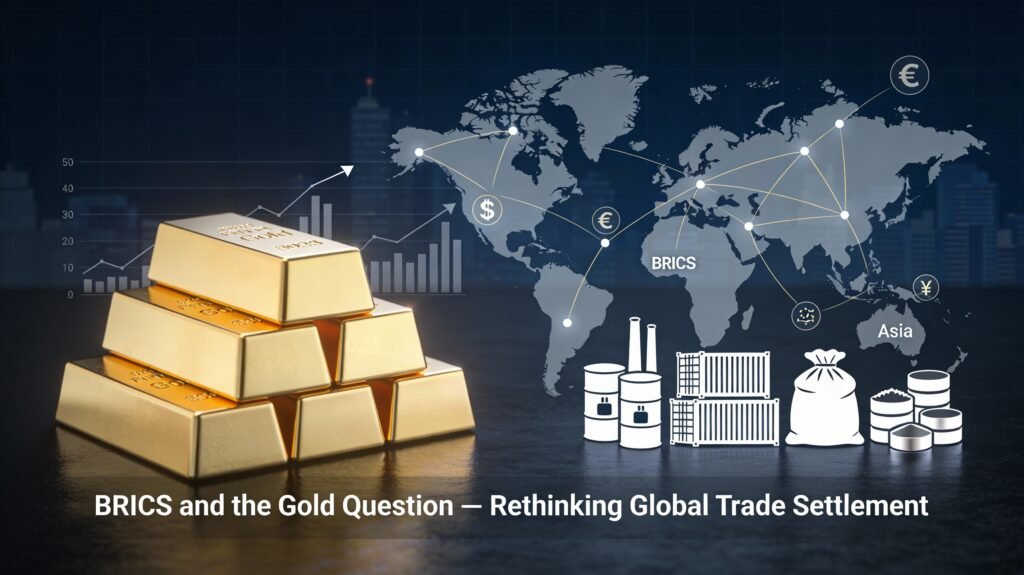
Gold has re-emerged as a strategic asset for several reasons:
1️⃣ Massive Gold Reserves
BRICS nations collectively hold thousands of tonnes of gold, with China, Russia, and India among the world’s top holders.
2️⃣ Trust Deficit in Fiat Currencies
After years of:
- Aggressive money printing
- Rising global debt
- Inflationary pressures
Many emerging economies view gold as a neutral store of value.
3️⃣ Sanctions and Frozen Assets
The freezing of Russian foreign reserves highlighted how dollar-based systems can be weaponised, accelerating interest in alternatives.
Importantly, BRICS is not advocating a return to the classical gold standard, but rather using gold as a value anchor.
Gold Alone or a Commodity Basket?
Most experts believe any future BRICS settlement unit would be backed by a basket of assets, not gold alone.
This could include:
- Gold
- Oil and gas
- Industrial metals
- Rare earth elements
- Agricultural commodities
Such a structure would better reflect the real economic strengths of the BRICS nations.
What Has BRICS Officially Agreed So Far?
Confirmed actions—not speculation—include:
✔ Increased use of local currencies in bilateral trade
✔ Development of alternative payment systems
✔ Strengthening the New Development Bank (NDB)
✔ Reduced exposure to dollar-based financial risks
What has not happened:
- No launch date announced
- No currency name approved
- No gold-backed currency issued
What Does This Mean for India?
For India, the BRICS initiative presents both opportunity and caution.
Potential Benefits:
- Reduced dollar dependency in energy imports
- Greater international use of the Indian rupee
- Strategic financial autonomy
- Protection against geopolitical financial shocks
India’s approach has been measured and pragmatic, supporting reform without destabilising global markets.
Will This Replace the US Dollar?
Highly unlikely—at least in the foreseeable future.
The US dollar:
- Accounts for nearly 60% of global reserves
- Dominates global trade invoicing
- Is deeply embedded in financial markets
What BRICS seeks is diversification, not the destruction of the dollar.
Myth vs Reality
| Claim | Reality |
|---|---|
| BRICS has launched a gold-backed currency | ❌ False |
| Dollar collapse is imminent | ❌ Unlikely |
| Gold standard is returning | ❌ Not in old form |
| BRICS wants alternatives to the dollar | ✔ True |
| A settlement unit is being explored | ✔ True |
The Bigger Picture: A Slow but Structural Shift
The BRICS gold-backed currency narrative reflects a broader global trend:
- Multipolar economics
- Reduced single-currency dominance
- Greater role of commodities in finance
This is a long-term transition, not a sudden financial revolution.
Conclusion
The idea of a gold-backed BRICS currency is real—but misunderstood.
There is no imminent launch, no dramatic overnight shift, and no collapse of the dollar. Instead, BRICS is cautiously laying the groundwork for a more balanced global financial system, where gold and commodities regain strategic relevance and monetary power is less concentrated.
In geopolitics, such changes happen gradually—and quietly.
BRICS currency, gold-backed BRICS currency, de-dollarisation, global trade settlement, BRICS unit, gold standard, US dollar dominance, India BRICS impact
#BRICS #GoldCurrency #DeDollarisation #GlobalEconomy #Geopolitics #IndiaEconomy #DollarVsGold
Discover more from
Subscribe to get the latest posts sent to your email.