FDA Approves At-Home Brain Stimulation for Depression — A Breakthrough That Could Disrupt Mental Health Care


DA Clears At-Home Brain Stimulation for Depression — A Turning Point Where Consumer Tech Meets Mental Health Care
A landmark approval signals a new era of “mental health at home”
In a decision that many clinicians and technology watchers are calling a watershed moment, the U.S. Food and Drug Administration (FDA) has approved an at-home brain stimulation device for the treatment of depression, marking the first time a regulated neuromodulation therapy traditionally confined to clinics has been cleared for domestic use under medical supervision.
The device uses transcranial direct current stimulation (tDCS)—a form of low-intensity electrical brain stimulation—to modulate neural activity associated with mood regulation. Approved for adults with major depressive disorder (MDD) who have not adequately responded to first-line treatments, the clearance signals more than just a new therapy option. It represents a deeper convergence of consumer technology, neuroscience, and regulated medicine, and hints at a potential reshaping of how mental health care is delivered in the years ahead.
Crucially, the approval comes amid a broader surge in “health tech at home”—from continuous glucose monitors and sleep diagnostics to digital therapeutics prescribed via apps—suggesting that mental health may be the next frontier in decentralised, technology-enabled care.
How the science works — gently nudging the brain’s mood circuits
Targeting the Brain Stimulation without surgery or drugs
Transcranial direct current stimulation works by delivering a very weak electrical current (typically 1–2 milliamperes) through electrodes placed on the scalp. Unlike electroconvulsive therapy (ECT), tDCS does not induce seizures and does not require anaesthesia. Instead, it subtly alters the excitability of neurons in targeted brain regions.
Most depression-focused protocols stimulate the left dorsolateral prefrontal cortex (DLPFC)—a region consistently implicated in mood regulation, emotional control, and cognitive flexibility. Neuroimaging studies have shown that this area often exhibits reduced activity in people with depression, while limbic regions linked to negative affect may be overactive.
By gently increasing cortical excitability in the DLPFC, tDCS is believed to help rebalance dysfunctional neural networks, improving mood, motivation, and executive function over repeated sessions.
What the clinical evidence shows — and what it doesn’t
Trial outcomes behind FDA approval
The FDA’s clearance was based on a combination of randomised controlled trials and real-world safety data, including studies that followed patients for several weeks of supervised at-home use.
Key findings reported to regulators included:
- Clinically meaningful reductions in depression severity, measured using standard scales such as the Montgomery–Åsberg Depression Rating Scale (MADRS) and Hamilton Depression Rating Scale (HDRS)
- Response rates (≥50% symptom reduction) are comparable to some antidepressant medications in mild-to-moderate cases
- Favourable safety profile, with the most common side effects limited to mild scalp tingling, itching, or transient headache
- No serious adverse neurological events when used as directed
These outcomes align with earlier peer-reviewed research, including meta-analyses published in The American Journal of Psychiatry, Brain Stimulation, and The British Journal of Psychiatry, which have found modest but statistically significant antidepressant effects of tDCS when protocols are followed correctly.
The uncertainties
However, experts caution that:
- tDCS effects are not universal—some patients respond strongly, others minimally
- Long-term durability of benefits remains under investigation
- Optimal dosing schedules and personalisation strategies are still evolving
In short, the science is promising but not definitive, underscoring the need for continued post-market surveillance and real-world outcome tracking.
Why this matters now: the mental health crisis meets system limits
Depression is now among the leading causes of disability worldwide, affecting an estimated 280 million people globally, according to the World Health Organisation. In the U.S. alone, rates of depression and anxiety surged during and after the COVID-19 pandemic, while access to care failed to keep pace.
Structural challenges persist:
- Severe shortages of psychiatrists and therapists
- Long wait times and high out-of-pocket costs
- Medication side effects and adherence challenges
- Persistent stigma around seeking care
Against this backdrop, a regulated, prescription-guided at-home brain stimulation device is being framed not as a replacement for therapy or medication, but as a complementary tool—especially for patients who struggle with access, tolerate drugs poorly, or need ongoing maintenance treatment.
Why the approval could disrupt the mental health-care model
1. Patients gain more autonomy
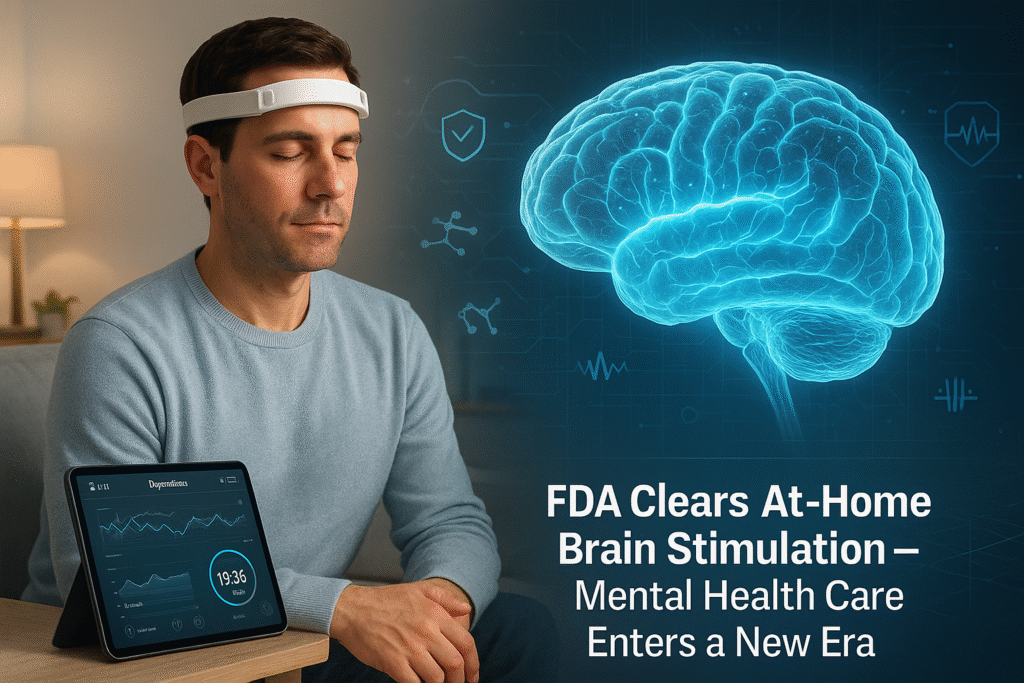
For patients, the shift is profound. Treatment that once required repeated clinic visits can now be administered at home, potentially increasing adherence and empowering individuals to play a more active role in managing their mental health.
2. Clinical practice becomes hybrid and data-driven
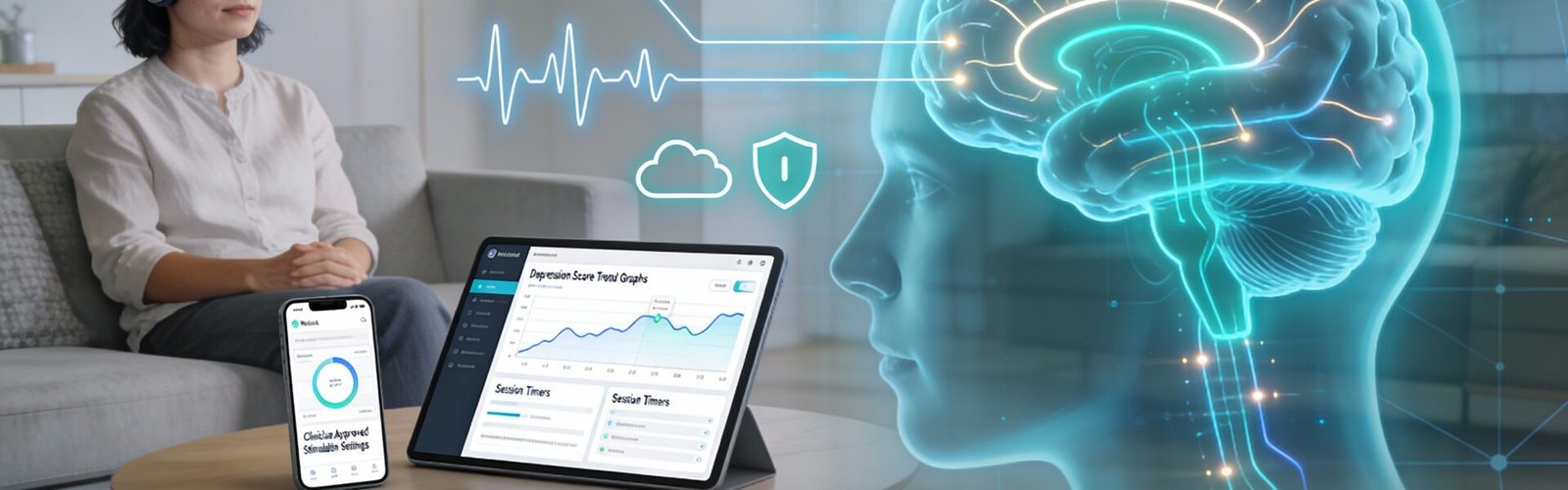
Clinicians may increasingly integrate tDCS into telepsychiatry workflows, combining:
- Remote monitoring dashboards
- App-based symptom tracking
- Algorithm-guided personalisation of stimulation protocols
This aligns with broader trends toward precision psychiatry, where treatment adapts dynamically to patient response.
3. Business and pharma face new competition
The approval opens the door for technology companies to enter regulated neurotherapeutics, potentially competing with pharmaceutical approaches or partnering with insurers through device-plus-subscription models.
This places at-home brain stimulation within the expanding category of digital therapeutics (DTx)—software- and hardware-based treatments evaluated with clinical trial rigour.
Billionaires, big tech, and the neurotech gold rush
Interest in brain stimulation and neurotechnology is not confined to academia. High-profile investors and tech founders increasingly view the brain as the next frontier after smartphones, wearables, and AI.
Venture capital has flowed into:
- Consumer neurostimulation startups
- Brain–computer interface companies
- Biohacking platforms promising cognitive and mood enhancement
Figures associated with Silicon Valley, longevity research, and human-performance optimisation have publicly expressed interest in non-invasive Brain Stimulation modulation, fueling both optimism and concern. While their involvement accelerates innovation, critics warn of commercial hype outpacing science, and the risk that mental health becomes overly technologised or inequitable.
Benefits, risks, and ethical fault lines
Potential benefits
- Expanded access for underserved or remote populations
- Reduced burden on overtaxed mental health systems
- Continuous, data-rich treatment insights
- Improved adherence when paired with coaching and apps
Risks and limitations
- Inappropriate self-use without adequate supervision
- Overreliance on devices at the expense of psychotherapy
- Data privacy and neurodata ownership concerns
- Unequal access driven by cost or digital literacy gaps
Professional bodies, including psychiatric associations and digital health policy groups, consistently stress that neuromodulation should remain embedded within clinician-guided care, not marketed as a standalone cure.
What success will really look like
The true test of at-home brain stimulation will unfold outside clinical trials. Key metrics will include:
- Real-world symptom reduction and relapse rates
- Long-term safety and adherence
- Cost-effectiveness compared with standard care
- Integration with AI-driven personalisation and digital platforms
Whether these devices become mainstream tools or remain niche options for early adopters will depend on evidence, regulation, reimbursement, and public trust.
A future of promise — with caution
The FDA’s approval of an at-home brain stimulation device for depression marks a historic inflexion point. It reflects the growing belief that technology can extend the reach of mental health care beyond clinic walls, offering new hope to millions who struggle to access treatment.
Yet it is not a magic cure.
Technology may enhance, complement, and personalise care—but it cannot replace the human dimensions of mental health: therapeutic relationships, social context, and compassionate clinical judgment.
As neuroscience, digital health, and consumer technology converge, the challenge for regulators, clinicians, and society will be to ensure that innovation remains ethical, evidence-based, and patient-centred.
Anyone considering such devices should do so only under the guidance of qualified medical professionals and should never discontinue prescribed treatment without expert advice.
The brain may be the final frontier—but how we navigate it will define the future of mental health care.
FDA approval brain stimulation, at-home brain stimulation device, tDCS depression treatment, mental health technology, digital therapeutics FDA, neuromodulation for depression, mental health innovation
health tech at home, non-invasive brain stimulation, future of mental health care
Discover more from
Subscribe to get the latest posts sent to your email.