
Swiss Report Operation sindoor Exposes the ’88-Hour War’: How Operation Sindoor Forced Pakistan to Beg for Truce


The Untold Saga Revealed: Swiss Report Operation Sindoor Confirms the Indian Army Broke Pakistan’s Air Defence in 88 Hours
The fog of war has finally lifted, and neutral observers are confirming what New Delhi has maintained for months. A groundbreaking report by the Swiss Centre for Military History and Perspective Studies (CHPM) has validated the sheer scale of India’s victory in Operation Sindoor, the high-intensity air conflict of May 2025.
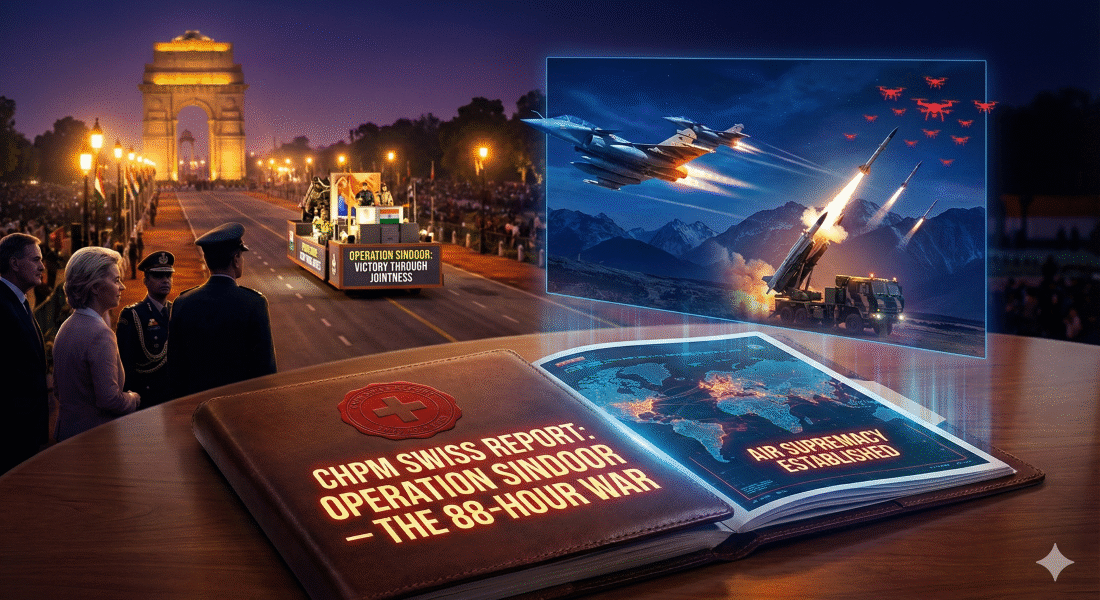
Released strategically to coincide with India’s 77th Republic Day celebrations—attended by European Union heavyweights Ursula von der Leyen and António Costa—the report, authored by historian Adrien Fontanellaz, dismantles Pakistani narratives and cements a new reality: India no longer manages conflicts; it dominates them.
The “3-Day” Collapse: Why Islamabad Begged for Truce
The most explosive revelation in the document, titled “Operation Sindoor: The India-Pakistan Air War (7–10 May 2025),” is the timeline of Pakistan’s collapse. Contrary to the “stalemate” often projected in international media, the Swiss analysis confirms that the Pakistan Air Force (PAF) ceased to be a cohesive fighting force by the morning of May 10, 2025.
According to the report, India’s shift from “defensive deterrence” to “punitive dominance” was swift. After a measured strike on terror launchpads on May 7, India responded to Pakistani retaliation not with caution, but with an overwhelming suppression campaign.
“By Day 4, the destruction of forward radars and command nodes at Nur Khan Airbase left the PAF flying blind. Facing the prospect of total asset annihilation, the Pakistani command had no choice but to request an immediate ceasefire through the DGMO hotline,” the report states.
Debunking Myths: The Loss Ratios
For months, propaganda bot-farms claimed the downing of multiple Indian jets. The CHPM Swiss Report Operation Sindoor provides a forensic audit that debunks these claims entirely.
- Confirmed Losses: The Swiss Report Operation Sindoor verifies the loss of one Indian Rafale (pilot recovered safely) and likely one legacy jet.
- The Exchange: In return, India decimated Pakistan’s integrated air defence network and ground infrastructure, a trade-off that left Islamabad defenceless against further waves.
The “Iron Shield”: Indigenous Tech Comes of Age
Perhaps the proudest takeaway for the Indian defence establishment is the performance of the Akash Prime missile system. While the Russian S-400 garnered headlines, the Swiss Report Operation Sindoor credits the indigenous Akash system as the “workhorse” that created an impenetrable wall against drone swarms, proving the Aatmanirbhar Bharat (Self-Reliant India) initiative has matured into a lethal reality.
A Message to Europe on Kartavya Path
The timing of the Swiss Report Operation Sindoor’s circulation cannot be ignored. During the 77th Republic Day parade, the “Operation Sindoor” tableau rolled down Kartavya Path under the gaze of European leadership. It wasn’t just a float; it was a geopolitical statement.
By showcasing the assets used in the operation—Rafales, BrahMos, and the networked “Integrated Operation Centre”—India signalled to the EU that it is a net security provider capable of enforcing stability. The Swiss validation serves as the academic stamp on this military message: India’s “New War Doctrine” is not about long-drawn-out battles, but about speed, precision, and forced capitulation.
As the dust settles on the “88-Hour War,” the legacy of Operation Sindoor is clear. It was the moment India stopped hesitating and started winning.
Swiss Report Operation Sindoor,
Discover more from
Subscribe to get the latest posts sent to your email.







1 COMMENTS