Bondi Beach Terror Attack: Inside the Investigation into ISIS-Inspired Self-Radicalisation and the Father-Son Suspects


Bondi Beach Massacre: Anatomy of an Ideologically Driven Attack
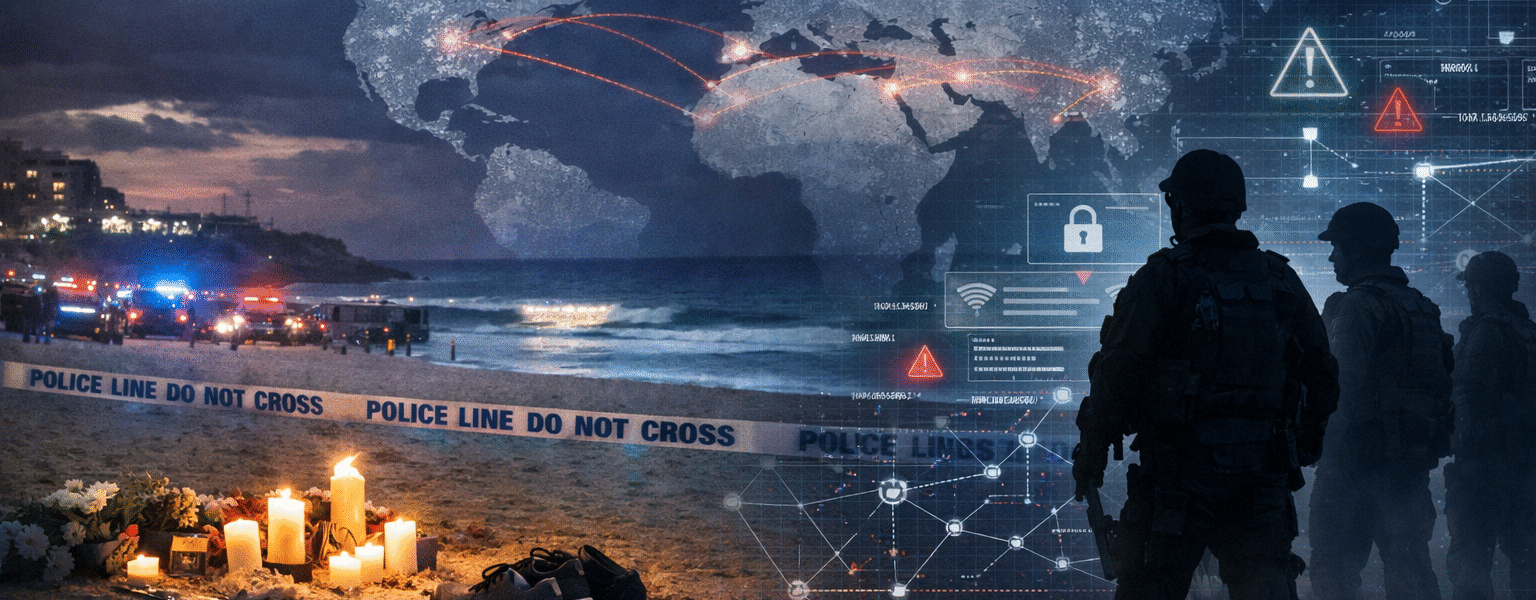
On the evening of Sunday, December 14, 2025, one of Australia’s most beloved public spaces — Bondi Beach — became the scene of a horrific mass shooting that left 15 people dead and dozens injured. The terror unfolded during a Hanukkah “Chanukah by the Sea” Jewish festival, as hundreds gathered along Campbell Parade and the beachside promenade.
According to official summaries and police statements:
- The attack began around 6:47 pm local time, with emergency calls reporting gunfire and chaos.
- Witness and video evidence reveal two armed men opening fire on civilians, focused on Festival attendees at Bondi Beach.
- Emergency services responded rapidly, and law enforcement confronted the gunmen. The father, later identified as 50-year-old Sajid Akram, was killed at the scene by police. His 24-year-old son, Naveed Akram, was shot and critically wounded but later regained consciousness and was formally charged with multiple counts, including murder and terrorism.
- Emergency units treated dozens of injured bystanders; ages among the dead ranged from children to elderly adults.
Among the victims were families, elderly community members, and religious figures. Heart-rending tributes emerged in the days after, including the funeral of 10-year-old Matilda Poltavchenko, whose life and loss symbolised the attack’s human toll.
Who Were the Suspects? Backgrounds and Radicalisation
Australian authorities and international reporting name the attackers as Sajid and Naveed Akram. Key verified details emerging from investigations include:
- Origins and Life in Australia: The father emigrated to Australia in 1998, settling and raising a family; his immediate family in Hyderabad, India, reportedly did not know any radical views.
- The son was born in Australia, growing up locally, with no formal criminal conviction before the attack.
- In 2019, intelligence agencies monitored Naveed in relation to individuals linked to an ISIS-associated group in Sydney. Still, after a months-long probe, authorities found no actionable threat at that time.
Crucially, law enforcement now publicly classifies the Bondi Beach shooting as a terrorist act “inspired by Islamic State (ISIS/ISIL)” ideology, not directed by a formal external network. Two homemade ISIS flags were found in the suspects’ vehicle, and public statements from Australia’s Federal Police Commissioner and government emphasise self-radicalisation and ideological allegiance.
As of the latest reporting, investigators have no confirmed evidence that the pair had direct operational ties — in Australia or abroad — to an organised terrorist group with handlers or formal command structures. A recent trip the pair made to the Philippines in November has raised questions, but local authorities there assert they saw no outreach to militant cells or evidence of training or support.
Self-Radicalisation in the Digital Age
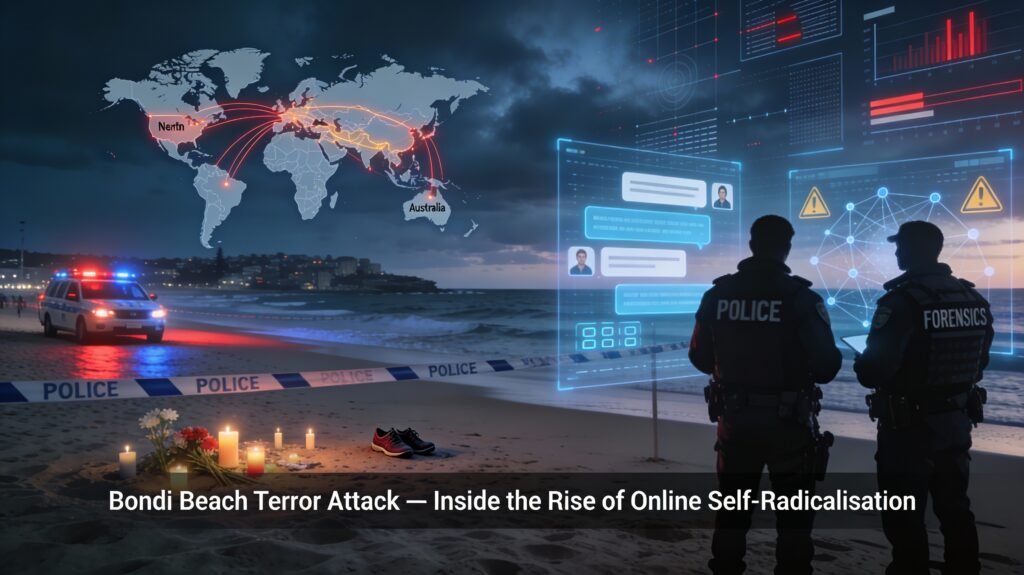
Analysis: what authorities and counter-terrorism experts increasingly describe is a pattern seen in several western democracies over the past decade — self-radicalisation via online propaganda and social media ecosystems rather than hierarchical control:
- Islamic Extremist organisations like ISIS have, even after territorial defeats abroad, maintained a prolific online propaganda presence, disseminating ideological justification for violence against Jews, Westerners, non-believers (kafirs) and other groups.
- Individuals can consume videos, messages, manifestos, and tactical guidance through encrypted platforms, fringe social networks, and private chat groups. This content — devoid of human oversight — can cultivate extremist mindsets and motivate violent action.
- Law enforcement and security researchers note that in many cases, no direct contact or formal recruitment occurs; rather, the ideology embeds itself in vulnerable minds through repeated exposure online.
This phenomenon is not unique to Islamist extremism — similar dynamics occur in far-right, accelerationist, and other ideological contexts — yet the violent Islamic jihadist internet ecosystem remains a persistent challenge for democracies because it blends religious symbolism with political grievance.
Motive, Targeting, and Antisemitism at Bondi Beach
Authorities have stated that the choice of time and place — targeting a Jewish festival during the first night of Hanukkah — was deliberate. Australian Prime Minister Anthony Albanese publicly acknowledged the antisemitic dimension of the attack.
The attack’s timing, location, and ideological symbolism — combined with the ISIS allegiance indicators — are consistent with both global Islamic jihadist calls to target Jewish communities and broader trends in antisemitic violence observed internationally.
Crucially, available evidence points to direct targeting based on religious and cultural identity, not accidental location or collateral harm. This underscores why Australian leaders have characterised the massacre as terrorism with antisemitic intent.
Legal, Security, and Policy Implications for Australia
In the wake of the Bondi Beach massacre, Australia is confronting urgent questions about violent Islamic extremism, online radicalisation, gun laws, and public safety:
- Hate-crime and extremism laws: The federal government has pledged to tighten hate speech definitions, strengthen penalties, and broaden powers for visa and immigration scrutiny tied to extremist conduct.
- Gun law reform: Although Australia has some of the world’s strictest firearms regulations, scrutiny now focuses on how one suspect legally held multiple firearms despite prior intelligence interest in his son. Proposals include letting police more thoroughly consider intelligence in licensing decisions.
- Counter-radicalisation strategies: Police leadership is calling for enhanced community and family vigilance, early reporting of concerning behaviour, and preventive programs to counteract online extremist narratives.
These policy conversations occur amid civil liberties concerns. Activists warn against overly broad surveillance or restrictions on protest and speech that could inadvertently dampen democratic freedoms; a proposed limitation on public rallies after a terrorism designation, for example, has drawn resistance from rights advocates.
Community Impact and Responses
The Bondi Beach attack has rippled through multiple sectors of Australian society:
- Jewish organisations and leaders have mourned victims and called for enhanced protections against antisemitism.
- Muslim community leaders have condemned the violence and rejected extremist ideology, reiterating that the overwhelming majority of Muslims do not support terrorism or violent jihad. Such statements are routinely issued in the aftermath of Islamist extremist attacks on civilians, often emphasising that “this is not Islam” and that Islam is a religion of peace. However, critics note that this pattern has become familiar: while one set of individuals carries out acts of violence in the name of a distorted religious ideology, another segment of the community responds by distancing the faith from the act rather than confronting the ideological roots that enabled radicalisation in the first place. In countries like India, this dynamic is frequently observed, where responsibility for violence is disowned by one group even as others attempt to rationalise or contextualise the actions through selective interpretations or political arguments.
- Grassroots efforts have organised vigils, interfaith dialogues, and support networks for survivors and families, reflecting a collective desire for unity over division.
International Context and Patterns
Globally, several democratic societies have faced attacks by individuals self-radicalised through online jihadist propaganda. While each case has unique features, recurring patterns include:
- Lack of formal operational ties, yet clear ideological motivation.
- Use of publicly accessible or encrypted online platforms for radical messaging.
- Targeted violence against minority communities.
These patterns pose shared challenges for policymakers: balancing public safety measures with civil liberties, investing in digital counter-narratives, and ensuring community resilience without stigmatisation.
Conclusion
The Bondi Beach massacre represents a tragic intersection of antisemitic violence, self-radicalisation via Islamic extremist propaganda, and domestic security vulnerabilities. As investigations continue, a central question for Australia and other democracies remains: how to disrupt the pipeline from online ideology to real-world violence without impairing the freedoms that define open societies.
Bondi Beach terror attack, Bondi Beach shooting investigation, ISIS inspired attack Australia, Islamic self-radicalisation, Australia terror attack analysis, online jihadist radicalisation, lone wolf Islamic extremism, father son terror suspects Australia, antisemitic terror attack Bondi, ISIS propaganda online radicalisation, counter terrorism Australia policy, extremist ideology and lone actors
Discover more from
Subscribe to get the latest posts sent to your email.