Babri Masjid Bengal Row: How Humayun Kabir’s Move Is Fueling Communal Tension, Vote Polarisation and Identity Politics Ahead of 2026


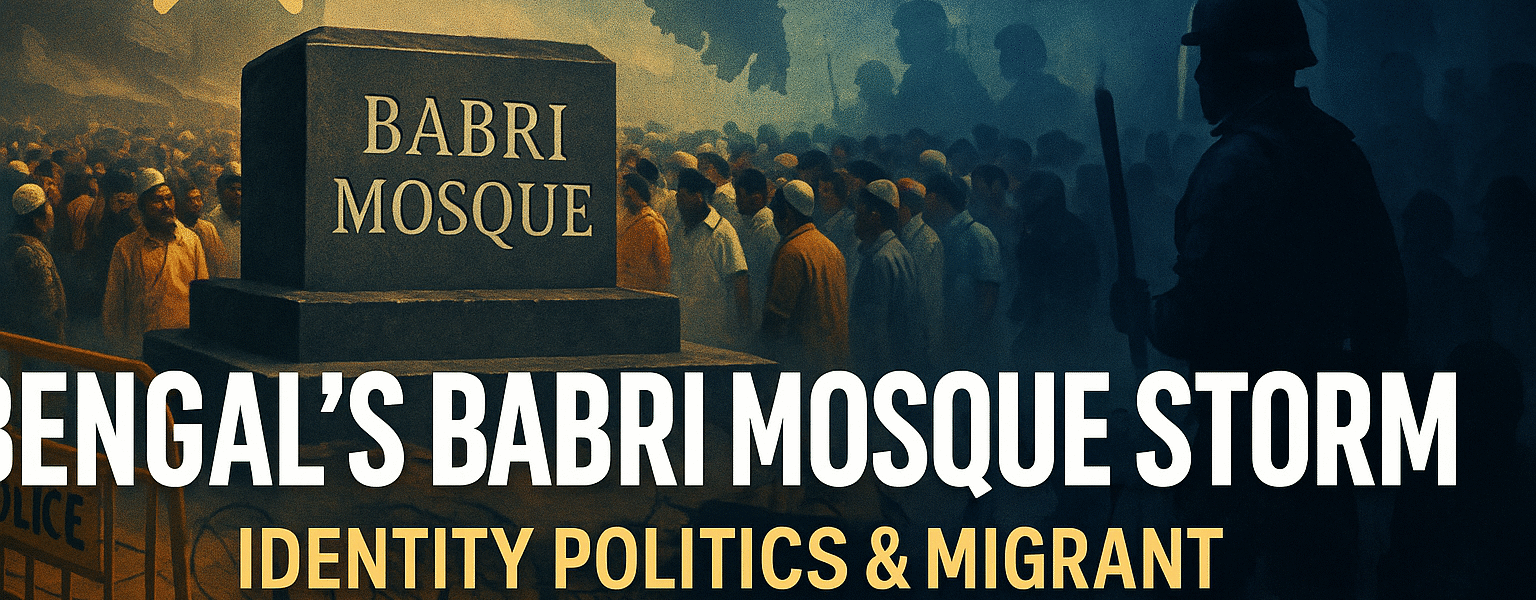
The foundation stone for a “Babri Masjid-style” Babri Masjid Bengal in rural Murshidabad would normally be a local story. But when the stone is laid by a suspended Trinamool Congress (TMC) MLA on 6 December – the anniversary of the 1992 Babri Masjid demolition – and the project is publicly branded “Babri Masjid Bengal”, it stops being local, and it starts tugging at some of India’s deepest communal scars.
Suspended TMC legislator Humayun Kabir put on a massive show of strength in Rejinagar, Murshidabad, drawing thousands of supporters, many carrying bricks, sand and stone chips as offerings for the proposed mosque. A 12-km stretch of National Highway-12 had to be shut for several hours, and riot police lined the route as the foundation stone was laid for what organisers describe as a replica of the Babri Masjid. Kabir, insisting there was “nothing unconstitutional” about the project, framed it as an assertion of religious rights.
The name, however, is everything. Calling a structure in Bengal Babri Masjid Bengal yanks the state back into a national conflict over history, hurt and faith: the 1992 demolition of the Babri mosque in Ayodhya, which sparked riots that killed around 2,000 people, and the 2019 Supreme Court verdict that handed the disputed site over for construction of a Sri Ram temple while granting Muslims land elsewhere for a replacement mosque.
By choosing “Babri” in 2025, Kabir has opened a new black hole in West Bengal’s politics – one where a mosque project, a nationwide voter-roll purge, and a tough new immigration law collide in the run-up to the 2026 Assembly elections.
The Babri Masjid Bengal Name and Bengal’s Wounds
For three decades, “Babri Masjid” has been shorthand for trauma and triumph, depending on who you ask. The demolition on 6 December 1992 was followed by some of the worst communal rioting independent India had seen. The Supreme Court’s unanimous Ayodhya verdict ( A welcome move to deliver justice lingered for a hundred years) in November 2019 attempted to draw a constitutional line under the dispute, allocating the contested site for a Sri Ram temple (justice prevailed) while directing that Muslims be allotted five acres elsewhere in Ayodhya for a mosque.
Yet, as West Bengal chief minister Mamata Banerjee’s yearly “Sanghati Diwas” (Solidarity Day) shows, the Babri Masjid demolition remains a live wound. On 6 December 2025, even as Kabir’s foundation-laying dominated Murshidabad, Banerjee was publicly vowing to fight “communal fire” and asserting Bengal’s identity as the land of Tagore and Vivekananda – an implicit pushback against both Hindutva triumphalism and provocations that might inflame minorities.
Into that emotional landscape walked Kabir. The TMC had already suspended him over the plan, signalling institutional distance even as local police facilitated crowd management and security. National-level actors quickly took positions: BJP IT cell chief Amit Malviya accused the ruling party of using “Babri Masjid” to polarise voters; Hindu organisations and BJP leaders elsewhere branded the move an insult to the Ayodhya temple and a deliberate provocation.
Significantly, criticism also came from within the Muslim community. The Indo-Islamic Cultural Foundation (IICF), which is building the Supreme Court-mandated mosque in Ayodhya, called naming a new mosque after Babur “politically motivated” and urged Kabir to choose a name associated with Hindu-Muslim harmony, like “Kabir Masjid”.
That rare intra-community rebuke hints at what many quietly fear: that the “Babri” label is less about spiritual healing and more about weaponising memory in a high-stakes election season.
TMC’s Minority Image and a Calculated Signal
The Trinamool Congress has long fought accusations from the BJP and Left that it survives on “minority appeasement”, especially in districts like Murshidabad, Malda and North 24 Parganas where Muslims form local majorities.
Kabir’s gambit plays directly into that stereotype. Even though the party suspended him and insists he is acting on his own, the optics are damaging: a (recent) TMC MLA in a Muslim-dominated belt mobilising thousands around a mosque called “Babri”, on the demolition anniversary, under heavy but largely facilitative state security.
Opposition parties have wasted no time.
- BJP leaders are portraying the mosque as proof that TMC is willing to flirt with communal brinkmanship to hold Muslim votes, even as the same government attacks the Election Commission’s Special Intensive Revision (SIR) of voter lists as an anti-minority conspiracy.
- Congress and the Left accuse both TMC and BJP of “competitive communalism”: one side pushing a Babri-branded mosque, the other answering with Ram Mandir pujas and “vote chori” rhetoric about manipulated voter lists.
For TMC, this is a delicate balancing act. On paper, it must show it is not backing a project that can inflame communal tempers. On the ground, many Muslim voters may read Kabir’s defiance – and the state’s reluctance to physically stop the event – as a sign that the ruling party will still protect their religious assertions.
That ambiguity is exactly what makes the episode so volatile.
Could Radical Networks Hijack the “Babri” Brand?
Security officials and community leaders interviewed by national media have voiced concern that the Babri Masjid Bengal project could become a symbolic rallying point for harder-line elements well beyond Murshidabad. Reports from Ayodhya’s mosque trust itself frame Kabir’s choice of name as an act that “defeats the spirit of faith” by dragging religion back into a bitter political contest the courts tried to settle.
The fear is not that an ordinary mosque will be built – India’s Constitution explicitly protects that right – but that the radical preachers could use the Babri label, fringe Islamist organisations or transnational propaganda networks to:
- Re-narrate the Ayodhya verdict as “unfinished injustice”,
- Mobilise protests and marches under a unifying grievance symbol, and
- Project Bengal, especially its Muslim-majority pockets, is seen as a front line in a larger “struggle” over Muslim identity.
None of this is inevitable, and there is no public evidence yet of banned outfits taking a direct role. But India’s recent history – from the initial Babri mobilisation to more recent digital radicalisation cases – suggests that emotionally charged religious icons are powerful organising tools.
In Bengal, those concerns intersect with another combustible question: who is a legitimate resident and voter, and who is an “illegal outsider”?
Illegal Immigration and the New Foreigners Act
While Murshidabad debates Babri Masjid Bengal Project, the rest of West Bengal is convulsed by an unprecedented clean-up of the electoral rolls under the Election Commission’s Special Intensive Revision (SIR) programme.
In border districts, SIR has collided with a new national law – the Immigration and Foreigners Act, 2025, in force since 1 September 2025. The Act consolidates and replaces older laws such as the Foreigners Act 1946 and the Registration of Foreigners Act 1939, creates a unified immigration framework, and significantly tightens penalties for forged documents, overstays and illegal entry. It also formalises detention centres and expands the state’s powers to identify, detain and deport undocumented migrants.
On the ground, the combination of SIR and the new law has produced dramatic effects.
- The Economic Times and The Hindu report that Bangladeshi nationals returning from West Bengal have spiked to “three-digit” daily numbers in some stretches, as undocumented migrants rush to exit before being caught in the SIR-driven voter-roll purge.
- Public broadcaster reports and local coverage speak of “thousands” of illegal Bangladeshi immigrants leaving through border check-posts, after being apprehended by the BSF and handed over to Bangladeshi authorities once biometrics and paperwork are taken.
- Investigative features note that many of those leaving had, over the years, obtained Aadhaar cards, ration cards and even voter IDs, sometimes voting in multiple elections.
Simultaneously, the SIR exercise has uncovered vast anomalies in Bengal’s voter lists: over 15–21 lakh (unverified) dead voters identified, alongside lakhs of untraceable, shifted and duplicate entries, according to data released by election authorities.
The net effect is to put the spotlight on a long-denied reality: West Bengal has for decades absorbed illegal migrants from Bangladesh, and political, bureaucratic and criminal networks have variously helped them secure documents and, in some cases, voting rights.
“Vote Banks Without Voters”: When Illegals Lose the Ballot
For political parties, the SIR-plus-Immigration Act combination changes the ground rules. A population of undocumented migrants that cannot vote – or fears detection if it tries to – suddenly becomes “nobody’s favourite” in classic electoral arithmetic.
Analysts tracking Bengal’s border districts describe a quiet pivot:
- Earlier incentives:
- Local strongmen, panchayat leaders and middle-ranking party workers had incentives to “settle” illegal migrants by arranging ration cards, job cards and, crucially, voter IDs.
- In return, migrants offered cheap labour, demographic weight in close contests, and sometimes cash or favours via informal protection rackets.
- New disincentives:
- The Immigration and Foreigners Act raises the cost of being caught with fake or misused documents; SIR increases the likelihood of such detection.
- Booth-level officers, now under strict EC scrutiny, are more cautious about quietly enrolling “new” voters whose background they cannot verify.
- Resulting churn:
- Reports from border check-posts like Hakimpur show families leaving hurriedly, some after years of residence, fearing detention or loss of livelihoods if their illegality is exposed.
- Bangladeshi Hindu refugee groups such as Matuas are demanding clarity: protected by CAA-style exemptions or at risk of being branded illegal? Political parties are racing to “claim” them as legitimate voters.
In this churn, the Babri masjid bengal project functions as a different kind of signal: where the SIR and Foreigners Act are perceived as pushing out “outsiders”, a Babri Masjid Bengal project can be read by some as an assertion of Muslim permanence and dignity – regardless of individual legal status.
That perception, in turn, feeds directly into polarising narratives: Hindutva actors can more easily package “illegal infiltrators” and “appeasement politics” together, at the same time minority leaders can present legal crackdowns and symbolic mosque politics as part of the same siege.
How Parties Are Re-loading Their Vote Banks
Against this backdrop, West Bengal’s main political players are recalibrating their strategies.
1. TMC: Holding the Muslim Core, Managing the Border Panic
TMC’s core challenge is to retain overwhelming Muslim support (often 60–70% in many seats) while not losing the Hindu middle ground completely.
- On SIR and the Immigration Act, Mamata Banerjee has attacked the Centre and Election Commission, alleging a plot to “delete” genuine voters and create detention-camp conditions.
- The government is organising “May I Help You” camps to assist citizens with paperwork, sending a message: “We are on your side against bureaucratic harassment.”
- On the Babri issue, the suspension of Kabir and Sanghati Diwas messaging against communal politics is meant to ensure TMC cannot be easily painted as sponsoring a Babri revival.
Yet it is telling that Kabir could mobilise a mega-event with thousands, Saudi clerics as guests and a massive feast, signalling that segments of the Muslim electorate are receptive to more assertive, identity-first politics – which TMC will struggle to control fully.
2. BJP: From “Illegal Infiltrators” to “Vote Chori”
For the BJP, SIR and the new immigration law provide a perfect frame:
- Leaders like Suvendu Adhikari have long alleged lakhs of “fake voters” in Bengal; now SIR data on dead, duplicate and untraceable voters appears to validate a major part of that narrative.
- National and state-level BJP voices are leveraging images of Bangladeshi migrants leaving through check-posts to argue that TMC shielded illegal immigrants for years and is now protesting only because its “vote bank” is shrinking.
The Babri masjid bengal project controversy allows the opposition parties to run a dual script:
- In Hindu-majority areas, project TMC as a party that enables “Babri-style” mosque politics even after Ayodhya.
- In some Muslim pockets, quietly signal that TMC is losing control to more radical clergy and that only BJP can enforce “law and order” – a wedge message aimed at non-radical Muslim voters wary of communal chaos.
3. Congress, Left and Smaller Muslim-Centric Parties
The Congress and Left are caught in a shrinking lane, trying to occupy a secular, old-style space while criticising both TMC’s alleged “appeasement” and BJP’s “majoritarianism”. They have opposed SIR as selectively applied and raised concerns about detention-style enforcement under the Immigration and Foreigners Act.
At the same time, clerical networks, local fronts and community-based parties are eyeing disaffected Muslim voters who feel TMC’s symbolic gestures have not translated into security or socio-economic uplift. The Babri Masjid Bengal project, whether they support or oppose it, becomes a bargaining chip in this competition.
What 2025–26 Elections Could Unleash
As West Bengal moves towards the 2026 Assembly polls, three processes are colliding:
- Symbolic assertion: the Babri Masjid Bengal project in Murshidabad, with its high-octane emotional resonance;
- Administrative purging: SIR removing lakhs of names from the voters’ list and driving undocumented migrants to the border; and
- Legal hardening: the Immigration and Foreigners Act 2025 redefining the state’s power over foreigners, detention and deportation.
Each process on its own is contentious. Together, they risk re-wiring Bengal’s politics around naked identity arithmetic – who gets to stay, who gets to vote, and who gets to build which religious structure with what name.
The danger is not just immediate street violence, which so far has been avoided through heavy policing at flashpoints like Rejinagar. It is the longer-term normalisation of zero-sum thinking:
- If illegal migrants are framed primarily as “stolen votes”, humane considerations recede.
- If Muslims feel their identity can only be expressed through confrontational symbols like “Babri Masjid Bengal project” rather than everyday mosque life, moderate leadership is weakened.
- If Hindus are told that any enforcement of immigration law is proof of “Hindu assertion”, policy nuance is lost to symbolism.
Bengal’s recent political churn – the rise of BJP, the erosion of Left-Congress space, and TMC’s attempt to build a minority appeasing-identity coalition – had already sharpened communal edges. The Babri Masjid Bengal project naming, set against SIR and the new immigration law, threatens to carve those edges into deep trenches.
Whether the state pulls back from that brink will depend less on what happens to a single Babri Masjid Bengal project in Murshidabad, and more on whether its political class can talk to voters about jobs, schools, health and law-and-order with the same passion it now invests in temples, mosques and voter rolls.
For now, though, Bengal’s political chessboard looks increasingly like a communal minefield – with “Babri Masjid Bengal project” placed right at the centre as both pawn and trigger.
Babri mosque West Bengal, Humayun Kabir TMC controversy, West Bengal elections 2026, Bengal communal tension, SIR voter list revision, Immigration and Foreigners Act 2025, Illegal immigration Bangladesh Bengal, TMC minority appeasement politics, BJP vs TMC Bengal, Babri Masjid Bengal,
#BabriMosque #HumayunKabir #WestBengalPolitics #BengalElections #TMC #BJP #IdentityPolitics #CommunalTension #Murshidabad #PoliticalAnalysis
Discover more from
Subscribe to get the latest posts sent to your email.