Prana Shakti & Nitric Oxide: Where Ancient Mastery Meets Nobel-Winning Science


Prana Shakti & Nitric Oxide:
When Ancient Wisdom Meets Nobel Prize Science
The life-force energy described in the Vedas 2,000 years ago and the molecule that won the 1998 Nobel Prize in Medicine are, the evidence now suggests, the very same thing — and three specific breathing techniques can restore it.
There is a moment in the history of science when a new discovery, hailed as revolutionary, turns out to be a rediscovery — a modern instrument reading an ancient inscription that was always there. Such a moment arrived in 1998, when Robert Furchgott, Louis Ignarro, and Ferid Murad received the Nobel Prize in Physiology or Medicine for identifying nitric oxide as a master signalling molecule of the human body. They were celebrated as pioneers. They were, in a deeper sense, confirming something the rishis of ancient India had already mapped — not in laboratories, but in the systematic, millennia-long empirical tradition of Ayurveda and Yoga.
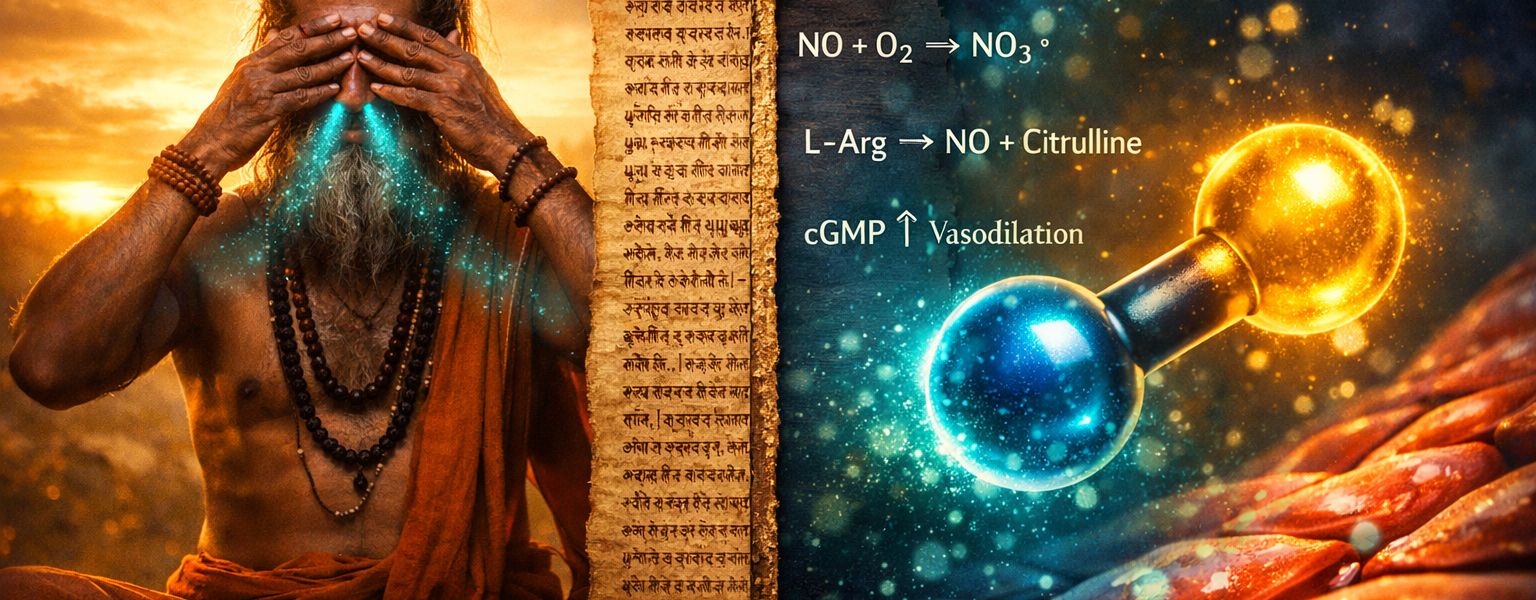
The ancient sages called it Prana Shakti — the primal life-force energy that animates every cell, travels through invisible channels called Nadis, and whose depletion is the very engine of ageing. The Nobel laureates called it nitric oxide — a tiny gaseous molecule produced in the nasal passages and paranasal sinuses, travelling between cells as a biochemical messenger, governing cardiovascular health, immunity, cognition, and cellular longevity. Two vocabularies. One biological reality.
The ancient Tantric scriptures of Shiva Swarodaya declare that the longevity of a human being is measured not by years, but by the number of breaths. Science has confirmed: slower, deeper breathing is directly associated with longer life.
— Synthesis: Vedic Wisdom & Respiratory ScienceThe Ancient Framework: What Ayurveda Said About Life Force
In Sanskrit, Prana means breath, life force, and vital principle simultaneously. Ayurveda and Yoga classified Prana into five forms — the Pancha Vayus — each governing a specific biological domain. Prana Vayu, the master form, was held to be the energy that charged the body to action, entered through the nostrils, and circulated through channels (Nadis), of which the Ida (left nostril, lunar, parasympathetic) and Pingala (right nostril, solar, sympathetic) were the two governing highways of physiological balance.
The Vedic texts were unambiguous on the relationship between Prana and ageing. The ancient Tantric scriptures, including the Shiva Swarodaya and Gyan Swarodaya, stated that human longevity is determined not by years but by the total number of breaths taken in a lifetime. At the normal breathing rate of 15 breaths per minute, a person lives approximately 75–80 years. Reduce that to 10 breaths per minute through conscious pranayama, and the texts forecast a life of 100 years. The dog breathes 30–35 times per minute — and lives 10–15 years. The tortoise, among the longest-lived vertebrates on earth, breathes only 4 times per minute.
“Jab tak shwaas, tab tak aas” — “As long as there is breath, there is hope” — is a common Indian proverb rooted in a deeper Vedic truth: that breath is not merely air but the carrier of Prana Shakti, the sovereign force of life. Pranayama (prana + ayama = extension of life force) was designed not merely for spiritual attainment but as a precise biomedical intervention for longevity.
The Nobel Molecule: What Modern Science Discovered in 1998
Nitric oxide (NO) is one atom of nitrogen bonded to one atom of oxygen. It is a gas. It exists in the body for only seconds before being metabolised. Yet in those fleeting seconds, it orchestrates processes that no pharmaceutical yet synthesised can fully replicate. It relaxes and dilates blood vessels, ensuring free circulation. It prevents platelets from clumping, protecting against clots. It defends against invading pathogens — bacteria, viruses, parasites. It supports neuroplasticity and memory. It regulates the immune system. It governs erection and reproduction. It drives wound healing and tissue regeneration.
Critically — and this is the connection that links it irrevocably to prana — the greatest concentration of nitric oxide in the human body is produced in the paranasal sinuses of the nasal passages. It is released specifically during nasal breathing. Mouth breathing produces essentially none. Every classical pranayama text in existence prescribes nasal breathing as the only correct method. The ancient sages did not know what nitric oxide was. But they had empirically identified the nasal passages as the site of Prana’s entry into the body — and they were, to the molecular level, correct.
The Ageing Equation: Declining Prana = Declining Nitric Oxide
Here is where the two traditions converge most powerfully on the question of ageing. Ayurveda teaches that Prana Shakti is at its peak in youth and diminishes progressively with age, weakening every system of the body as it wanes. Modern science has now documented the precise molecular mechanism of this decline.
Peer-reviewed research published in leading cardiovascular journals confirms that NO production declines measurably with every decade of life, even in healthy individuals. The enzyme responsible for producing nitric oxide — endothelial nitric oxide synthase (eNOS) — becomes progressively less active as we age. The result is endothelial dysfunction: blood vessels stiffen, circulation slows, blood pressure rises, cognitive function declines, immune response weakens, and cellular repair slows. These are not diseases. They are the hallmarks of normal ageing — and they are, at the molecular level, the consequence of falling nitric oxide.
| Ayurvedic Concept | Modern Scientific Equivalent |
|---|---|
| Prana Shakti (life force) | Nitric Oxide — master signalling molecule |
| Nadi (energy channels) | Vascular endothelium (blood vessel lining) |
| Ida Nadi (left, lunar) | Parasympathetic nervous system |
| Pingala Nadi (right, solar) | Sympathetic nervous system |
| Prana Vata imbalance | eNOS dysfunction / NO deficiency |
| Nasal passages as seat of Prana | Paranasal sinuses as the primary site of NO production |
| Declining Prana with age | Age-related eNOS decline and vascular senescence |
| “Life measured by breaths” | Breathing rate as a validated predictor of lifespan |
The Three-Stage Protocol: Ancient Prescription, Modern Validation
The breathing sequence described in classical Yoga texts — Nadi Shodhana, followed by Bhramari, concluded with Kumbhaka — is not a random collection of techniques. It is a sequentially engineered biological protocol that acts on three distinct physiological mechanisms in a compounding cascade. Each stage prepares the body for the next. Together, they systematically restore the body’s nitric oxide (Prana Shakti) at every level — from the nervous system to the cellular genome.
Alternating inhalation and exhalation through left and right nostrils in a precise rhythm, balancing the Ida and Pingala Nadis. The classical ratio is 4:4:8 (inhale:hold:exhale).
Science: Forces mechanical balance between the sympathetic (fight-or-flight) and parasympathetic (rest-and-digest) nervous systems. Reduces cortisol — the hormone that suppresses eNOS activity. Activates the parasympathetic state in which the endothelium can begin restoring NO synthesis. Lowers blood pressure and improves heart rate variability (HRV).
ANS Rebalancing · Cortisol Reduction · eNOS ActivationDeep nasal inhalation followed by slow exhalation with a sustained humming sound — ideally with Shanmukhi Mudra (plugging the ears and closing the eyes). The vibration resonates through the skull, sinuses, and chest cavity.
Science: The oscillating airflow created by humming dramatically amplifies gas exchange between the paranasal sinuses (the body’s NO reservoir) and the nasal cavity. Clinical studies confirm a 15-fold increase in nasal NO during humming versus silent exhalation. In a 268-patient clinical trial, Bhramari + Om chanting raised eNOS enzyme levels by 3.4-fold. The skull vibration also activates brain lymphatics, clearing tarpaka kapha — what Ayurveda identifies as congested cerebral lymph associated with mental and emotional stagnation.
15× NO Release · eNOS Enzyme Rise · Vagal Tone · Brain LymphaticsDeliberate holding of the breath after full inhalation (Antara Kumbhaka) or after complete exhalation (Bahya Kumbhaka). Beginners start with a 1:1:2 ratio and build gradually over weeks.
Science: Creates a state of controlled intermittent hypoxia (brief, intentional oxygen reduction). This directly induces the NOS enzyme that synthesises nitric oxide at the cellular level. Simultaneously, rising CO₂ dilates cerebral blood vessels, releases antioxidant enzymes (glutathione peroxidase, superoxide dismutase), and triggers spleen contraction — releasing a stored reserve of oxygen-rich red blood cells into circulation. Research confirms kumbhaka also stimulates erythropoiesis (EPO production), vascular VEGF (new blood vessel growth), stem cell production, and neuroprotective effects.
Intermittent Hypoxia · NOS Induction · Stem Cells · VEGF · EPOBreath retention — kumbhaka — is like your body’s own hyperbaric oxygen chamber. Brief hypoxia does not decrease tissue oxygen; it supersaturates tissues with it, while simultaneously inducing the very enzyme that manufactures the body’s master longevity molecule.
— Dr. John Douillard, LifeSpa; synthesis of intermittent hypoxia researchThe Timeline of Change: Why 2–3 Months?
The claim that just 12 minutes of daily practice can transform the body in two to three months is not aspiration — it is the documented timeframe of biological adaptation. The changes occur in layered waves, each building on the last.
Within the first few minutes of a single session, nasal NO surges 15-fold from the humming stage. Blood pressure drops measurably. The autonomic nervous system begins to shift. After two to four weeks of daily practice, cortisol rhythms normalise and the endothelium begins recovering eNOS activity. After six to eight weeks, blood pressure, HRV, and sleep quality show statistically significant improvements in clinical studies. By the two-to-three-month mark, structural endothelial changes are measurable: vascular compliance improves, new capillaries begin forming through VEGF stimulation, and cellular markers of ageing — oxidative stress, inflammatory cytokines, telomere erosion — are measurably reduced.
The ancient texts were specific about this timeline because the practitioners had observed it empirically over generations. The body requires a minimum of sixty to ninety days of consistent practice for Prana Shakti — or, in modern terms, the eNOS-mediated nitric oxide signalling network — to be fundamentally retrained. This is not a quick fix. It is a biological re-education.
Conclusion: The Breath That Science and Sages Agree On
The convergence documented in this investigation is not coincidental, and it is not superficial. It runs to the molecular level. The ancient Indian sciences, through millennia of disciplined empirical practice, identified the nasal passages as the seat of the life force — precisely where nitric oxide is produced. They prescribed nasal breathing exclusively — which is the only mode that delivers NO to the lungs. They designed a three-stage breathing protocol — Nadi Shodhana, Bhramari, Kumbhaka — that acts on the autonomic nervous system, the paranasal NO reservoir, and the cellular NOS enzyme cascade respectively. They stated that this practice could restore vitality, slow ageing, and extend life when practised for a few minutes each day over two to three months.
Modern science, beginning formally in 1998 and accelerating rapidly through peer-reviewed research published up to 2025–26, has confirmed each of these claims at the molecular level. The rishis were not speaking metaphor. They were doing science in the only language available to them — the language of lived, observed, and transmitted experience. That language, it turns out, was entirely accurate.
This article is for educational and informational purposes, grounded in peer-reviewed research. Individuals with cardiovascular conditions, respiratory disorders, or hypertension should consult a qualified physician or certified yoga therapist before beginning breath retention (kumbhaka) practices. Pranayama is a powerful physiological intervention — it should be introduced gradually and learned correctly.
Discover more from
Subscribe to get the latest posts sent to your email.