
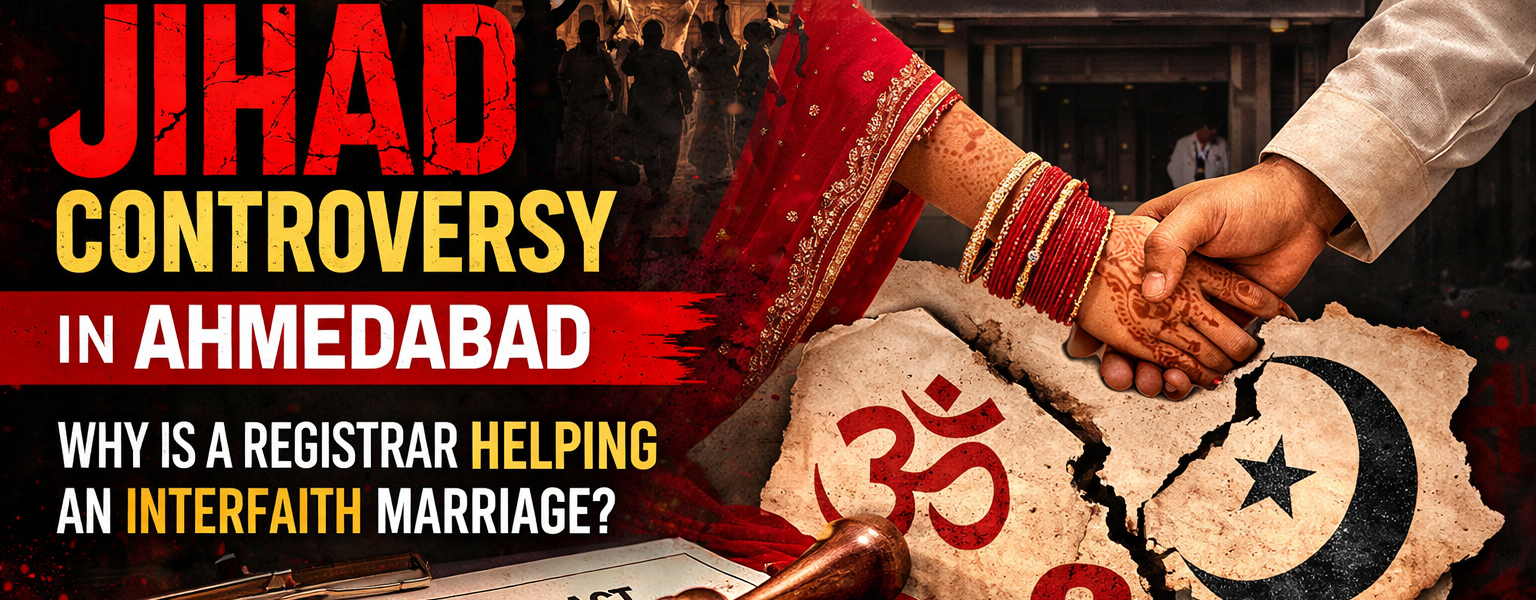
Ahmedabad Love Jihad Controversy: Registrar Office Incident Sparks National Debate


Ahmedabad Registrar Controversy Sparks Renewed Debate Over ‘Love Jihad’: Allegations, Legal Loopholes, and a Growing National Anxiety
In a quiet office inside Ahmedabad’s Gheekanta metro court complex, an incident unfolded that has once again ignited one of India’s most polarising debates, the alleged phenomenon popularly known as “love jihad.”
What began as a routine attempt by an interfaith couple to register their marriage quickly spiralled into protests, accusations, and a storm of suspicion surrounding the role of a government official.
At the centre of the controversy is marriage registrar M.M. Syed, whose actions during the incident have raised questions from activists, lawyers, and political observers.
But beyond the immediate dispute lies a deeper and more unsettling question:
Is this merely a single administrative controversy, or a glimpse into a much larger and hidden social conflict unfolding across India?
The Morning That Sparked a Controversy
For kind attention of @sanghaviharsh ji.
— Oxomiya Jiyori 🇮🇳 (@SouleFacts) March 11, 2026
Ahmedabad's marriage registrar, Syed Mujahideen, is allegedly promoting #lovejihad on a large scale. Syed Mujahideen called a Hindu girl and a Muslim boy for marriage through the back door of his office, wearing a lawyer's black coat to… pic.twitter.com/x8tVCGJOzA
According to multiple reports, an interfaith couple, a Muslim man and a Hindu woman, arrived at the marriage registration office early in the morning to complete their marriage formalities under civil procedures.
However, their presence triggered protests from family members and certain social organisations, leading to a tense confrontation inside the court complex.
Police eventually intervened and escorted the couple away to prevent escalation.
Authorities later stated that the woman declared she was acting of her own free will and refused to return home with her parents.
Yet the incident did not end there.
Questions soon began circulating among lawyers and observers present at the court complex.
The Questions That Refuse to Go Away
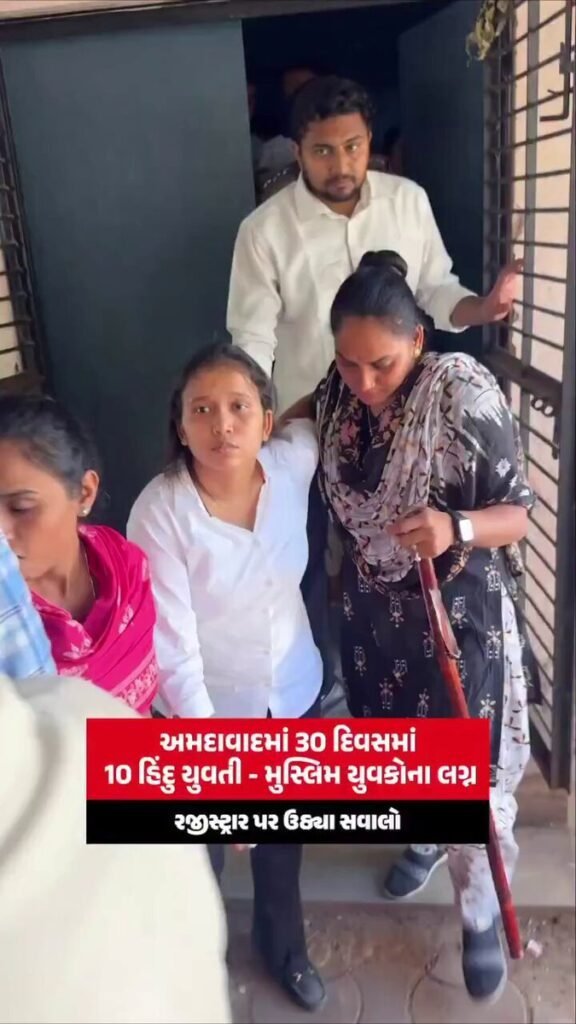
Some lawyers raised doubts about how the couple was able to access the office earlier than normal working hours, since the registrar’s office typically begins proceedings later in the morning.
Others alleged irregularities in the process, including claims that the couple entered through a side or back entrance.
These allegations have not been officially proven and remain part of an ongoing public controversy rather than fact.
However, social organisations and activists have demanded a formal inquiry into the registrar’s office, asking authorities to examine past marriage registrations handled by the office.
Until such an inquiry occurs, the claims remain allegations rather than confirmed findings.
A Narrative That Divides India
The Ahmedabad episode has revived debate around the practice of “love jihad.”
Trapped by Deception: Ayodhya Woman Exposes Sinister ‘Love Jihad’ Plot
The phrase itself does not exist in Indian criminal law and is widely considered a not-so-established practice to describe alleged cases where Muslim men marry non-Muslim women as part of a broader conversion agenda.
Because the term has no legal definition, official national data on such cases does not exist.
In fact, the Union Ministry of Home Affairs informed Parliament in 2020 that “love jihad” is not defined under existing laws and no such cases are officially recorded by central agencies.
Yet individual criminal cases involving deception, coercion, sexual exploitation, or forced conversion do occur in large numbers and are sometimes described in public debate using the name “Love Jihad”.
This mixture of verified crimes, political narratives, and social fears has created one of the most emotionally charged discussions in contemporary India.
The Legal Tightrope
Indian law strongly protects adult autonomy in choosing a spouse, a principle repeatedly upheld by the Supreme Court.
In the landmark Lata Singh vs State of Uttar Pradesh (2006) judgment, the court declared that adults are free to marry anyone they choose, regardless of caste or religion.
Many interfaith couples rely on the Special Marriage Act (1954) to legally formalise their relationships.
However, the Act’s procedural requirements, including public notices, can sometimes expose couples to social pressure, protests, or family opposition, making such marriages politically and socially sensitive.
Bhojpuri Actress Vannu’s Ordeal Exposes Dark Reality of Forced Conversions and Abuse
The Ahmedabad Allegations
What has amplified the controversy in Ahmedabad is the suspicion surrounding the registrar’s conduct.
Some activists claim the office may have facilitated multiple similar marriages involving Muslim men and Hindu women.
Others allege selective obstruction of marriages where the religious roles were reversed.
However, the research available so far emphasises an important point:
These allegations have not yet been proven through any official inquiry, FIR findings, or court proceedings.
For the moment, they remain claims made by organisations and certain media reports rather than facts.
Why This Incident Has Triggered Anxiety
Despite the lack of proven wrongdoing, the Ahmedabad controversy has struck a nerve across India.
For many critics of “love jihad,” the case appears to symbolise what they believe are systemic loopholes in the legal framework governing interfaith marriages.
Their concern is simple but powerful:
Why would a neutral legal authority appear to actively facilitate such marriages — especially in secrecy or outside standard procedures?
For others, the case highlights a different danger, the risk of communal polarisation and harassment of consenting adults exercising their constitutional rights.
The Evidence Gap
Researchers studying the phenomenon argue that the central challenge lies in distinguishing between narratives and evidence.
There is currently:
- No national dataset on “love jihad”
- No consistent definition of the term
- Wide variation in how cases are reported and labelled
In many instances, disputes arise from family opposition to interfaith relationships rather than organised conspiracies.
Yet individual crimes involving coercion or deception do occur and must be investigated on their own legal merits.
What Must Happen Next
If the Ahmedabad controversy is to be resolved, experts say the only credible path forward is a transparent investigation.
A proper inquiry would need to examine:
- Registrar’s office records and access logs
- Marriage registration timelines
- CCTV and administrative documentation
- Compliance with Special Marriage Act procedures
Only such evidence could determine whether the allegations represent administrative irregularities, political exaggeration, or something more serious.
The Larger Question
The Ahmedabad incident has once again exposed a deep tension within Indian society.
On one side stands the constitutional promise of personal liberty.
On the other hand lies the fear shared by some communities that organised social manipulation may be taking place under the guise of romance and marriage. And such fears are not baseless, and indian past during the colonial era and before that is living proof of what the majority had faced in the name of personal liberty and equality.
Whether that fear reflects reality or perception remains the subject of intense debate.
But one thing is certain:
Until India develops clearer legal frameworks, stronger transparency in marriage registration processes, and a commitment to evidence-based investigation, controversies like the one in Ahmedabad will continue to surface each time, deepening suspicion, anger, and mistrust.
And in that sense, the story unfolding in a registrar’s office in Ahmedabad may be less about one couple and more about the unresolved fault lines of modern India.
Discover more from
Subscribe to get the latest posts sent to your email.