CBSE Board Exam Reforms 2026: Dual Exams & Digital Marking Explained


CBSE Board Exams 2026: A Historic Shift Toward Flexibility and Digital Accuracy
As over 46 lakh students across India and 26 countries begin their board examinations today, they are entering a transformed academic landscape. The 2026 CBSE Board examination cycle is the first to fully implement several landmark reforms under the National Education Policy (NEP) 2020, designed to transition the board experience from a “one-day judgment” to a more student-centric, continuous process.
From a dual-exam system for Class 10 to a fully digital evaluation for Class 12, here is how the CBSE is redefining the future of school assessments.
1. Class 10: The Era of the “Second Chance”
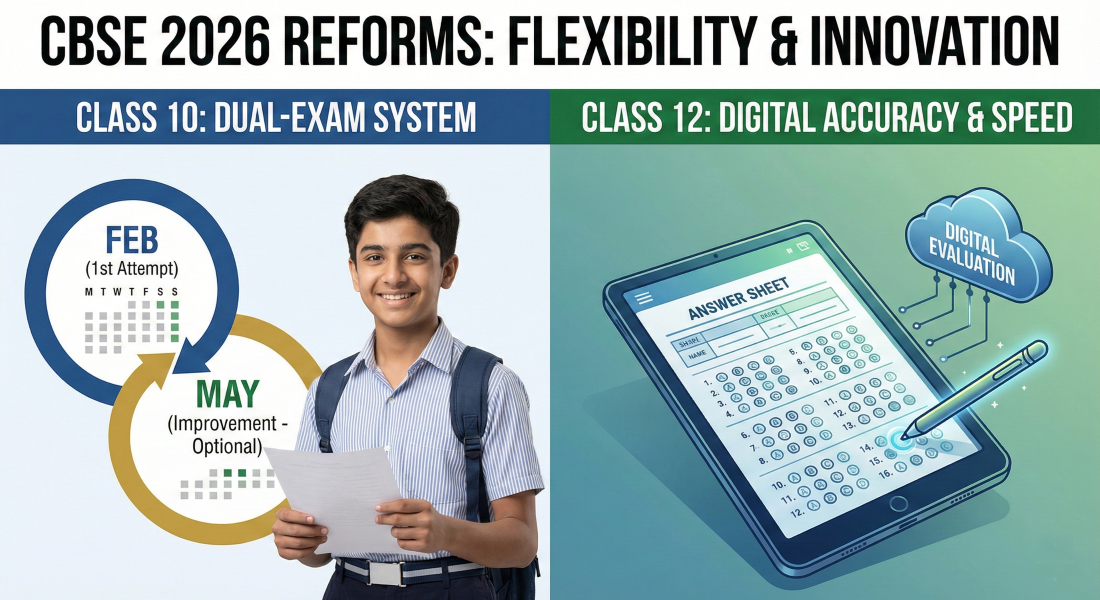
In a move to drastically reduce student anxiety, the CBSE has introduced a dual-CBSE board exam system for Class 10. For the first time, students have two opportunities within the same academic year to prove their mettle.
- The Mandatory First Attempt: The first CBSE board exam (currently underway) remains compulsory.
- The Optional May Session: Students who wish to improve their scores or who failed in up to two subjects (Compartment category) can appear for a second CBSE board exam scheduled for May 15 to June 1, 2026.
- Best of Two: If a student chooses to sit for both, the higher score between the two sessions will be reflected in their final marksheet.
- The Catch: This flexibility is not an excuse to skip the first round. Students who fail to appear for at least three subjects in the February session will be labelled as “Essential Repeaters” and must wait until 2027 to re-attempt.
The “Must-Carry” Checklist – CBSE Board Exams 2026
2. Class 12: Digital Evolution via On-Screen Marking (OSM)
While Class 10 follows traditional marking, Class 12 has leapt into the future with fully digital evaluation. This change affects nearly 18.6 lakh students and over 1 crore answer scripts.
- Zero-Error Ambition: Answer sheets are scanned and uploaded to a secure server. Teachers mark these scripts on-screen, and the software automatically totals the marks.
- No More Verification: Because the digital system eliminates manual totalling and posting errors, the CBSE has announced that post-result verification of marks will no longer be offered for Class 12.
- Faster Results: Digital evaluation reduces the marking window from 12 days to approximately 8–10 days, promising a significantly faster result declaration.
3. Structural Changes: Subjects & Competency
The “rote-learning” era is being phased out in favour of competency-based assessment.
- Analytical Focus: 50% of the question paper now consists of competency-focused questions, including case studies, source-based integrated questions, and application-driven MCQs.
- Specialized Marking: In Class 10 Science and Social Science, papers are now strictly divided into sections (e.g., Physics, Chemistry, Biology). Answers written in the wrong section will not be evaluated, ensuring that only subject-matter experts grade their respective portions for maximum accuracy.+1
4. The Discipline Mandate: 75% Attendance
The board has sent a clear message to “dummy candidates” and irregular students: attendance is non-negotiable.
- The Rule: A minimum of 75% attendance as of January 1 is mandatory for eligibility.
- Strict Monitoring: Schools were required to report shortages by early January, and the board has conducted surprise inspections to verify records. Only verified medical emergencies or national-level sports participation are accepted as valid grounds for an exemption.
Impact at a Glance
| Stakeholder | Key Change | Primary Benefit |
| Students | Two chances for Class 10; Best of two scores. | Lowered anxiety; focus on improvement. |
| Parents | No manual totaling errors for Class 12. | Greater trust in result accuracy. |
| Schools | Teachers evaluate from their own labs. | Reduced logistics; faster academic cycles. |
A Message for the Week Ahead
With the first major papers now active, students are reminded that the 10:00 AM gate closure rule is absolute. As the CBSE moves toward a more flexible system, the emphasis remains on consistent, year-long learning rather than last-minute cramming.
CBSE board exam,
Discover more from
Subscribe to get the latest posts sent to your email.