
Inside the TPG1000Cs: How China’s Invisible Microwave Weapon Threatens Starlink


The Silent War Above: How Nations Are Building Invisible Weapons (TPG1000Cs) and “Unkillable” Satellites
As the night sky brims with ever-growing constellations of satellites, a silent, unseen conflict is rapidly escalating in the vacuum of space. Forget the traditional image of explosive missile strikes; the battle for orbital dominance is now being waged with invisible beams of energy, designed to disable and degrade, rather than destroy. At the heart of this new arms race lies a chilling reality: nations are building weapons that can “fry” a satellite’s brain, and others are racing to make their space assets virtually “unkillable.”
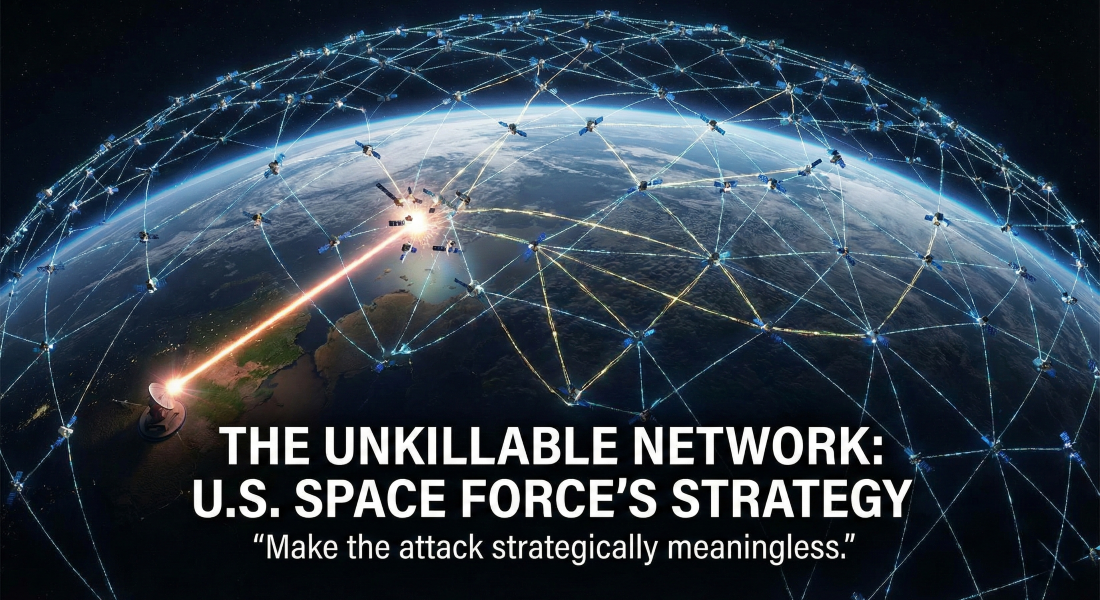
Recent revelations from China have unveiled a potent new player in this technological chess match: the TPG1000Cs. Developed at the Northwest Institute of Nuclear Technology (NINT) in Xi’an, this compact, high-power microwave (HPM) system is a game-changer. Capable of unleashing an astounding 20 gigawatts of power for nearly a minute, the TPG1000Cs represents a quantum leap in directed-energy weapons. Its small size – roughly four meters long and five tons – makes it deployable from a truck, a ship, or even a specialised satellite, positioning it as a versatile, silent assassin in the space domain.
The “Starlink Killer- TPG1000Cs” and the New Rules of Engagement
The primary target for such a weapon is clear: the burgeoning mega-constellations, such as SpaceX’s Starlink. With thousands of interconnected satellites, these networks are too numerous to be efficiently destroyed by conventional kinetic missiles, which also create dangerous orbital debris. The TPG1000Cs offers an insidious alternative: it aims to overload and disrupt a satellite’s sensitive electronics, rendering it useless without leaving a trace of an attack. This “soft-kill” approach introduces a terrifying layer of plausible deniability, making it difficult to attribute blame for a sudden satellite malfunction.
“We are entering an era where ‘attribution’ itself becomes a weapon,” notes a leading space security analyst. “If you can disable an adversary’s communication or navigation network without leaving a smoking crater, the geopolitical fallout is far more complex.”
America’s “Race to Resilience”: Proliferation, Hardening, and Manoeuvre
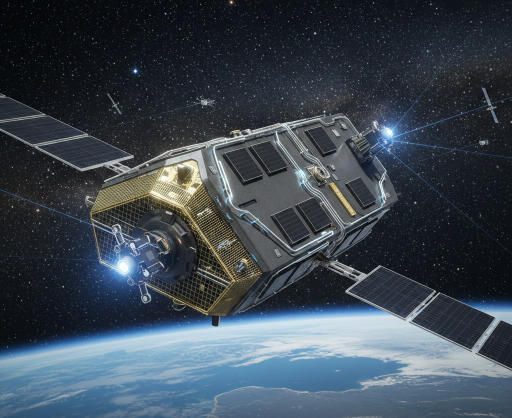
In response, the U.S. Space Force (USSF) and private industry, led by SpaceX, have launched a multi-pronged strategy: the “Race to Resilience.”
SpaceX, with its massive Starlink constellation, is leading the charge on proliferation. The sheer number of satellites acts as a distributed defence; taking out one, or even a dozen, is merely a ripple in a vast network that quickly reroutes data. Their Starshield military variant goes further, incorporating advanced electromagnetic interference (EMI) shielding and Faraday-cage-like enclosures to protect vital components. Crucially, SpaceX’s ability to push rapid software updates – demonstrated effectively against Russian jamming in Ukraine – allows for dynamic, real-time defences against evolving threats.
The USSF, meanwhile, is embracing Dynamic Space Operations (DSO). Future military satellites aren’t just orbiting rocks; they are active combatants, capable of manoeuvring out of the beam of an HPM weapon with electric or chemical propulsion. Projects like the “Silent Shield” Initiative, which uses experimental cubesats like the Deloitte-1 as live-fire testbeds, are pushing the boundaries of automated defensive systems that can detect an attack and “safe-mode” sensitive components almost instantly.
In a 2024 address at the Global Air & Space Chiefs Conference, General B. Chance Saltzman emphasised that the goal is to “deny the benefit” of an attack. He argues that if the U.S. has a “proliferated” constellation (like Starlink), an adversary would have to expend more effort and cost to disable it than the benefit they would gain, effectively making the attack “pointless.” General B. Chance Saltzman, Chief of Space Operations, on Improving Space Capabilities
The Unseen Battle for Space Dominance
Beyond proliferation and hardening, advanced technical defences are emerging:
- Surge Protectors: Micro-circuits that act like lightning rods, instantly disconnecting antennas when an energy spike is detected.
- Liquid Dielectrics: Advanced cooling systems that can absorb and dissipate sudden thermal energy from microwave attacks.
- Optical Inter-Satellite Links (OISL): Using lasers instead of radio waves for communication, eliminating the “front-door” entry point for HPM.
The strategic implications are profound. As the line blurs between commercial and military space assets, the international legal framework is struggling to keep pace. Does a microwave “glitch” constitute an “armed attack” in space, triggering a proportional military response? The answer is murky, adding another layer of complexity to an already volatile environment.
As nations continue to invest billions in these silent, invisible weapons and their equally advanced countermeasures, the war in space remains a battle fought in the shadows, with the very fabric of our interconnected world hanging in the balance. The images of gleaming, hardened satellites are a stark reminder of the sophisticated defence strategies now in play—strategies vital for securing the high ground of the 21st century.
TPG1000Cs, Starlink-killer, High-power microwave (HPM) weapon, Directed-energy warfare, Non-kinetic anti-satellite (ASAT), 20-gigawatt pulse
Discover more from
Subscribe to get the latest posts sent to your email.