

India’s New Cigarette Tax Shock: Why Every Extra Millimetre of Smoke Will Cost More from 2026


A Cigarette tax shock that redefines smoking economics
From 1 February 2026, buying a cigarette in India will no longer be just about brand preference or nicotine strength. It will be about length. Under changes introduced through the Central Excise (Amendment) framework alongside a reworked GST–sin tax architecture, India has formally embedded a stark principle into its tobacco policy: “the more you smoke, the more you pay.”
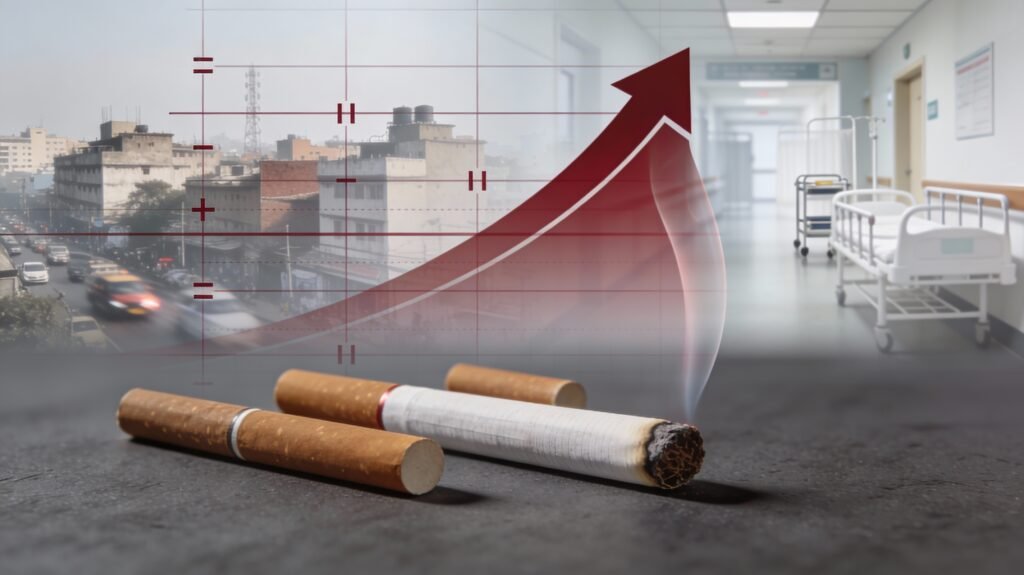
The new Cigarette tax system sharply increases taxes on longer, premium and king-size cigarettes, making them the most heavily taxed per stick in absolute terms. Short cigarettes, often perceived as cheaper or “less harmful,” are not spared either. They continue to face a high effective tax burden through a combination of GST—often close to 40%—and excise duties, ensuring that every additional millimetre of tobacco smoke now carries a visible price penalty.
For smokers, this translates into higher retail prices across the board. For policymakers, it signals a decisive shift: cigarette taxation is no longer only about revenue extraction, but also about engineering behaviour through price.
How India’s cigarette tax system has changed
The old structure: layered but blunt
Until recently, cigarettes in India were taxed through a complex mix of:
- 28% GST,
- a compensation cess,
- the National Calamity Contingent Duty (NCCD), and
- additional excise-style elements, often differentiated by length and filter type.
While this system did impose higher taxes on longer cigarettes, the price signals were often diluted by inflation, rising incomes, and aggressive pricing strategies by manufacturers.
The new Cigarette tax structure: length becomes destiny
From FY 2025–26, the new framework restructures this architecture:
- The Central Excise (Amendment) Act reshapes and partially replaces the cess component.
- Cigarettes are now taxed through explicit length-based excise slabs, with rates ranging approximately from ₹11,000 to ₹82,700 per 1,000 sticks, depending on:
- cigarette length,
- whether the cigarette is filtered, and
- It’s a premium classification.
- GST continues under a special high slab for sin goods, ensuring cigarettes remain among the most heavily taxed consumer products in the economy.
What this means in practice
Using current market estimates:
- Short, unfiltered cigarettes still carry a high tax share but remain the cheapest option per stick.
- Short, filtered cigarettes now see a steeper jump, narrowing the price gap with longer variants.
- Long and king-size cigarettes face the highest absolute tax per stick, sharply lifting retail prices and compressing manufacturer margins.
In effect, length has become a fiscal signal—a clear message that more smoke equals more tax.
Why governments use price as a public-health weapon
The logic behind this policy is grounded in decades of health research.
According to the World Health Organisation, tobacco use kills over 8 million people globally every year, including more than 1.2 million deaths from second-hand smoke (SHS)
In India, the burden is especially heavy:
- About 28–29% of adults use tobacco in some form, according to the Global Adult Tobacco Survey (GATS).
- Smoking and SHS together contribute to nearly 1 million deaths annually, driven largely by:
- cardiovascular disease,
- chronic obstructive pulmonary disease (COPD), and
- multiple cancers, particularly lung cancer.
Second-hand smoke: the invisible killer
Roughly one-third of non-smokers in India remain exposed to SHS at home, workplaces, or public places. Medical studies link SHS exposure—even in adolescents—to:
- asthma and reduced lung function,
- respiratory infections,
- heart disease and stroke, and
- increased cancer risk.
The WHO classifies second-hand smoke as a known human carcinogen, with no safe level of exposure.
Smoke-free on paper, smoky in reality
India’s legal framework appears strong. The Cigarettes and Other Tobacco Products Act (COTPA) bans smoking in public places, allows designated smoking rooms only in large establishments, and mandates smoke-free workplaces and public transport
Yet compliance remains weak.
Multiple urban surveys show that only about one in five locations that should have designated smoking rooms actually comply. Anecdotal and reported violations are routine:
- smoking in trains and station premises,
- near hospital entrances,
- inside markets, offices, and crowded streets.
The result is persistent SHS exposure—especially for non-smokers who have little choice in shared spaces.
“The more you smoke, the more you pay”: will it work?
Economists and public health experts broadly agree that price is one of the most effective tools for reducing tobacco consumption.
WHO studies show that a 10% increase in tobacco prices can reduce consumption by 4–6%, with stronger effects among youth and low-income users.
But behavioural responses matter
India’s length-based Cigarette tax design raises key questions:
- Will smokers down-trade from long cigarettes to shorter ones?
- Will some switch to bidis or smokeless tobacco, which remain cheaper and widely available?
- Will higher prices actually reduce total consumption, or merely shift patterns?
Youth initiation is a particular concern. Single-stick sales, though restricted, remain common in many markets, potentially blunting the deterrent effect unless enforcement improves.
Big tobacco, stock markets, and lobbying pressure
The financial markets responded swiftly to the Cigarette tax announcement. Major Indian tobacco stocks recorded sharp single-day declines, reflecting investor concerns over:
- margin compression,
- possible volume contraction, and
- pricing power limits in a highly taxed market.
Manufacturers have raised familiar arguments about illicit trade and smuggling, warning that excessive taxation could push consumers toward illegal cigarettes. This argument is frequently deployed by tobacco lobbies worldwide, even as independent studies show that strong enforcement, not low taxes, is the real determinant of illicit trade.
Globally, India’s move aligns with trends seen in countries using high excise Cigarette taxes, plain packaging, and strict smoke-free laws to reduce smoking prevalence.
Second-hand smoke and the rights of non-smokers
Beyond economics lies an ethical question: why should non-smokers pay with their health?
GATS data and recent Indian studies show that SHS exposure among non-smoking youth and adults remains substantial, particularly in rural areas and informal workplaces.
Cigarette taxation alone cannot solve this. Experts argue that meaningful protection requires:
- stricter COTPA enforcement,
- higher penalties for violations, and
- sustained public awareness campaigns.
Only then can taxation support a broader social norm shift toward smoke-free living.
Revenue versus public health: a policy crossroads
Despite recent hikes, experts note that Indian cigarettes remain relatively affordable when adjusted for income growth, compared with the WHO-recommended tax shares of retail price.
This raises a critical question: is the new system primarily about revenue, or health?
Some policy analysts have proposed ring-fencing part of tobacco tax revenue for:
- cancer treatment and palliative care,
- strengthening public health systems, and
- funding anti-tobacco education campaigns.
Such visible reinvestment could transform tobacco taxation from a fiscal tool into a health security instrument.
Can India breathe smoke-free in the next decade?
India’s new cigarette tax regime sends a powerful signal. By linking tax directly to cigarette length, the government has sharpened the price weapon against smoking.
Whether this delivers lasting health gains will depend on what follows: enforcement, education, and political will. The question is no longer whether smoking is costly—it clearly is. The question is whether India can finally ensure that non-smokers, especially children, are no longer forced to pay the price for others’ smoke.
India new cigarette tax 2026, length-based tobacco excise, cigarette prices to rise in India, second-hand smoke in India, tobacco health burden India, GST on cigarettes, COTPA enforcement, Cigarette tax
Discover more from
Subscribe to get the latest posts sent to your email.