
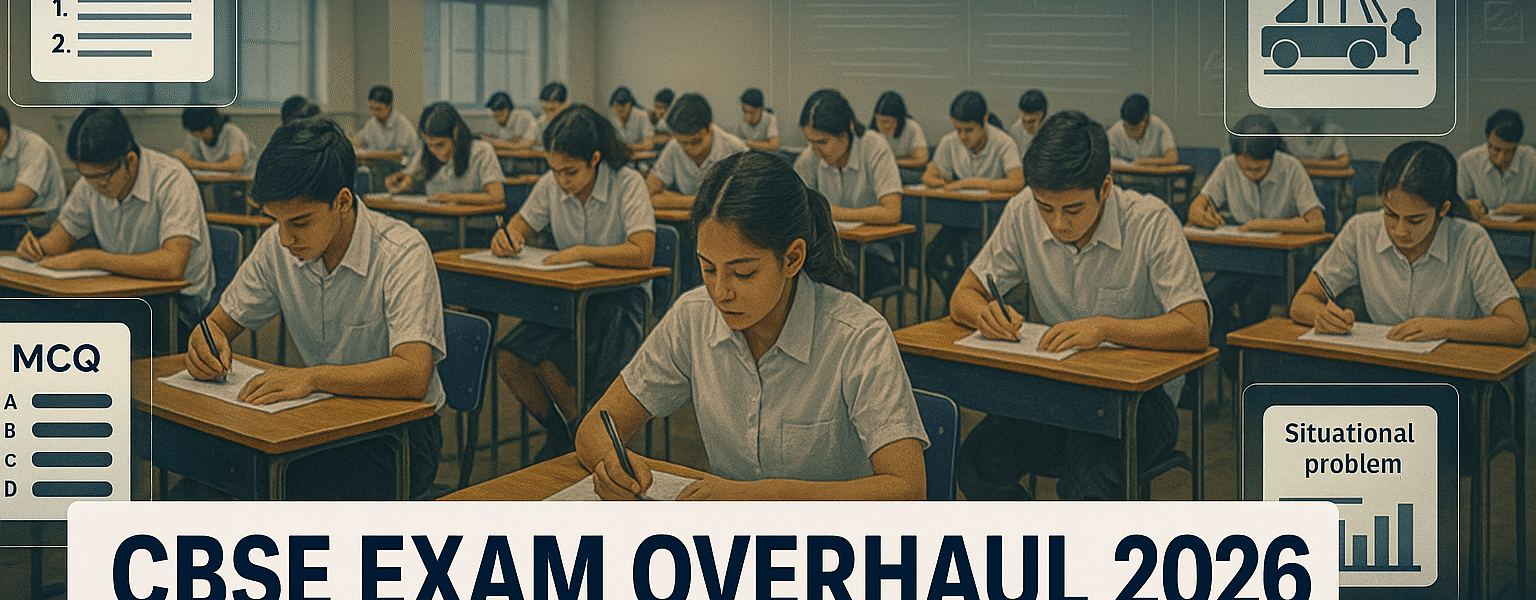


CBSE Announces Major Exam Overhaul for CBSE 2026 exam: Class 10 & 12 to Shift to Competency-Based Assessments; Class 10 to Get Two Board Exams Every Year
A landmark reform aligned with NEP 2020 aims to end rote learning and push real-world application, problem-solving and conceptual thinking
In a sweeping transformation of India’s school assessment system, the Central Board of Secondary Education (CBSE) has announced that Class 10 and Class 12 board exams will adopt a competency-based format from 2026, marking one of the biggest examination reforms in recent decades. Class 10 students will additionally receive the option to take two board exams annually, giving them more flexibility and reducing performance pressure.
The CBSE 2026 exam follows recommendations from the National Education Policy (NEP) 2020, which emphasises critical thinking, conceptual clarity, and reduction of high-stakes memorisation-based examinations.
**📌 What Will Change from 2026?
A Complete Breakdown of CBSE 2026 Exam’s New Assessment Structure**
1️⃣ 50% Competency-Based Questions — The Core of the New System
CBSE has confirmed that half of all questions in Class 10 and 12 exams will test competency, not recall.
These include:
- Case-based questions
- Source-based integrated questions
- Data interpretation and analysis
- Situational and real-life problem-based questions
- Multiple-choice questions (MCQs) using application triggers
🔎 What this means: Students will need to apply knowledge, not memorise chapters.
2️⃣ 20% Select-Response Questions (MCQs)
These will test foundational fact-based knowledge, but in a way that supports learning and clarity.
3️⃣ 30% Constructed-Response Questions (Short + Long Answer)
Long-form answers remain—but their weightage drops to ensure the paper is balanced and application-driven.
📌 Class 10 to Have Two Board Exams Annually from 2026
In line with NEP 2020’s proposal for flexibility and modularity:
- Class 10 students can sit for two board exams each academic year.
- The best score will be considered.
- Students will no longer experience extreme pressure tied to a “one-chance exam”.
CBSE officials have clarified that students are not required to take both attempts — one is enough, but two attempts offer opportunities for improvement without repeating a full year.
Why This Change Matters: The Bigger Picture
Education experts note that this shift will reshape classroom teaching and learning:
✔ Reduction in rote memorisation
✔ Emphasis on application and real-world reasoning
✔ Increased student confidence through exam flexibility
✔ Better alignment with global assessment frameworks
✔ Improved readiness for competitive exams & future careers
M. Jagadesh Kumar and other NEP-linked policymakers have consistently argued for a shift away from heavy syllabus-driven content toward competency, flexibility, and outcome-based learning.
What CBSE Has Officially Stated for CBSE 2026 exam
📘 1. CBSE Circular on Competency-Based Education (CBE) – December 2023
CBSE issued Circular No. Acad-100/2023, confirming increased competency-based question weightage starting from 2024 and further revisions planned for 2026.
📘 2. Official Confirmation of 2026 Assessment Pattern
CBSE’s Assessment Unit and NEP Implementation Report (2024) outline the final model for 2026, specifying the 50-20-30 structure.
📘 3. Two Board Exams per Year (NEP 2020 – Para 4.42 & 4.43)
The NEP clearly recommends flexible, modular board exams.
CBSE’s internal note (2024) confirms operational rollout by March 2026.
📘 4. National Curriculum Framework (NCF 2023)
NCF reiterates a shift away from rote learning and towards conceptual understanding and performance-based tasks.
Expert Reactions on CBSE 2026 exam
Education leaders have welcomed the reform:
“Many education analysts believe this reform could shift Indian schooling away from rote memorisation toward conceptual understanding and application.”
Education analysts and school-leaders say that two exam opportunities may significantly reduce mental stress for students and encourage continuous learning.
What Schools Must Do Now
- Start integrating competency-based questions in internal exams
- Train teachers on case-based and application-style instruction
- Update teaching plans to move away from chapter-wise rote teaching
- Encourage projects, problem-solving activities, and data analysis tasks
- Align pre-board exams with the new 50-20-30 structure
Conclusion
CBSE 2026 exam overhaul marks a historic evolution of India’s school examination system. By shifting the emphasis to skills, application, and multidimensional thinking, the Board is setting up millions of students for success in higher education, competitive exams, and future careers.
With two board exams for Class 10 and a more holistic question pattern, students are likely to face less pressure but greater academic depth — a powerful combination for India’s next generation of learners.
#CBSE2026 #CBSEUpdate #NEP2020 #CompetencyBasedEducation #CBSEBoardExam #EducationNews #Edupedia #SchoolUpdates #ConceptBasedLearning #CBSEReforms
CBSE 2026 exam pattern, CBSE competency-based questions, CBSE Class 10 two board exams, CBSE new assessment pattern, NEP 2020 exam reforms, CBSE 2026 curriculum, competency-based education CBSE, CBSE Class 12 board change, CBSE 2026 board exam news, CBSE update 2026, CBSE 2026 exam
Discover more from
Subscribe to get the latest posts sent to your email.








3 COMMENTS