

US Regime Change Operations and the American Coup Playbook
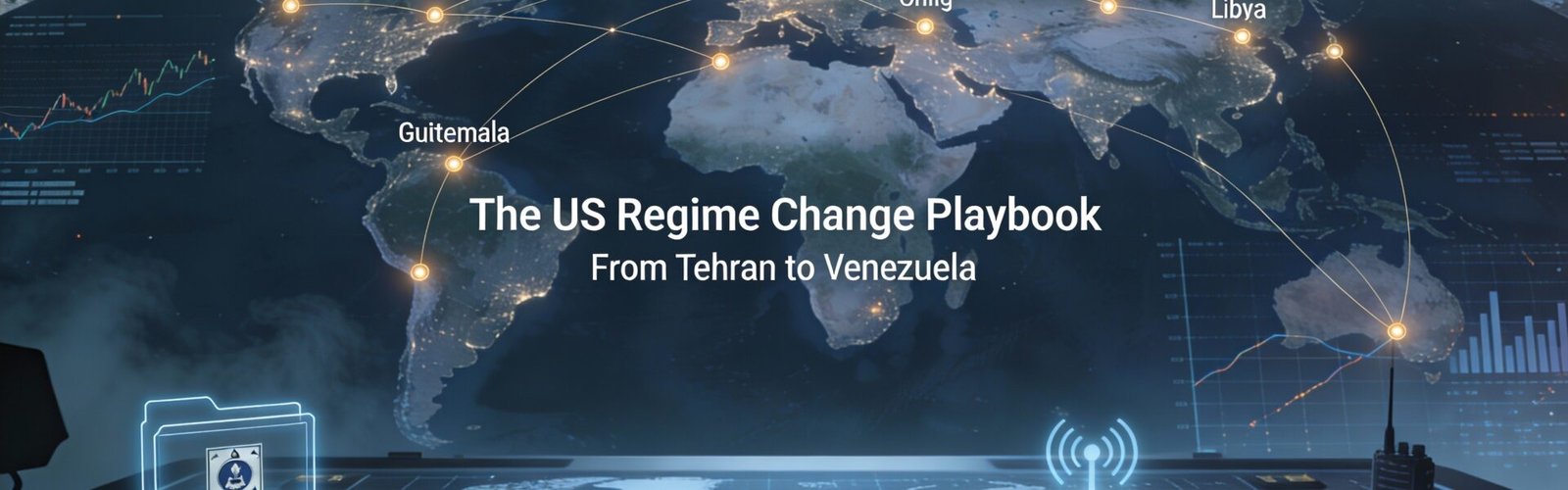
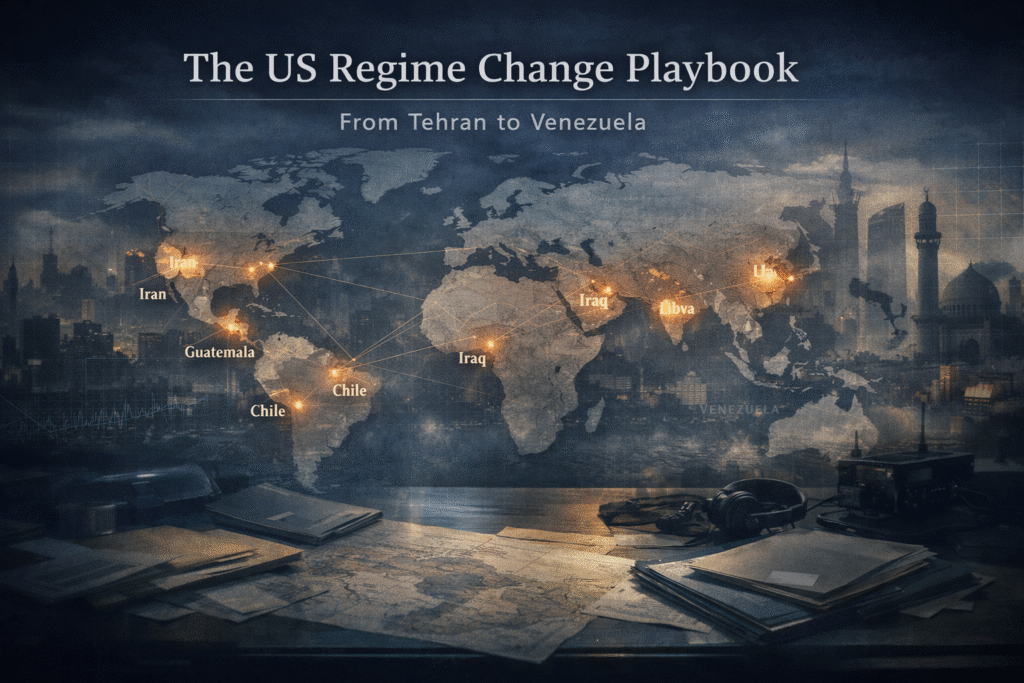
Over the past 70 years, the United States has developed a repeatable playbook for geopolitical US regime change — a mix of covert interventions, economic pressure, media framing, and military force — used to project power, secure economic advantage, and assert regional dominance. Far from isolated, the Venezuela regime change case echoes patterns from Tehran to Guatemala and beyond.
What Are US Regime Change Operations and Why They Matter
US regime change operations refer to deliberate efforts by American political, intelligence, and military institutions to remove or influence foreign governments — overtly or covertly — often to align those states with U.S. strategic and economic interests. These interventions matter because they have reshaped political orders, provoked long-term instability, and undercut global norms of sovereignty and democracy.
Origins of the Playbook: Iran and Guatemala
Iran, 1953: The First Cold War Coup
In 1953, the CIA orchestrated a coup against Iran’s democratically elected Prime Minister Mohammad Mossadegh after he nationalised British oil assets and sought greater control over Iranian resources. U.S. and British intelligence overthrew him and reinstalled the Shah, cementing Western-friendly rule.
Guatemala, 1954: Operation PBSUCCESS
A year later, the U.S. targeted Guatemala’s reformist President Jacobo Árbenz, whose land reforms threatened the United Fruit Company and U.S. interests. The CIA’s Operation PBSUCCESS used psychological warfare, economic pressure, and guerrilla forces to topple Árbenz. This became a benchmark case of covert intervention and financial leverage.
What this establishes:
- Covert planning and intelligence action
- Economic pressure and trade manipulation
- Supporting proxy forces to achieve political ends
Expansion Across the Global South
By the 1960s and 1970s, Washington applied the US regime change playbook across continents.
Cuba, 1961: Bay of Pigs and Covert Actions
The failed Bay of Pigs invasion epitomised early CIA efforts to topple Fidel Castro using exile forces, propaganda, and covert sabotage — underscoring how the U.S. sought to curtail leftist governments near its borders.
Southeast Asia and Proxy War
Vietnam became America’s longest foreign intervention, evolving from advisory roles into full-scale war aimed at containing communism — a strategic extension of US regime change logic via proxy forces.
Chile, 1973: Allende and Pinochet
After Salvador Allende’s democratic election, the CIA supported economic destabilisation and political agitation that culminated in a military coup, installing Augusto Pinochet’s dictatorship — a stark example of covert influence translating into overt regime change.
Central America and Beyond
U.S. operations in El Salvador, Nicaragua (Contra wars), the Congo, Indonesia, Brazil, Bolivia and elsewhere reflect a broad catalogue of Cold War–era interventions where Washington backed coups or rebel forces aligned with anti-communist objectives or U.S. economic interests.
Recurring tactics in expansion:
- Funding, arming, and training opposition forces
- Proxy wars and covert action
- Diplomatic isolation and economic sanctions
Economic and Monetary Logic Behind US Regime Change
US Regime change operations were often rationalised by ideological conflict (e.g., anti-communism), but economic and monetary interests were equally central:
- Protection of U.S. corporate interests, such as oil, mining, agriculture, and infrastructure
- Maintaining U.S. dollar dominance and control over economic institutions
- Ensuring unfettered access to strategic resources, especially oil and minerals
In Guatemala, for instance, fears over land reforms impinging on U.S. business mirrored broader concerns about markets and capital flows.
Sanctions — often described as tools of diplomacy — have been used to cripple target economies, as seen in Cuba, Iran, Iraq (post-1990s), and Venezuela, where economic pressure was designed to force political change.
The lesson: US Regime change rarely stems from ideological purity alone — economic and monetary imperatives often drive strategic choices.
Information, Media, and Narrative Control
Beyond guns and bombs, the U.S. has shaped narratives to justify intervention:
- Public diplomacy and propaganda to frame regimes as threats
- Media framing to build domestic support
- Think tank and NGO narratives that label U.S. actions as “democracy promotion”
- Psychological operations designed to sow dissent within target countries
The Bay of Pigs, for example, was accompanied by intense propaganda campaigns designed to delegitimise Castro long before kinetic action.
This manipulation of narrative sustains both public and international support for intervention, even when outcomes contradict proclaimed ideals of peace and democracy.
Venezuela as a Contemporary Case Study
In the post-Cold War era, the playbook has adapted but remained recognisable.
Sanctions and Diplomatic Pressure
For years, U.S. administrations imposed broad sanctions on Venezuela’s oil sector, financial system, and key individuals aimed at destabilising Nicolás Maduro’s government.
Recognition of Opposition
Washington’s early recognition of opposition figures like Juan Guaidó in 2019 was part of a diplomatic strategy to delegitimise Maduro’s government long before kinetic moves were on the table.
Covert and Overt Escalation
In 2025, then-President Donald Trump publicly confirmed authorising CIA covert operations in Venezuela — a significant escalation of the campaign against Maduro that critics likened to Cold War-style coups.
In January 2026, U.S. forces carried out airstrikes and captured President Maduro, then announced intentions to administer Venezuela and tap its oil reserves. This marked a dramatic, direct intervention unlike almost any in recent decades — and starkly reminiscent of earlier playbooks of force backed by broader strategic goals.
Why It Reflects Continuity
- Economic leverage via oil
- Diplomatic isolation and sanctions
- Covert CIA operations
- Military force as a last stage of escalation
The Venezuela case is not an exception but a continuation of a historical pattern.
Consequences and Blowback
Long-term consequences in target countries often include:
- Civil war and instability, as in Vietnam and Guatemala
- Authoritarian entrenchment, as seen in Chile and Indonesia
- Economic collapse and migration crises, as in Nicaragua and Venezuela
- Anti-American sentiment and backlash
Scholars argue these blowback effects frequently outweigh any short-term geopolitical gains. For instance, the U.S.-backed interventions in Latin America have left enduring distrust and deep social wounds that span generations.
On the U.S. side, such interventions can erode international credibility, spark retaliatory alignments with U.S. adversaries, and undermine claims of promoting democracy.
What This Reveals About Modern Geopolitics
The history of US interventions, from Tehran to Venezuela, shows global politics shaped less by altruistic ideals and more by strategic calculations:
- Power projection to shape geopolitical architecture
- Economic interests tied to resources and markets
- Security imperatives that justify preventive or corrective action
US Regime change operations, once buried in classified files and covert actions, are now in full view — revealing how global systems operate via a mix of covert influence, economic pressure, and military force.
Discover more from
Subscribe to get the latest posts sent to your email.