
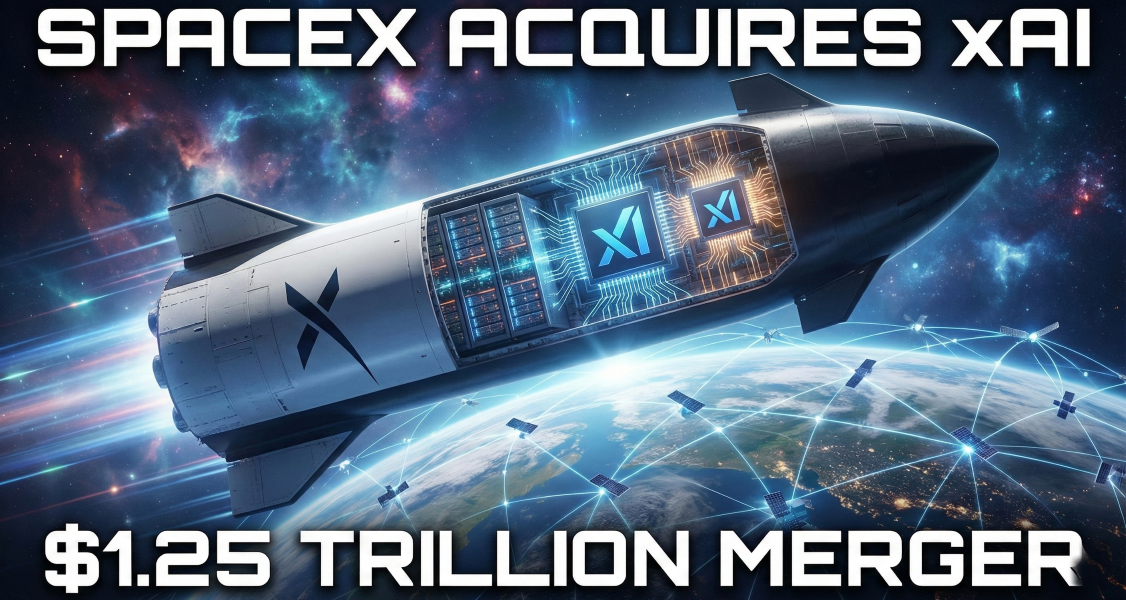


The Trillion-Dollar Liftoff: Musk’s “Orbital AI” SpaceX-xAI Merger Gamble Reshapes the Global Economy
In a move that has simultaneously electrified Wall Street and terrified regulators, Elon Musk has officially consolidated his private empire- SpaceX-xAI Merger. As of this week, SpaceX has acquired xAI—which itself absorbed the social platform X (formerly Twitter) last year—creating a vertically integrated colossus valued at $1.25 trillion.
To the stars!@SpaceX & @xAI are now one company https://t.co/2SPVVhZQsp
— Elon Musk (@elonmusk) February 3, 2026
The SpaceX-xAI Merger creates the largest private company in history, eclipsing the valuations of public giants like Meta and approaching the GDP of mid-sized nations. But while the press releases herald a sci-fi future of “Orbital Data Centres,” financial analysts see a more grounded motivation: a massive balance sheet restructuring designed to save cash-burning assets while preparing for the most anticipated IPO of the decade.
The “Kardashev” Pitch: Servers in the Sky
Musk’s public rationale for the SpaceX-xAI Merger is characteristically grandiose. In a blog post titled “Space is Called Space for a Reason,” the analyst argued that Earth’s power grids are nearing a breaking point due to the insatiable energy demands of Artificial Intelligence.
The solution? Orbital Data Centres.
While critics call it a financial bailout, Musk frames the merger as an engineering necessity. In a memo to employees this week, he reiterated a warning he first delivered at the 2024 Bosch Connected World conference: that Earth is running out of power. ‘Global electricity demand for AI simply cannot be met with terrestrial solutions,’ the statement read. The merged company’s new mission—building orbital data centres—aims to solve this by tapping into solar energy in the vacuum of space.
The SpaceX-xAI Merger entity plans to launch up to one million compute-heavy satellites via Starship. These orbiting server racks would run on infinite solar power and be cooled by the vacuum of space—eliminating the two highest costs of terrestrial AI: electricity and water.
The Financial Reality of SpaceX-xAI Merger: The “Backdoor Bailout”
Behind the futuristic gloss, the deal solves immediate, terrestrial problems.
SpaceX is a cash cow. According to leaked financials, the rocket company generated $15 billion in revenue and $8 billion in profit in 2025, driven by its monopoly on launch contracts and the Starlink internet constellation.
In contrast, xAI has been burning an estimated $1 billion a month to compete with Google and OpenAI, while X (the social platform) has struggled to regain its pre-acquisition ad revenue levels.
“This is classic Musk financial engineering,” says a senior analyst at TechCapital Partners. “He is using SpaceX’s massive profit margins to subsidise the capital-intensive AI war. By folding xAI into SpaceX, he eliminates the need to raise desperate funding rounds for xAI at lower valuations. It’s a bailout disguised as a synergy.”
The deal structure—an all-stock transaction—also dilutes existing SpaceX shareholders to pay for the acquisition. Several minority investors, including two UK-based investment trusts, have reportedly expressed fury at having their profitable rocket stakes diluted by a money-losing social media platform.
Regulatory Storm Clouds
The “Everything Company” is already facing headwinds.
- Antitrust: In Brussels, EU Competition Commissioner Margrethe Vestager has reportedly fast-tracked an inquiry. The fear is that a combined SpaceX-xAI-X could monopolise the entire AI supply chain: controlling the data (X), the model (Grok), the infrastructure (Orbital Compute), and the distribution network (Starlink).
- Space Debris: The proposal to launch “megatons” of server satellites has drawn sharp rebukes from astronomers and environmental groups. The risk of “Kessler Syndrome”—a cascading collision of space debris—is now a business liability.
The IPO Horizon
Despite the risks, the market is salivating. The SpaceX-xAI Merger is widely seen as the final grooming stage before a SpaceX IPO, rumoured for mid-2026.
By rebranding SpaceX from an “aerospace contractor” (typically valued at 2-3x revenue) to the “singular engine of human intelligence” (valued like a tech growth stock), Musk could command a share price that makes him not just the world’s richest man, but perhaps the first trillionaire.
For now, the industry watches Boca Chica. The Starship waiting on the pad isn’t just carrying fuel anymore; it’s carrying the financial weight of an entire empire.
Discover more from
Subscribe to get the latest posts sent to your email.








3 COMMENTS