
Rise of Adult Content in India: OnlyFans, OTT Platforms & the War on Culture


The Digital Red Tide: Rise of Vulgar and Semi-Pornographic Adult Content in India
How subscription platforms, social media funnels, and the podcast-to-paywalled-content pipeline are reshaping culture, corrupting youth, and challenging the nation’s regulatory imagination
India is in the middle of a silent cultural crisis — one that does not announce itself with the thunder of political upheaval or the visible devastation of natural calamity, but seeps in through the glowing rectangle in every pocket, every bedroom, every school corridor. Over the past five years, an avalanche of vulgar, erotic, and semi-pornographic adult content in India has colonised India’s digital landscape with breathtaking speed, exploiting the architecture of social media, the economics of the creator economy, and the near-total absence of enforceable age-gating mechanisms. What once required a furtive trip to a roadside stall now arrives — unsolicited, algorithmically recommended, relentlessly promoted — on the phones of children as young as ten.
This research study examines the full scope of this phenomenon: its structural drivers, its commercial architecture, the psychological and physical harm it inflicts on India’s young population, the government’s fitful attempts at containment, and — most critically — what a coherent, multi-stakeholder response must look like if India is to preserve the generational and civilisational fabric that distinguishes it from more permissive societies.
Section I · BackgroundThe Digital Explosion That Made It Possible
To understand the scale of to adult content in India, one must first understand the scale of India’s digital revolution. Between 2008 and 2024, registered mobile SIM cards more than tripled from 346 million to over a billion. Monthly data consumption per user grew from roughly 12 gigabytes in 2020 to 27 gigabytes by 2024. Jio’s 2016 disruption of the telecom market made India home to some of the cheapest mobile data in the world — and with cheap data came cheap, unfiltered access to everything the internet contains, including its most exploitative content.
India today has over 500 million internet users — the second-largest online population on earth. The Indian digital media market, valued at an estimated USD 33 billion by 2025, has grown at a compound annual growth rate of over 20%. This infrastructure of connectivity, built at extraordinary national investment and with genuine developmental intent, has simultaneously become a superhighway for adult content in India that civilised societies have historically sought to keep away from minors and to regulate for adults.
The COVID-19 pandemic was a galvanising inflection point. Lockdowns pushed hundreds of millions of Indians — including children — into an exclusively digital world for education, socialisation, and entertainment, often without parental supervision. Content creators who had previously cultivated modest followings on YouTube and Instagram suddenly found audiences of unprecedented scale. Among them was a cohort who quickly identified that the intersection of sexual curiosity, isolation-driven loneliness, and easy digital payments created a market opportunity of remarkable commercial potential.
Section II · The Architecture of the MarketFrom Free Reel to Paid Paywall: The Content Monetisation Funnel
The commercial model that has emerged around adult and semi-pornographic adult content in India is not random or accidental — it is a carefully engineered funnel that exploits algorithmic social media dynamics to convert free audiences into paying subscribers of explicitly sexual content. Understanding this funnel is essential to understanding the scale and nature of the problem.
Stage 1 — The Hook: Free, Algorithmically Optimised Content
A creator — typically a woman, often with prior exposure to modelling, regional cinema, or fashion — begins with free content on Instagram Reels, YouTube Shorts, or similar short-form platforms. The content starts with a veneer of respectability: lifestyle, fashion, comedy, fitness. Progressively, double-meaning jokes, seductive presentation, suggestive dialogue, and increasingly revealing visuals push the content toward the edge of platform guidelines without technically violating them. Algorithms, which prioritise engagement above all else, amplify this content at exactly the moment when it generates maximum interaction through comments, shares, and time-spent metrics.
A documented case: a Delhi-based influencer who began with food and snack reviews in 2022 had pivoted by 2023 to seductive Reels laden with double-meaning dialogue. By March 2024, she launched a subscription model on Instagram at ₹399 per month — and within weeks had accumulated over 8,000 subscribers, generating income exceeding ₹30 lakh from semi-nude poses and flirtatious storytelling alone.
Stage 2 — The Amplifier: The Podcast Circuit
The next stage of the funnel involves the podcast ecosystem — and it is here that the mechanism becomes most insidious and most effective. India’s podcast audience grew by over 34% year-on-year in 2024–25, with Hindi-language podcasts particularly dominant in Tier 2 and Tier 3 cities. Major podcast platforms have attracted millions of young, impressionable listeners who trust the intimate, conversational format inherently.
“The podcast becomes the legitimiser. It takes a figure who exists in the shadows of suggestive content and, in a single long-form conversation, transforms them into a ‘bold personality,’ a ‘trailblazer,’ a ‘woman who broke taboos.’ The mass audience is created before the paywall is raised.”
— News24Media Research AnalysisThe pattern is now well-established: a creator with a growing but still niche following appears on a major podcast — often framing the conversation around personal freedom, breaking societal taboos, or dismantling “regressive” attitudes toward sexuality. The podcast host, driven by viewership incentives, facilitates a narrative that generates controversy and therefore virality. The episode is clipped, shared across WhatsApp and Instagram, and reaches audiences far beyond the original podcast subscriber base. Within days, the creator’s social media following surges significantly — and the call-to-action that follows is a link to their premium, paid content platform.
Stage 3 — The Monetisation Platform
The final destination in this funnel is a pay-per-view or subscription platform that sits beyond the immediate reach of Indian content regulation. OnlyFans — the British subscription platform that processes creators receiving 80% of earnings from subscriptions, tips, and pay-per-view messages — occupies the dominant position in this space globally. By the close of 2024, the platform had approximately 377.5 million registered users globally and over 4.1 million creators. India has emerged as one of its fastest-growing markets, with the country appearing in the top five for monthly traffic volumes alongside Germany, Mexico, the United States, and the United Kingdom.
The Indian OnlyFans ecosystem is projected to become a billion-dollar industry within the next few years. While the platform ostensibly requires age verification for creators and blocks access through standard Indian ISPs, the barrier is trivially circumvented through VPN services — which, as this report documents, are used by an estimated 31% of Indian internet users and are entirely legal under Indian law.
Section III · The ParticipantsWho Is Joining the Wagon — And Why
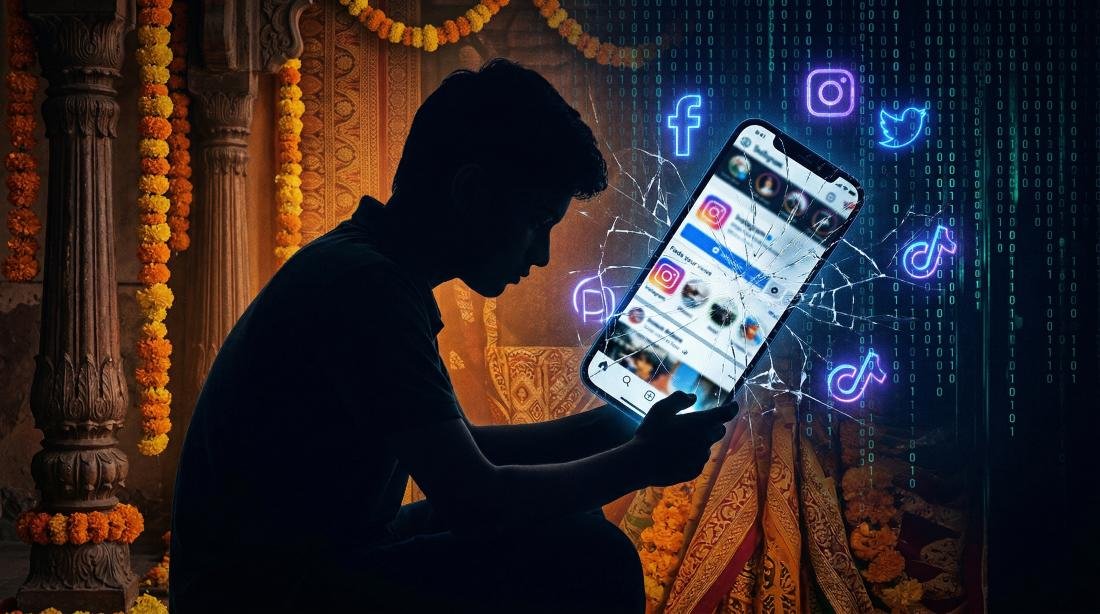
The popular framing of adult content creation as an empowerment choice made freely by self-determining women obscures the structural economic pressures, the absence of alternative pathways to comparable income, and the long-term consequences — personal, professional, and societal — that participants rarely understand at the point of entry.
Failed Aspirants from Entertainment and Modelling
India’s film and modelling industries — Bollywood, regional cinema, the fashion and advertisement ecosystem — are extraordinarily competitive, with hundreds of thousands of aspirants competing for positions that number in the dozens. For those who have invested years and savings in these aspirations but failed to break through, adult and semi-adult content creation on subscription platforms has become a well-worn escape route. Many of these individuals have an existing social media following, a familiarity with camera presence, and the physical attributes marketable in that space.
Critically, the income available is genuinely significant relative to alternatives. While most OnlyFans creators globally earn modest sums — an average of USD 150–180 per month — the top tier earns orders of magnitude more. The top 1% of creators globally capture nearly one-third of all platform revenue. For a creator with an existing Indian social media following of even 50,000–100,000 persons, the conversion economics to a paid subscriber base can deliver lakhs per month — far exceeding what modelling assignments or regional film roles would have generated.
Content, once created, is permanent. Screenshots, re-uploads, and leaks mean that material posted behind a paywall routinely surfaces on free pornographic aggregators globally, permanently and irreversibly. Creators who later wish to exit — to marry, to pursue mainstream employment, to raise children — carry a digital legacy they cannot erase. Mental health consequences including shame, anxiety, depression, and social withdrawal are extensively documented in research. The Indian legal framework, which criminalises the creation and distribution but not the private viewing of sexually explicit content, means creators bear maximum legal and social risk with minimal protection.
The Broader Creator Economy Entry Points
Beyond entertainment aspirants, the problem extends to ordinary young Indians for whom the creator economy broadly — legitimised by years of government and media promotion — has normalised the idea of monetising one’s personal presentation. When the algorithm rewards increasingly suggestive content with exponentially greater reach, the gradient from fashion influencer to semi-adult content creator is neither steep nor clearly demarcated. Many young women in particular enter this gradient without a clear destination or exit strategy, and find themselves past lines they did not consciously choose to cross.
Section IV · Social Media as Marketing MachineHow Platforms Become Involuntary Distribution Networks
Instagram, YouTube, X (formerly Twitter), Telegram, and WhatsApp — all theoretically subject to content guidelines — have become the principal marketing engines for adult content in India. The mechanisms through which they enable this are worth examining in detail.
Instagram’s Hybrid Model
Meta introduced Instagram Subscriptions in 2023, allowing creators to charge followers for exclusive content. While the platform prohibits full nudity and explicit sexual adult content in India, its enforcement of “suggestive content” in the intermediate zone is algorithmically inconsistent. A creator posting semi-nude imagery framed as “artistic” or “empowering” can sustain a profitable subscription operation within Instagram itself — while using the platform’s public-facing Reels to continuously recruit new subscribers from its 350+ million Indian user base. This has led researchers to describe Instagram as having effectively become India’s OnlyFans-adjacent platform, with the free tier as advertising and the subscription tier as the paid product.
Telegram: The Unregulated Corridor
Telegram channels and groups operate with essentially no content moderation for private or unlisted channels. The platform has become the primary distribution mechanism for content that exceeds even OnlyFans’s own guidelines — including non-consensual intimate images and content featuring minors. Paid Telegram channels, operating with subscription prices in the range of ₹200–₹2,000 per month, serve millions of Indian subscribers. These channels are unregistered, untaxed, operated anonymously, and effectively beyond the reach of Indian regulatory enforcement.
X (Twitter) and the Referral Pipeline
Research on OnlyFans traffic sources consistently identifies X as the dominant social media referral platform — a reflection of X’s historically permissive approach to adult content. Adult content in India creators routinely use X accounts to post explicit previews and link directly to their paid platforms. X’s Blue subscription, which removes algorithmic suppression, has made this strategy even more effective. Indian creators exploit X’s India-accessible status (unlike OnlyFans, which requires a VPN for Indian users) to build mass audiences before funnelling them to offshore paid platforms.
WhatsApp: The Invisible Distributor
WhatsApp’s end-to-end encryption makes it effectively invisible to regulatory oversight. Adult content in India — including explicitly pornographic videos — circulates in WhatsApp groups at extraordinary volume. Forward chains ensure that a single video can reach millions of devices within hours. The platform’s ubiquity across age groups, including in households where children access parents’ devices, means that content created for adult audiences reliably reaches children at scale.
| Platform | Role in Funnel | Enforcement Effectiveness | Indian User Reach |
|---|---|---|---|
| Top-of-funnel recruitment + in-platform subscriptions | Inconsistent; suggestive content widely accessible | 350M+ users | |
| YouTube / Shorts | Long-form legitimisation; initial audience building | Better on explicit content; poor on suggestive | 450M+ users |
| Telegram | Paid explicit content channels; direct distribution | Near zero for private channels | 200M+ users |
| X (Twitter) | Preview content; direct link to paid platforms | Permissive; minimal enforcement | 25M+ users |
| Viral distribution; horizontal spread to minors | Zero (end-to-end encrypted) | 500M+ users | |
| OnlyFans | Final paywall destination; explicit content | ISP-blocked; trivially bypassed via VPN | Growing rapidly |
| Indian OTT (Ullu, ALTT etc.) | Soft-porn streaming with subscription | Two major crackdowns: March 2024, July 2025 | Tens of millions |
Table 1: Platform roles in the Indian adult content ecosystem. News24Media Research compilation, April 2026.
Section V · Psychological and Physical ImpactWhat This Is Doing to India’s Youth — The Evidence
The harm caused by early, frequent, and unregulated exposure to pornographic and semi-pornographic content is not a matter of moral opinion — it is a matter of documented, peer-reviewed science. Research from India and global institutions converges on a body of evidence that should alarm anyone who cares about the developmental outcomes of the generation now growing up inside this environment.
The Neurological Architecture of Pornography Addiction
The brain’s dopamine reward system — evolved to reinforce survival-critical behaviours including eating and reproduction — responds to pornographic content in a manner functionally identical to the way it responds to addictive substances. Repeated stimulation creates neurological tolerance: the same content no longer generates the same reward, and the brain requires escalating novelty and explicitness to achieve the same dopamine response. Research published by Fight the New Drug and supported by neuroscientific peer review demonstrates that the brain activity of a pornography addict in the presence of triggering content is neurologically indistinguishable from that of a drug addict in the presence of their substance of choice.
For adolescents, whose prefrontal cortices — the brain region governing impulse control, consequence assessment, and decision-making — are not fully developed until age 25, this dynamic is particularly dangerous. The average age of first exposure to pornographic adult content in India is now documented at approximately 12 years: an age at which the brain is maximally vulnerable to addictive rewiring.
“Increased exposure to pornography leads to low motivation, poor decision-making skills, impaired impulse control, and insensitivity to sexual rewards. It also harms adolescent social interaction and distorts the formation of intimate relationship expectations.”
— Study cited by the Utah State Board of Education; consistent with findings of Indian Journal of Psychological Medicine, 2024–2025Clinical Research in the Indian Context
A landmark cross-sectional study published in the Indian Journal of Psychological Medicine in 2025 examined 589 individuals who had sought treatment for compulsive sexual behaviour in which problematic pornography use was the primary complaint. The study was conducted between January and June 2024 across online and offline psychiatric and sexual health service platforms in India. Of the 589 participants, 583 were male and the vast majority fell in the 18–35 age bracket — confirming that this is emphatically a young population. The study was approved by institutional ethics committees and follows ICD-11 diagnostic criteria, giving it strong clinical credibility.
A separate study published in BJPsych Open in June 2025 — drawing on observational data from India — examined the relationship between demographic factors, socio-cultural norms, and addiction patterns, finding that co-morbid conditions including anxiety, depression, and relationship dysfunction were substantially elevated in the pornography-addicted population. The study also highlighted that India’s sociocultural environment of shame around sexuality dramatically reduces help-seeking, meaning the clinical cohort represents only a fraction of those experiencing harm.
Psychological Harm: The Documented Consequences
The psychological harm of habitual exposure — especially at young ages — includes the following, all documented in peer-reviewed research in the Indian and international context:
- Distorted sexual attitudes and expectations: Young people who consume pornography regularly develop unrealistic, performance-based, and often degrading expectations of sexual relationships. They internalise scripts that normalise aggression, objectification, and non-consent.
- Anxiety and depression: Shame cycles triggered by compulsive pornography use — in a society where discussion of sexuality remains taboo — create conditions of sustained psychological distress, often undiagnosed and untreated.
- Social isolation and attachment disorders: Pornography provides a simulation of intimacy that requires no reciprocity, vulnerability, or social skill. Regular consumption reduces motivation to build real relationships, creating profound loneliness masked by synthetic stimulation.
- Academic and occupational impairment: Research documents poor concentration, reduced motivation, poor decision-making, and impaired impulse control as direct effects of chronic pornography use.
- Desensitisation to sexual violence: Repeated exposure to content depicting coercive or aggressive sexual behaviour normalises these dynamics, reducing empathy for victims and potentially increasing the probability of perpetration.
- Body image disorders: Both male and female consumers develop distorted body image standards derived from the unrealistic physical presentation of pornography actors.
- Relationship and marital breakdown: Research in the community survey conducted in Bengaluru identified verbal abuse with spouses and family members, cancelled social commitments, and inability to maintain occupational responsibilities as direct consequences of pornography addiction.
The Link to Sexual Violence
A scoping review published in the SAGE journal Trauma, Violence, and Abuse examined the relationship between pornography addiction and sexual violence against women in India. India simultaneously ranks third globally in pornography consumption and fourth in the highest reported rape rates — approximately 93 women raped daily, according to NCRB data. While the scoping review found the direct causal link difficult to establish with statistical confidence across the studies surveyed (partly because of data quality issues), a meaningful subset of studies did identify a correlation between increased internet user density — and by extension increased pornography access — and elevated rates of sexual crime against women. The dehumanisation that pornography facilitates in its consumers’ perception of women is a variable that cannot be responsibly excluded from any serious analysis of sexual violence in India.
Research from the International Journal of Indian Psychology (2025) confirmed a statistically significant positive correlation between peer pressure and cybersexual activities among Indian youth, with 234 young respondents studied using the Peer Pressure Scale and Internet Sex Screening Test. The study found that the social dimension of pornography consumption — sharing in groups, participating in WhatsApp chains, and responding to peer expectation — functions as a powerful normalisation mechanism that makes individual resistance uniquely difficult.
The Civilisational Stakes: What Is Being Lost
India’s cultural framework — rooted in millennia of philosophical tradition, familial ethics, and the concept of dharmic restraint — has always held sexuality within a context of relationship, responsibility, and purposefulness. Classical Indian thought, from the Vedic to the Bhakti traditions, does not treat sexuality as something shameful, but neither does it treat it as a commodity to be marketed, consumed in isolation, or divorced from the relational and spiritual contexts that give it meaning. The wholesale commercialisation of the human body, packaged as “empowerment” and delivered through subscription models to anonymous consumers, represents a fundamental rupture from this framework.
What is at stake is not merely the moral sensibility of individual viewers — it is the architecture of the institutions through which Indian civilisation reproduces itself: marriage, family, intergenerational trust, the dignity of women and men in public life, and the capacity of young people to form authentic intimate relationships. When a generation’s primary education about human sexuality comes not from parents, teachers, or cultural tradition but from content designed to maximise dopamine response and commercial subscription revenue, the consequences for those institutions are profound and long-lasting.
“When a generation’s first and most vivid lessons about intimacy come from a platform optimised to maximise subscriber retention rather than human flourishing, something irreplaceable has been surrendered — and its loss will be felt not in statistics but in the silent dissolution of the bonds that hold families and communities together.”
— News24Media EditorialThe particular risk for India lies in the rapidity of the exposure and the absence of countervailing education. In Western societies, the public debate about the harms of pornography has been running for two decades — and even there, the outcomes are alarming. In India, an entire generation has been exposed to the endpoint of a pipeline that took the West twenty years to build, compressed into five years, without the institutional sex education infrastructure, the mental health resources, or the cultural frameworks to absorb or contextualise it.
Section VII · The Government ResponseIndia’s Regulatory Effort: Measures Taken and Their Limits
The Indian government has not been passive in the face of this challenge. A sequence of significant regulatory actions has unfolded since 2023, demonstrating genuine institutional will — but also exposing the fundamental limitations of censorship as the primary instrument of a policy response.
The Legal Architecture
India’s existing legal framework governing pornographic and obscene adult content in India draws on multiple statutes, which together constitute a comprehensive prohibition on the creation, transmission, and distribution — though not private consumption — of sexually explicit material. The key legislative provisions include:
| Legal Provision | Coverage | Penalty |
|---|---|---|
| IT Act §67 & §67A | Publishing / transmitting obscene / sexually explicit material electronically | Up to 5 years’ imprisonment |
| BNS §294 | Obscene acts and songs in public view (Bharatiya Nyaya Sanhita, 2023) | Criminal prosecution |
| IPC §292 (now BNS equivalent) | Sale / distribution / import of obscene material | Up to 2 years (first offence) |
| Indecent Women §4 | Indecent Representation of Women (Prohibition) Act, 1986 — publication / distribution | Up to 2 years |
| IT Act §67B | Child Sexual Abuse Material (CSAM) — creation, dissemination, viewing | Up to 7 years; treated as serious crime |
| IT Rules 2021 | Digital intermediary due diligence; content removal obligations on platforms | Loss of safe harbour under §79(3)(b) |
Table 2: Key legal provisions governing adult content in India. Compiled by News24Media Research Desk.
The OTT Crackdowns of 2024 and 2025
In March 2024, the Ministry of Information and Broadcasting took its most significant enforcement action to date, blocking 18 OTT platforms — including MoodX, Prime Play, Hunters, Besharams, Rabbit Movies, Voovi, Nueflik, and X Prime — for streaming obscene, vulgar, and in some instances explicitly pornographic adult content in India. The action disabled 19 websites, 10 mobile apps across the Google Play Store and Apple App Store, and 57 associated social media accounts.
In July 2025, a second, larger crackdown followed. A ministry blocking order dated July 23, 2025 — issued in consultation with multiple government departments and civil society stakeholders — targeted 25 OTT platforms and associated properties. Among those banned were ALTT, Ullu, Big Shots App, Desiflix, Boomex, NeonX VIP, Gulab App, Bull App, Hitprime, Feneo, ShowX, and MoodX. The platforms had received formal warnings in September 2024 and, in the case of Ullu, a specific instruction in May 2025 to remove the programme “House Arrest.” The Ministry found that these platforms contained — in its own words — “graphic sexual innuendos, long sequences of nudity, and pornographic visuals” with “hardly any storyline, theme, or message in a social context.”
The Supreme Court of India has also engaged with the issue. In April 2025, the apex court heard a petition specifically seeking a ban on sexually explicit adult content in India on OTT and social media platforms. While declining to treat the matter as within its own domain, the court issued notices to the Union Government, OTT platforms, and social media platforms — and directed executive action, stating that regulation of OTT content is “a necessity.”
- August 2023: Government assures it will bring rules against vulgar and obscene content on social media and OTT platforms.
- March 2024: MIB blocks 18 OTT platforms; disables 57 social media accounts and 19 websites. First major enforcement action.
- September 2024: Formal warnings issued to a further set of non-compliant OTT platforms including Ullu and ALTT.
- April 2025: Supreme Court hears petition on OTT/social media explicit content; issues notice to Centre and platforms.
- May 2025: Ullu directed to remove “House Arrest” programme.
- July 2025: Second major crackdown — 25 OTT platforms banned including Ullu and ALTT; 40 social media accounts suspended; 26 streaming websites closed.
The Fundamental Bypass Problem
Every act of blocking has been followed by an act of bypass. Platforms blocked by the government resumed operations through new domain names and offshore-hosted servers. International platforms such as OnlyFans have never been meaningfully blocked — access requires only a VPN, and VPN adoption in India has grown by approximately 43% since 2022. An estimated 31% of Indian internet users now employ VPN services at least occasionally.
VPNs are fully legal in India. While the government’s CERT-IN directive requires VPN providers to maintain user logs, the major international VPN providers have largely exited Indian server infrastructure rather than comply — which means their services remain fully available and their logs are stored offshore, beyond Indian legal reach. A user seeking to access blocked adult content in India faces an obstacle no more substantial than a two-minute Google search and a free VPN download.
The government’s blocking regime has been described by analysts as a “censorship paradox”: the controversy generated by each ban dramatically increases public awareness of the blocked content, and the ease of bypass ensures that determined users encounter only minutes of friction. In some cases, the bans have effectively served as publicity for the platforms targeted.
When India banned OnlyFans-adjacent content or major adult sites, search traffic for those platforms consistently spiked — a documented phenomenon in internet censorship research globally. The Streisand Effect — in which attempts to suppress information amplify its reach — operates with particular force in the context of adult content, where curiosity and the desire for the forbidden are precisely what drives consumption. Censorship, when applied as the sole instrument, is not merely insufficient — it may be counterproductive.
Beyond Censorship: A Comprehensive Intervention Framework
Censorship is a necessary but wholly insufficient response to a problem whose roots are structural, educational, and psychological. India requires a multi-stakeholder framework that addresses the supply side, the demand side, the protective environment for minors, the capacity of families and communities to engage with the issue, and the long-term cultural commitment to a different vision of sexuality and intimate life. The following recommendations emerge from the research:
India must follow the UK’s Online Safety Act model and implement mandatory, technically robust age verification for all adult content platforms accessible from Indian IP addresses. This requires legislative amendment and technical cooperation with major ISPs and device manufacturers, including age verification at the device or account level.
NCERT and state curriculum bodies must introduce structured, culturally appropriate, evidence-based sex education at the upper-primary and secondary levels — addressing healthy relationships, consent, the harms of pornography, and digital safety. In its absence, pornography fills the educational vacuum by default.
India’s IT Rules must be strengthened to require algorithmic audits of recommendation systems on major social media platforms. Platforms whose algorithms demonstrably amplify sexually suggestive content to minors should lose safe harbour protection. Fines must be scaled to global revenue to have deterrent effect.
NIMHANS and state mental health authorities should develop specific clinical protocols for pornography addiction in adolescents and young adults. School counsellors should be trained and mandated to address this issue. Helplines and online support resources in regional languages are urgently required.
Large-scale, NGO-led and government-supported campaigns equipping parents with the knowledge, vocabulary, and tools to discuss digital safety and pornography harms with their children. The silence of families on this issue is a direct accelerant of the problem.
India should pursue bilateral and multilateral agreements with the jurisdictions in which platforms like OnlyFans are registered — particularly the UK — to impose minimum age verification, creator verification, and content takedown obligations that apply globally when Indian users are involved.
A national coalition of NGOs — including those working in child protection, women’s rights, mental health, and education — should be formally structured and funded to coordinate public awareness, research, legal advocacy, and support services around the harms of adult content exposure in India.
Schools and families must actively cultivate a values framework — drawing on India’s rich philosophical and cultural heritage — that articulates a positive, dignified, and relational vision of sexuality and intimate life, providing young people with an alternative conceptual framework to the one pornography offers.
The evidence is unambiguous: the current trajectory — escalating content, widening exposure, deepening addiction, declining relational capacity — leads to outcomes that will cost India far more than the discomfort involved in confronting the problem directly. The question is not whether to act, but whether the response will be comprehensive enough to match the scale and sophistication of what India is facing.
Editorial Conclusion: A Crisis That Demands Honesty
India is navigating a genuine civilisational stress test. The digital revolution that has delivered extraordinary economic and social opportunity to hundreds of millions has simultaneously created a delivery mechanism for content that — in its explicit, commercially motivated, algorithmically amplified form — poses documented, serious harm to young minds and bodies and to the institutions that hold Indian society together.
Censorship alone will not solve this. The more platforms are blocked, the more VPN providers profit. The more individual creators are prosecuted, the more the narrative of persecution empowers them. What India needs is a generation that understands — from their families, their schools, and their communities — what healthy intimacy looks like, what the harms of pornography are, and what the digital content industry’s actual motivations are. It needs platforms held to standards that put children’s safety above engagement metrics. It needs parents equipped and willing to have difficult conversations. And it needs a government prepared to invest in the long, slow, unglamorous work of building the protective infrastructure that makes these conversations possible at national scale.
The fabric of Indian culture is not helpless before this challenge. But it is being tested — and the test requires more than a ban and a press release.
Discover more from
Subscribe to get the latest posts sent to your email.