
Luxury Brands Discounting: How the Global Luxury Market Is Shifting From Price Power to Survival Mode


When Luxury Brands Start Going on Sale: Inside the Global Discounting Shift Shaking High-End Fashion
In the hushed salons of Paris’s Avenue Montaigne, Milan’s Via Monte Napoleone, Dubai Mall, Shanghai’s IFC and New York’s Fifth Avenue, something unusual is happening. Not the theatrical kind of disruption—no red SALE banners, no shouting discounts—but a quieter, more consequential shift. Private client emails offering 20–30% off. Invitation-only “seasonal edits.” Online platforms quietly reducing prices on handbags and ready-to-wear that, just two years ago, seemed immune to markdowns.
For an industry built on scarcity, price discipline and the idea that luxury should never chase demand, the spread of discounting—even discreetly—marks a decisive break from the post-pandemic boom years. Those were the years when price itself became the product, when iconic bags doubled in cost, and waiting lists lengthened as if to prove a point: in luxury, higher prices meant higher status.
Today, that logic is being put to the test.
What the global Luxury Brands market is now grappling with is a strategic pivot—from a “price-as-status” model toward something far more pragmatic: sale-and-volume survival in a cooling world economy.
The Post-COVID Price Boom—and the Consumer Pushback
From 2020 to 2023, Luxury Brands houses executed one of the most aggressive price-increase cycles in modern fashion history.
- Chanel’s classic flap bag rose by roughly 90% compared to 2019.
- Louis Vuitton’s Speedy 30 nearly doubled in price.
- Prada’s Galleria bag climbed 100%+ over five years.
These were not isolated decisions but part of a coordinated “elevation strategy” across the industry. Inspired by Veblen-good economics—where higher prices can increase desirability—Luxury Brands leaned into the idea that exclusivity could be engineered through cost alone.
Consultants encouraged this approach. Pricing, they argued, was not just about covering inflation or input costs; it was a branding lever. If luxury consumers kept buying, prices could keep rising.
For a while, it worked.
Flush with savings, stimulus money and post-lockdown “revenge spending,” consumers—especially aspirational buyers—absorbed increases that would once have seemed unthinkable. But by late 2023, cracks appeared.
Shoppers began questioning value. Social media filled with side-by-side comparisons of older and newer bags. Complaints about declining craftsmanship, lighter hardware, and offshored production grew louder. The resale market, once a prestige-enhancing ecosystem, is increasingly exposed to price gaps between retail and secondary values.
The unspoken question became unavoidable: Were Luxury Brands still worth the price?
The Slowdown: Cooling Sales and Margin Pressure
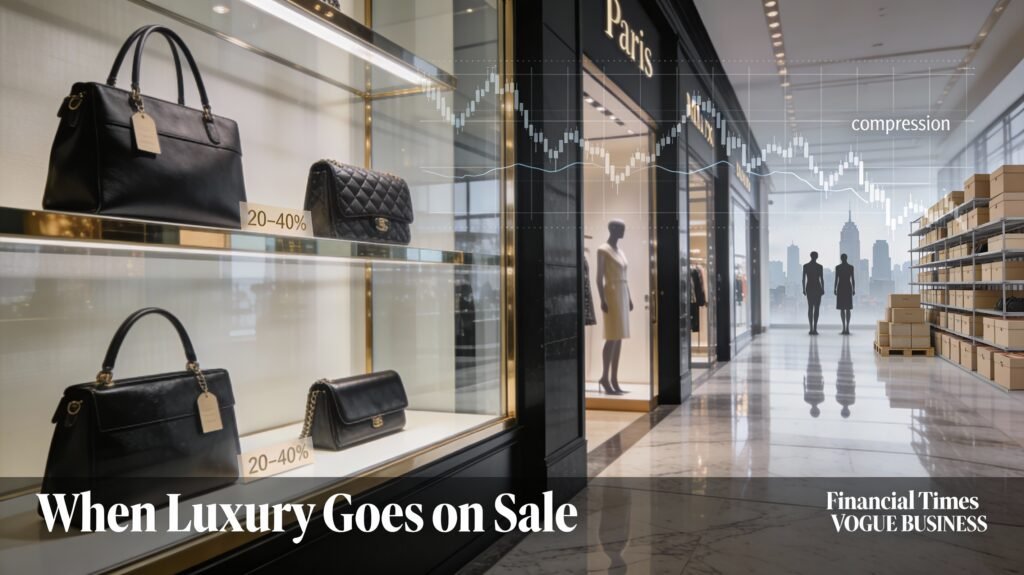
By 2024, the industry’s momentum had decisively slowed.
Global personal Luxury Brands’ goods sales, which surged in the immediate post-COVID years, are now expected to decline 2–5% in 2025, settling around €358–365 billion. Forward growth forecasts have been cut to just 1–3% annually through 2027, a far cry from the exuberance of 2021–22.
According to Bain and McKinsey, the Luxury Brands sector has effectively lost around 50 million customers globally—primarily aspirational consumers who were priced out or fatigued by relentless increases.
Regionally, the pressure is acute:
- China’s domestic Luxury Brands sales are projected to fall by around 20%, hit by property stress, youth unemployment and weaker consumer confidence.
- The US and Europe are seeing affluent shoppers grow more cautious, delaying big-ticket purchases and trading down.
Financial results reflect the strain.
At LVMH, fashion and leather goods revenues slipped into low-to-mid-teens declines in early 2025, with group net profit down more than 20%.
Kering reported a 16% revenue drop in H1 2025, while Gucci’s operating margin fell from roughly 25% to around 16%—a dramatic compression by luxury standards.
Across the sector, margins that once sat comfortably in the high-teens or low-20s are now sliding toward the low-teens. For many brands, the arithmetic no longer supports endless price hikes without sacrificing volume.
The Rise of “Quiet” Discounting
Faced with bloated inventories and slower sell-through, Luxury Brands have turned to a tool long considered taboo: discounting—albeit discreetly.
Rather than overt sales, the industry is deploying “quiet promotions”:
- Private client markdowns
- Expanded outlet assortments
- Limited-time online price adjustments
- Softer wholesale pricing in department stores
- Increased reliance on secondary and off-price platforms to clear stock
In the US, European outlet villages and Middle Eastern malls, Luxury Brands shoppers now encounter deals that would have been rare just a few years ago—especially on logo-heavy lines that overshot on pricing.
Major groups such as Richemont, Capri Holdings, and Tapestry are navigating a delicate balance: clearing inventory without openly undermining Luxury Brands’ equity.
At the same time, some houses are reducing wholesale exposure altogether, acknowledging that deep markdowns in department stores have diluted prestige faster than anticipated.
Luxury Brands-Level Recalibration
Several Luxury Brands have publicly signalled a change in tone.
- Gucci has spoken of “price recalibration” and refocusing on design and desirability rather than constant elevation.
- Burberry is repositioning toward clearer entry points after years of ambitious upmarket pricing.
- Labels like Michael Kors and Mulberry are rethinking their relationship with outlets and promotions to rebuild trust with consumers.
In China, some houses—including Balenciaga, Versace and Valentino—have scaled back aggressive promotions on platforms like Tmall, recognising that constant discounts erode long-term desirability.
Regional Fault Lines in the Discounting Trend
The shift toward promotions is not uniform.
China remains the epicentre of stress. Weak domestic demand has pushed some brands into aggressive markdowns, often via cross-border grey-market channels. Yet the backlash has been swift, with leading houses now attempting to restore discipline.
In the US and Europe, the end of “revenge spending” has forced brands to rely more on loyalty offers and seasonal promotions. High-income consumers still buy—but with more scrutiny and fewer impulse splurges.
The Middle East and Japan remain relative bright spots, but even here, shoppers are less tolerant of rapid price hikes unless paired with clear craftsmanship, heritage or design innovation.
Who Is Still Holding the Line?
Amid the turbulence, one name stands apart: Hermès.
Hermès continues to post double-digit revenue growth, robust margins and minimal discounting. Its formula—tight supply control, artisanal production and near-mythical brand mystique—has insulated it from the industry’s volatility.
Similarly, ultra-high-end jewellery and hard luxury remain resilient. Houses such as Cartier, Van Cleef & Arpels, and Bulgari retain pricing power, benefiting from rarity, emotional value and long replacement cycles.
The contrast reveals a widening structural divide: true luxury versus brands stretched thin by years of over-ambitious pricing.
A Crisis—or a Reckoning?
The deeper question now confronting the industry is existential.
If discounts become normalised, the symbolic power of the logo weakens. For aspirational buyers—who fuelled much of the post-COVID boom—the realisation that a coveted item might soon be discounted changes behaviour permanently.
Analysts warn that excessive promotions risk pushing luxury into the same trap that ensnared premium fashion: chasing short-term volume at the cost of long-term desirability.
The likely outcome is a bifurcation:
- True luxury, defined by scarcity, craftsmanship and disciplined pricing.
- A broad tier of “mass luxury”, increasingly dependent on outlets, entry-level products and promotions to sustain growth.
The New Economics of Status
Luxury is not dying. But its economics are being rewritten.
The era when brands could endlessly raise prices and rely on demand to follow is over. In its place is a more complex, fragile equation—one where value, trust and restraint matter as much as aspiration.
For investors, executives and consumers alike, the quiet sales unfolding behind velvet ropes are not just tactical moves. They are signals of an industry adjusting to reality.
When luxury starts going on sale, it tells you something fundamental has changed.
Do Blue Light Blocking Glasses Really Work? Science Questions a Booming Digital-Age Health Claim
luxury brands discounting, luxury market slowdown, luxury discounting trend, luxury brands price cuts, global luxury market, luxury sales decline 2025, LVMH Kering Gucci slowdown, aspirational luxury consumers, luxury pricing strategy, luxury outlets promotions,
Discover more from
Subscribe to get the latest posts sent to your email.