
The Great Emptying: Inside the Radical 2026 Race to Save the Human Workforce


As we move through the first month of 2026, the world is waking up to a stark new reality: the “population bomb” has not exploded; it is imploding. For the first time in modern history, the global engine of growth—people—is beginning to stall. From the “ghost apartments” of Tokyo to the silent maternity wards of Seoul and the shifting borders of Europe, the demographic map is being redrawn with permanent consequences.
The Epicentre: East Asia’s “Silent Spring”
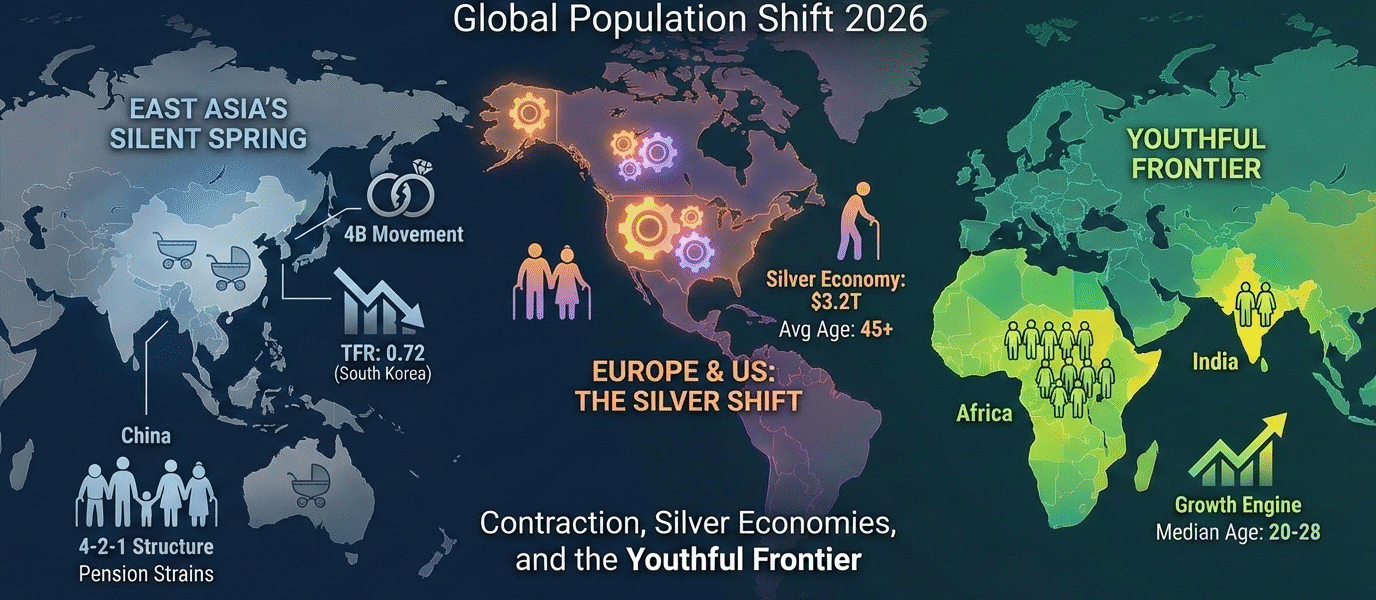
South Korea remains the world’s demographic “canary in the coal mine.” Despite government predictions that the Total Fertility Rate (TFR) might recover to 0.9 in 2026, the ground reality is a landscape of “N-po” (total giving up). The radical 4B Movement—a boycott of marriage and childbirth—has moved from the fringes to a mainstream social stance for young women who view traditional family life as a “bad deal.”
In China, the crisis has evolved from a social concern to a state emergency. Following a record-low 7.92 million births in 2025, the government has officially implemented raised retirement ages—pushing men to work until 63 and women until 58—to prevent the state pension fund from collapsing. The “996” work culture (9 am to 9 pm, 6 days a week) has given rise to a generation of “Lying Flat” (Tang Ping) youth who simply refuse to participate in the hyper-competitive cycle of raising a child.
The American Surprise: A Negative Turning Point
Perhaps the most eye-opening shift of 2026 is occurring in the United States. Traditionally a “demographic fortress” due to its ability to attract talent, recent reports from the Brookings Institution indicate that net migration to the US turned negative in late 2025 for the first time in half a century.
This rare demographic “double-whammy”—low birth rates combined with a sudden drop in new arrivals—has sent shockwaves through the labour market. Economists estimate that “breakeven employment growth” (the number of jobs needed to keep unemployment steady) could dip into negative territory this year, signalling a potential permanent labour shortage in the world’s largest economy.
The $3.2 Trillion “Silver Economy”
Where people are vanishing, capital is following. In 2026, the global Silver Economy—goods and services tailored to those over 60—is valued at a staggering $3.2 trillion.
- Healthcare REITs: Investors are deserting traditional tech startups in favour of Healthcare Real Estate Investment Trusts (REITs) and longevity research.
- The “Decumulation” Phase: Large insurers like Swiss Re have pivoted their entire business model. Instead of “Accumulation” (helping young people save), the industry is now obsessed with “Decumulation”—managing the vast wealth of the 65+ demographic as they draw down their life savings.
Technology: The Artificial Womb and the Robot Nurse
With no babies in sight, the race is on to “build” new humans or their substitutes.
- Ectogenesis (Biobags): In Philadelphia and Eindhoven, “womb-like life support systems” are entering human clinical trials. While full “conception-to-birth” artificial wombs remain decades away, the ability to gestate extremely premature babies in synthetic “Biobags” is no longer science fiction.
- The Carebot Boom: Japan is already deploying its third generation of social robots. These aren’t just industrial arms; they are empathetic agents like Paro and Pepper, designed to fill the “longevity gap” left by a missing generation of nurses.
The Geopolitical Pivot: The Rise of the Young
The 2026 geopolitical map is increasingly split between the “Ageing Superpowers” (China, Russia, EU) and the “Youthful Frontier” (India, Nigeria, Indonesia).
- India’s Dividend: With a median age of 28, India is currently the world’s most populous and fastest-growing major economy, acting as the “global office” while others shrink.
- African Growth: Sub-Saharan Africa is projected to be the only region with significant population growth by 2050, potentially replacing China as the “World’s Factory.”
Conclusion: A World Relearning to Exist
The decline of the global population is the defining challenge of the 21st century. It is not just about fewer people; it is about a total rethink of how societies function, how wealth is distributed, and what it means to be a “successful” nation in an era of contraction.
Demographic crisis 2026, Global population decline, Silver Economy trends, 4B movement South Korea, Artificial womb technology 2026, Ectogenesis ethics, China labor shortage, Carebots Japan, Youthful frontier Africa, Replacement migration Europe,
Recent Posts
- Greenland Crisis 2026: How Trump’s ‘Golden Dome’ Sparked a Global Geopolitical Showdown
- The Persian Paradox: Why Iran and the US are Trapped in a 2026 Standoff
Discover more from
Subscribe to get the latest posts sent to your email.