
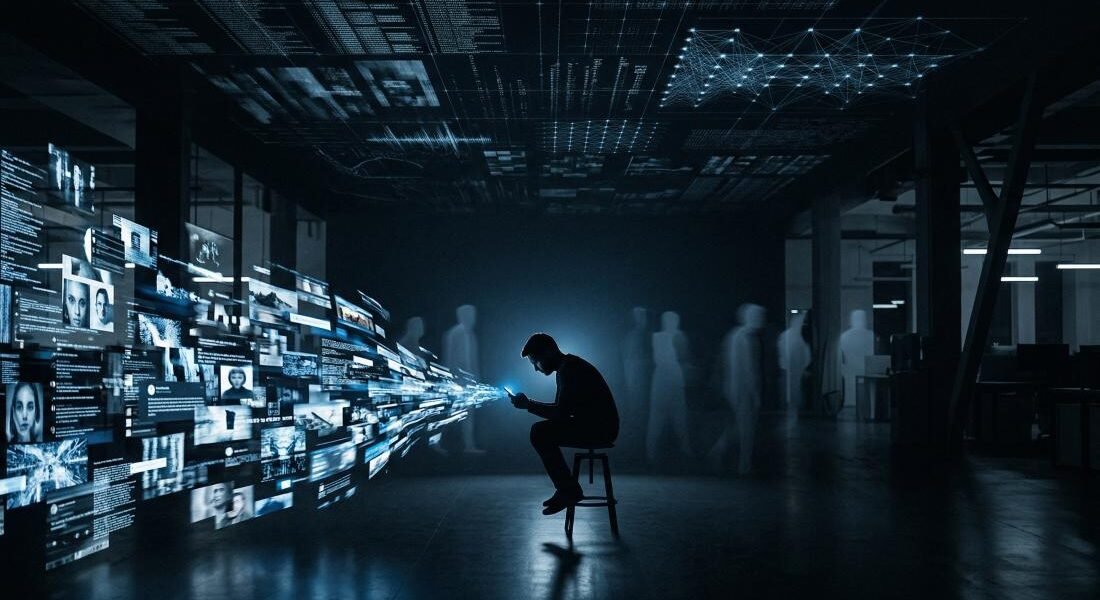


Is Social Media Dead? The Question Everyone Is Asking — and the Answer Nobody Wants
Five billion people are still on it. Engagement is collapsing. AI has flooded the feed. And the most important conversations have quietly moved somewhere you cannot see. The truth is more unsettling than a simple yes or no.
Let us be clear about one thing from the start: social media is not dead. With 5.66 billion users worldwide — outnumbering non-users nearly two to one — anyone filing its obituary is writing fiction. Facebook carries over three billion monthly active users. TikTok commands an average of 55 minutes of daily attention per person. The platforms are not shutting down. The advertisers have not left. The scroll continues, relentlessly, around the clock.
And yet — something has profoundly, measurably, irreversibly changed. Something that goes far beyond algorithm tweaks or platform rivalries. The question “Is social media dead?” has erupted across newsrooms, psychiatric journals, marketing conferences, and ordinary conversations not because the platforms are disappearing, but because what made them social — the human connection, the peer conversation, the genuine community — has been quietly gutted and replaced with something far colder.
The data is not subtle. Buffer’s 2026 analysis of over 52 million posts found that Instagram’s median engagement rate fell 26% in a single year. Posts on Facebook and X now reach an average engagement rate of just 0.15%. Threads dropped 18% in its second year. Non-Premium X users recorded effectively zero median engagement in the final months of 2025. These are not the metrics of a healthy, living social ecosystem. These are the metrics of a feed that users scroll but no longer inhabit.
“Recent analyses suggest that users increasingly “skim” algorithmic feeds rather than engage in meaningful conversation, indicating a shift from social interaction to passive consumption..”
— Noema Magazine Analysis, Sep 2025
The most revealing data point, however, came from an unlikely source: Meta’s own CEO. During US antitrust hearings in 2025, Mark Zuckerberg presented charts showing that content from your actual friends on Facebook had fallen from 22% of your feed in 2023 to just 17% in 2025. On Instagram, it dropped from 11% to 7%. Think carefully about what that means. Over 93% of what you now see on Instagram is not from anyone you chose to follow — it is content algorithmically served from creators, brands, news pages, and strangers. We still call these “social networks.” The word social is doing a great deal of heavy lifting.
Source: Meta antitrust hearings, 2025
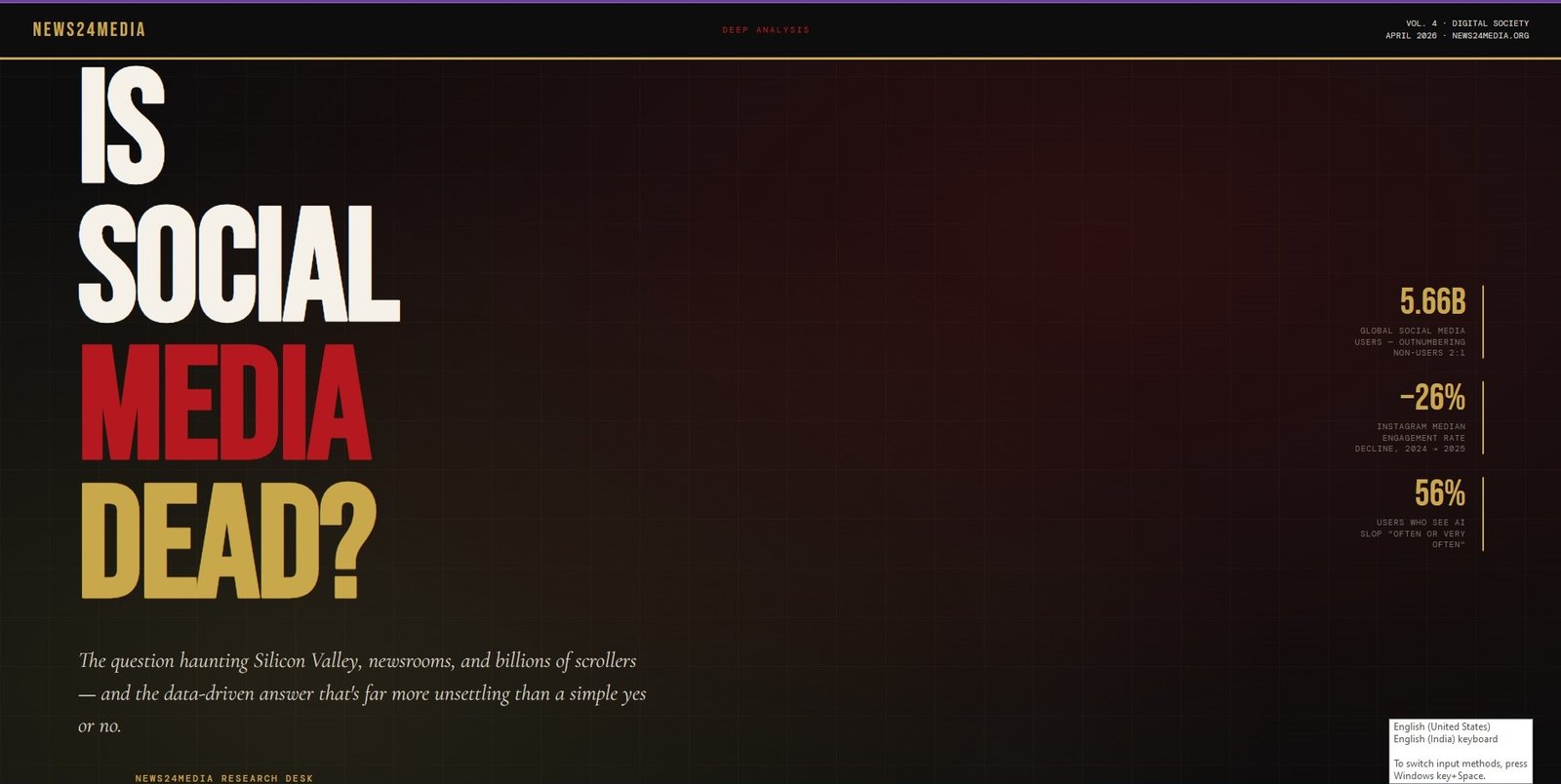
Then came artificial intelligence — and with it, a crisis the platforms were entirely unprepared for. The term “AI slop” — low-quality, algorithmically generated content produced at scale and dumped into feeds for engagement farming — has become the defining phrase of 2025-2026 digital culture. Sprout Social’s Q1 2026 Pulse Survey found that 56% of users now encounter AI slop “often or very often,” with 83% seeing it at least sometimes. Usage of the term itself increased ninefold in 2025 alone.
In 2025, AI-generated articles surpassed human-written content online for the first time in history. That is not a milestone. It is a warning. Feeds that were once populated by human voices — imperfect, authentic, worth disagreeing with — are increasingly populated by synthetic content optimised purely for algorithmic engagement, with no author, no accountability, and no truth obligation. Half of Americans cut back their social media use in 2025 specifically because of this. Many are not coming back.
But here is what most commentary has missed entirely: the social impulse has not died. It has gone underground. While public feeds deteriorate, a massive and largely invisible migration is underway — from open, algorithm-governed platforms to private WhatsApp groups, Discord servers, Telegram channels, Substack communities, and invite-only forums. Industry research now estimates that 95% of all content sharing happens through these dark social channels, invisible to conventional analytics. The conversations that matter most — product recommendations, political discussions, professional advice, genuine friendship — are no longer happening on the public feed. They never really were, not anymore.
Simultaneously, social platforms themselves are mutating into something entirely new. Nearly one in three consumers now bypasses Google and begins product research directly on TikTok, Instagram, or YouTube. For Gen Z, that figure exceeds 50%. Instagram is functionally a search engine. YouTube is a research library. TikTok is a discovery engine. These are not social media platforms in any meaningful historical sense — they are the new internet infrastructure, dressed in the familiar clothing of “social.”
So what is actually dying? The social media of memory. The version built in 2005 to 2015, in which ordinary people posted their lives, followed people they knew, had genuine conversations in comment sections, and built real communities across geographic boundaries. That version has been systematically replaced — by algorithmic broadcast, by creator-economy professionalism, by AI-generated content at industrial scale, and by advertising machinery so pervasive it has colonised the very grammar of online communication.
What is being born — in private groups, paid newsletters, closed communities, and niche forums — is something older and far more human: people gathering in trusted, curated spaces where conversation remains possible. This is not the notion “Is social media dead”. It is the slow, necessary death of its corporate-controlled imitation — and the quiet, unglamorous, deeply hopeful rebirth of what it was always meant to be.
The platforms will survive. The question is whether we will reclaim them — or simply build something better in the spaces they can no longer see. ◆
Discover more from
Subscribe to get the latest posts sent to your email.






1 COMMENTS