
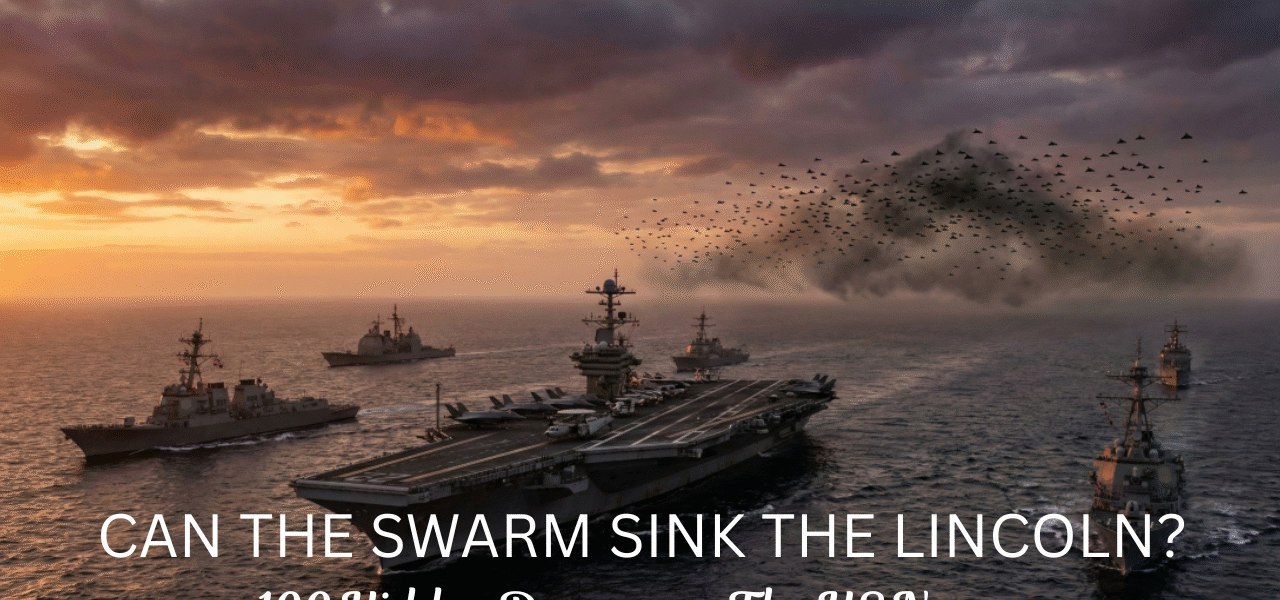
100 Hidden Iran drone swarm: Can ‘Kamikaze’ Swarm Blind the USS Abraham Lincoln?


The $20,000 Killer: Can Iran drone swarm ‘Hidden’ Paralyse the USS Abraham Lincoln?
In the volatile waters of the Middle East, the definition of naval power is shifting. For decades, the metric of dominance was tonnage—massive aircraft carriers and steel-hulled destroyers. But a new, silent threat has emerged from the Iranian coast, one that challenges the supremacy of the USS Abraham Lincoln with a chillingly simple equation: saturation.
This is the threat of the “100 Hidden Iran drone swarm”—a tactical evolution that pits disposable, low-tech kamikaze swarms against the world’s most advanced and expensive naval shield.
The Threat: Unmasking the ‘Hidden’ Fleet
The “hidden” nature of this threat is twofold. First, Iran has moved its airpower underground and to sea. The Islamic Revolutionary Guard Corps (IRGC) has unveiled “Drone Carrier” vessels like the Shahid Bagheri—converted merchant ships that can blend into commercial traffic before unleashing a barrage of 50 to 60 drones from disguised ski-jump decks.
Second, the weapon itself—the Shahed-136 (and its variants)—is a ghost. Built from composite materials and powered by a lawnmower-style engine, it has a radar cross-section so small that older radar systems often mistake it for a large bird. With a range of over 2,500 kilometres, these Iran drone swarm can target the USS Abraham Lincoln long before the carrier is close enough to launch its own strikes.
The Strategy: The Asymmetry of Cost
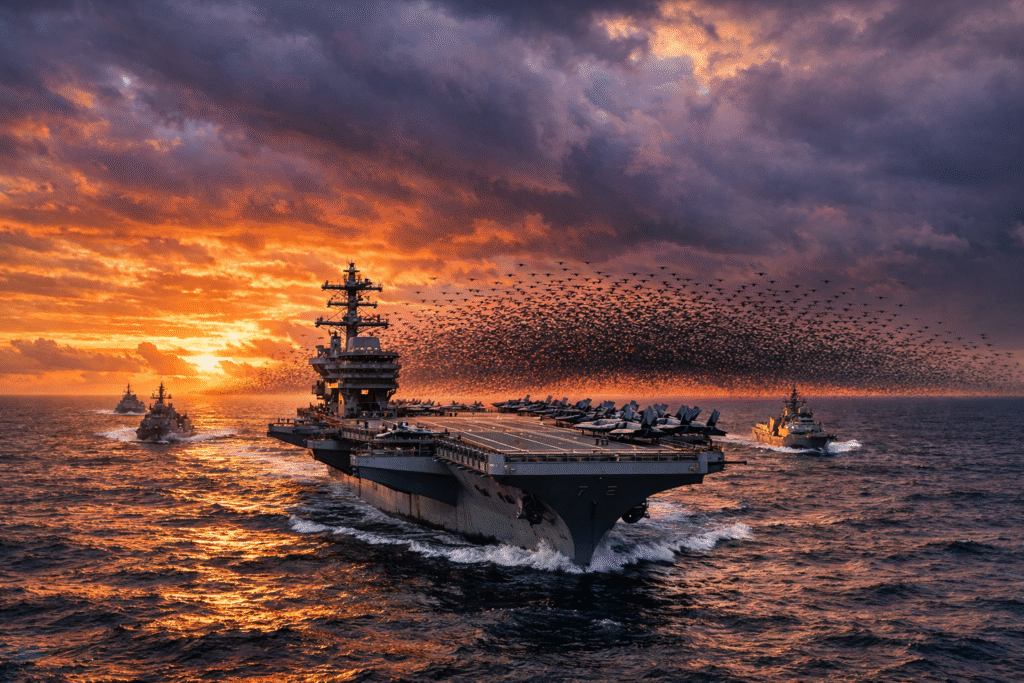
The most dangerous aspect of this confrontation is not the technology, but the economics.
“It is a battle of wallets as much as weapons,” says a defence analyst. A single Shahed drone costs roughly $20,000 to $50,000 to produce. In stark contrast, the primary interceptor missile used by the US Navy, the SM-6, costs upwards of $4 million.
This creates a tactical trap known as “magazine depletion.” If Iran launches a swarm of 100 drones, and the US Navy uses traditional missiles to intercept them, the fleet could burn through hundreds of millions of dollars in ammunition in minutes. More critically, once the destroyers’ vertical launch cells are empty, the fleet is left vulnerable to Iran’s real heavy hitters: anti-ship ballistic missiles.
The US Defence: Steel vs. Plastic
How does the USS Abraham Lincoln—a 100,000-ton fortress—defend against this Iran drone swarm? The answer lies in a layered defence, moving from “Soft Kills” to “Hard Kills.”
- The Invisible Wall (Electronic Warfare): Before a single shot is fired, EA-18G “Growler” jets would flood the airwaves with jamming signals. By severing the drones’ GPS links, the US hopes to confuse the swarm, causing them to drift aimlessly into the sea.
- The Kinetic Shield: For drones that leak through the jamming, the fleet’s Arleigh Burke-class destroyers would engage. However, to avoid wasting expensive missiles, the Navy is rapidly pivoting to Directed Energy Weapons (lasers) like the ODIN system, designed to blind or burn drone sensors for pennies per shot.
- The Last Resort: In a worst-case scenario, F-35C fighters would engage in “Beast Mode,” using external missiles and even jet wash—flying at supersonic speeds to use their wake turbulence to flip the lightweight drones into the ocean.
The Verdict: Mission Kill vs. Sinking
Could a Iran drone swarm sink a supercarrier? Highly unlikely. The USS Abraham Lincoln is a compartmentalised floating city designed to survive torpedo hits.
However, Iran doesn’t need to sink the ship to win. They only need a “Mission Kill.” If a handful of drones impact the flight deck, destroy the catapults, or wreck the radar tower, the carrier becomes unable to launch aircraft. A multi-billion-dollar asset is rendered useless by a plastic drone costing less than a luxury car.
As tensions simmer, the Persian Gulf has become a testing ground for the future of warfare: a high-stakes chess match between the overwhelming, sophisticated might of the US Navy and the cheap, swarming persistence of Iran’s drone fleet.
iran drone swarm vs uss abraham lincoln, Kamikaze,#iranprotest2026
Discover more from
Subscribe to get the latest posts sent to your email.








1 COMMENTS