
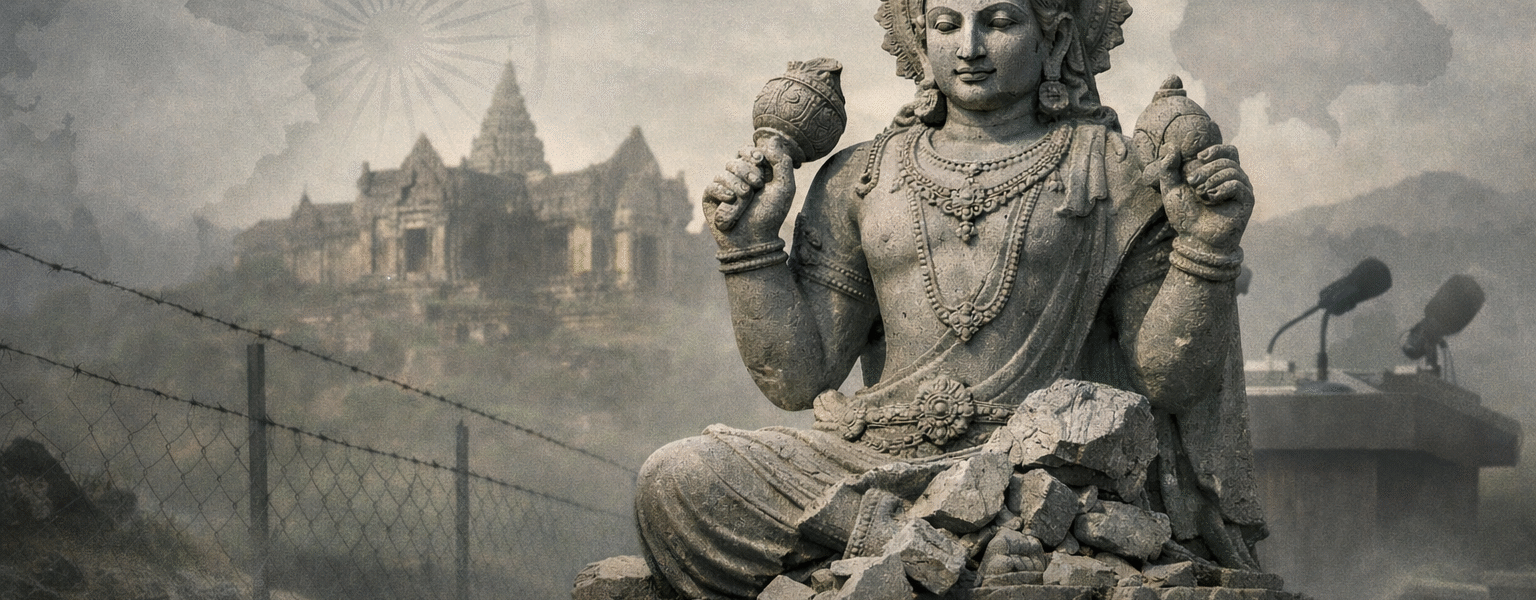
India Condemns Demolition of Lord Vishnu Statue Amid Escalating Thailand–Cambodia Border Dispute


India Condemns Lord Vishnu Statue Demolition Amid Thailand–Cambodia Row
India has strongly condemned the demolition of a Lord Vishnu statue near the Thailand–Cambodia border, calling the act “disrespectful” and deeply hurtful to religious sentiments worldwide. In a statement issued by the Ministry of External Affairs, New Delhi said that, irrespective of territorial disputes, cultural and religious symbols must be treated with sensitivity and respect.
The incident comes amid renewed and violent border tensions between Thailand and Cambodia around the long-disputed Preah Vihear region, where clashes in recent weeks have heightened regional anxiety.
Lord Vishnu Statue issue
India has condemned the demolition of a Lord Vishnu statue near the Thailand–Cambodia border, calling it “disrespectful” to global religious sentiments amid rising tensions around Preah Vihear.#India #Thailand #Cambodia #PreahVihear #HinduHeritage pic.twitter.com/YZEKt2fNHN
— News 24 Media (@news24nmedia) December 26, 2025
The Lord Vishnu statue, located in a frontier zone close to the Preah Vihear Temple, was erected around 2014 and had stood for nearly a decade. Video footage that circulated widely on social media showed heavy machinery being used to tear down the Lord Vishnu statue, triggering outrage and diplomatic exchanges.
Cambodia has accused Thai forces of demolishing the Lord Vishnu statue on what Phnom Penh claims is Cambodian territory, describing the act as a deliberate provocation and an insult to shared cultural heritage. Thai authorities, however, have denied targeting any religion, saying the Lord Vishnu statue was a non-registered decorative installation removed for “security” and “area management” reasons in a sensitive military zone.
India’s diplomatic messaging
In its response, India underlined the deep civilisational links that bind South and Southeast Asia, noting that Hindu and Buddhist deities are part of a shared heritage across the region. The MEA stressed that “notwithstanding territorial claims, such disrespectful acts should not take place,” and urged both sides to protect cultural and religious symbols even amid heightened security operations.
New Delhi also called for restraint and a return to dialogue, warning that actions involving sacred symbols risk damaging regional goodwill and hurting the sentiments of Hindu communities across the globe.
Thailand–Cambodia dispute: background and stakes
The area around the Preah Vihear temple has been contested for decades, despite past rulings by the International Court of Justice clarifying aspects of sovereignty. Periodic clashes have erupted over the years, but the latest flare-up has been among the most intense, with reports of dozens killed and close to a million people displaced along the border.
Both Bangkok and Phnom Penh are highly sensitive about infrastructure and symbols in the contested zone, seeing them as markers of control. As military deployments increase, heritage sites and religious markers have become increasingly vulnerable to damage or removal.
Regional and international political angles
The Lord Vishnu statue demolition has quickly turned into a diplomatic flashpoint:
- For Cambodia, it is being framed as evidence of Thai aggression and disregard for cultural heritage.
- For Thailand, officials present it as a security and territorial management issue, denying any religious motive.
- For India, the episode tests its role as a civilisational stakeholder and a strategic partner to both ASEAN neighbours, balancing close ties while speaking up on cultural and religious sensitivities.
Regional commentators have also raised questions about whether ASEAN mechanisms—or external mediation—might be invoked if tensions continue to escalate.
Global Hindu response and soft-power dimension
Hindu organisations and diaspora voices have reacted sharply online, condemning the demolition and urging greater protection for shared heritage sites across borders. Analysts note that such incidents intersect with India’s broader soft-power outreach in Southeast Asia, which emphasises temples, pilgrimage circuits, tourism, and the shared Indic cultural legacy of the region.
Current status and what to watch next
As of now, Thai authorities have issued clarifications reiterating that the removal was not religiously motivated, while Cambodia has continued diplomatic protests and public messaging on the issue. Talks to stabilise the border situation are reportedly ongoing, alongside ceasefire efforts and internal reviews of the demolition.
Key questions remain: Will the statue be rebuilt? Will there be compensation or a formal apology? And can cultural and religious sites be insulated from future military operations in disputed zones?
Closing reflection
The episode highlights how unresolved territorial disputes, if not carefully managed, can easily draw faith symbols and shared heritage into their crossfire—something all sides publicly claim they want to avoid. For regional stability and cultural harmony, diplomacy may prove as crucial as demarcation on the ground.
Recent Posts
- Tired of Unknown Calls? India’s New CNAP Caller ID Promises Verified Names — No Apps Needed
- Dipu Chandra Das Filmed to Death in Bangladesh: The Lynching of Hindu Man and the Crisis of Mob Justice
Secondary Keywords
Lord Vishnu statue demolition, India MEA statement Southeast Asia, Hindu heritage Southeast Asia, Thailand Cambodia tensions latest news, Cultural heritage border conflict, India condemns Vishnu statue demolition, Thailand Cambodia border dispute, Preah Vihear temple conflict,
- Why did India condemn Vishnu statue demolition
- Preah Vihear border clash explained
- Hindu religious symbols in Southeast Asia politics
Discover more from
Subscribe to get the latest posts sent to your email.








1 COMMENTS