
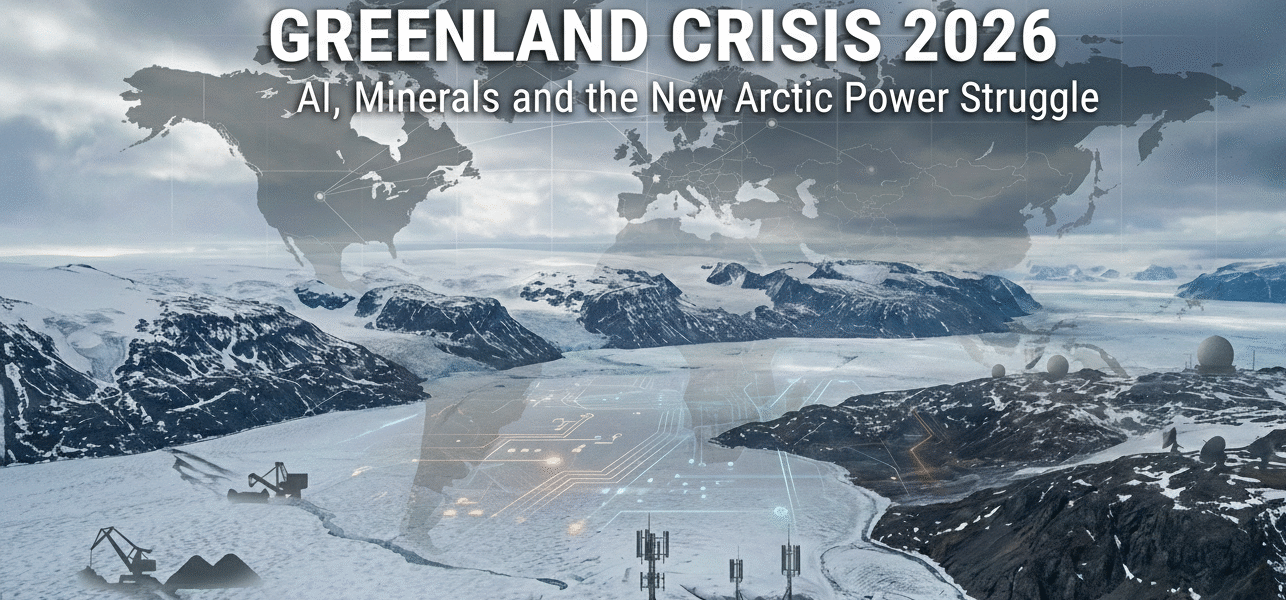
Greenland Crisis 2026: How AI, Rare Earths and U.S. Debt Are Pushing the Arctic to the Brink


The Greenland Crisis: How AI, Minerals, and Debt Are Redrawing the Transatlantic Order
January 2026 may be remembered as the moment the Arctic stopped being peripheral and became central to global power. What is now widely referred to as the Greenland Crisis is not a diplomatic oddity or a revived real estate joke. It is a hard-edged confrontation at the intersection of resource scarcity, artificial intelligence, and the fragility of the post-dollar world order.
At its surface, the crisis appears absurd: the United States pressuring Europe over the fate of a vast, icy island. Beneath that surface, however, lies a strategic logic that explains why Greenland—long ignored—has suddenly become indispensable to Washington’s future planning.
From Curiosity to Ultimatum
The administration of Donald Trump has moved decisively from rhetorical “interest” to outright coercion. As of January 2026, Washington has threatened 10% tariffs on eight European nations, including Denmark, Germany, and the UK, unless negotiations over Greenland are resolved by February 1.
The White House frames the pressure as a matter of national and economic security, citing the urgency of preventing China and Russia from consolidating influence in the Arctic. Europe calls it blackmail. Washington calls it preemption.
Neither label captures the full story.
Why Greenland? The Three Pillars of the Strategy
Greenland is not being targeted for sentimental or symbolic reasons. It aligns with a three-pronged American strategy that combines mineral security, AI infrastructure, and missile defence dominance.
1. The Critical Minerals Hedge
The most immediate driver for the Greenland Crisis is the race for critical minerals—the raw materials without which modern economies cannot function.
- China’s chokehold: Beijing dominates the global processing of gallium, germanium, and rare earth elements (REEs), giving it de facto veto power over green technology and advanced weapons systems.
- Greenland’s buried leverage: Greenland holds 25 of the EU’s 34 designated critical raw materials and is believed to contain the world’s largest untapped reserves of neodymium and dysprosium—key inputs for electric vehicles, wind turbines, precision missiles, and nuclear submarine propulsion.
- Strategic outcome: Securing Greenland would allow the US to break China’s grip on the supply chains of 21st-century technology, reshaping global dependence almost overnight.
This is not about abundance. It is about control.
2. AI, Data Centres, and the “Cooling Advantage”
The second pillar of the Greenland Crisis is less visible but arguably more transformative: artificial intelligence infrastructure.
AI supercomputers generate immense heat. Cooling alone consumes roughly 40% of a data centre’s total energy. In a warming world with energy grids under stress, cooling is fast becoming the limiting factor of AI expansion.
Greenland offers a solution no Silicon Valley campus can replicate:
- Free-air Arctic cooling, slashing operating costs
- Geographic proximity to the minerals needed to manufacture advanced AI chips
- A politically stable environment compared to equatorial alternatives
Notably, tech-linked investors, including Bill Gates and Sam Altman, have backed mineral-intelligence firms such as KoBold Metals, which are explicitly designed to integrate AI, mining, and strategic supply resilience.
In this light, Greenland is not a frozen outpost. It is a potential AI industrial zone.
3. Missile Defence and the Arctic High Ground
The third pillar of the Greenland Crisis is overtly military.
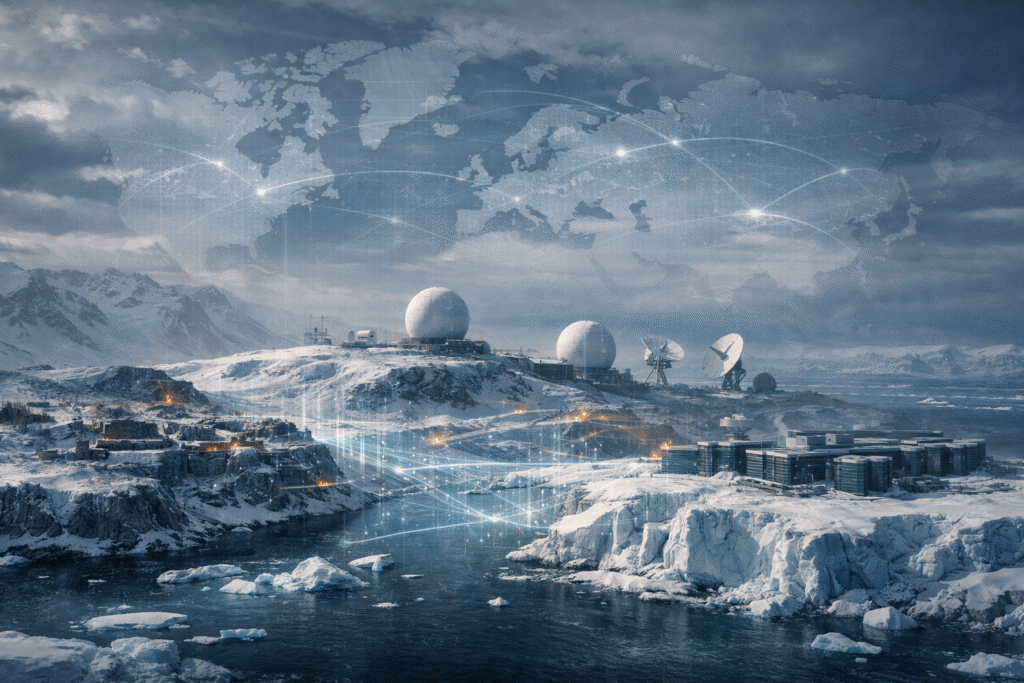
Greenland anchors the GIUK Gap (Greenland–Iceland–UK)—one of the world’s most critical maritime and aerospace chokepoints. Control of this corridor determines who can monitor and intercept threats moving between the Arctic and the North Atlantic.
With the recent expansion of the “Golden Dome” missile defence architecture at Pituffik Space Base, Greenland has become the ultimate early-warning platform for:
- Hypersonic missile trajectories
- Arctic submarine movements
- Over-the-pole strategic threats
In military terms, Greenland is no longer a defensive depth. It is strategic high ground.
The Hidden Calculation: Debt, Dollars, and Hard Assets
Beneath defence and technology lies the most uncomfortable motivation of all: economic survival.
The United States is navigating:
- A historic national debt burden
- Persistent trade deficits
- Rising global experimentation with de-dollarisation, stablecoins, and crypto-based settlement systems
In this context, Greenland functions as a balance-sheet hedge.
| Economic Pressure | Greenland’s Strategic Role |
|---|---|
| High national debt | Trillions in untapped mineral assets add tangible value |
| Trade deficit | From REE importer to dominant exporter |
| De-dollarization | Forces AI and green tech trade to remain within a US-controlled ecosystem |
The logic is blunt: if fiat money faces erosion, hard assets restore leverage. Greenland offers those assets at a planetary scale.
Europe’s Impossible Choice
Europe is responding—but cautiously.
A token deployment of roughly 50 multinational soldiers (French, German, and Nordic) signals unity without provoking escalation. Militarily, it changes nothing. Politically, it buys time.
The deeper problem is internal division.
- Eastern European states, wary of Russia, are reluctant to confront Washington.
- France and Germany view the pressure campaign as an existential assault on European sovereignty.
- Denmark insists that Greenland is not for sale—but knows its leverage is thin.
With military resistance off the table, Europe has turned to trade retaliation, risking a prolonged economic slowdown that could ripple across already fragile global markets.
Winners, Losers, and Wildcards
This is not a clean contest. It is a strategic gamble.
- Potential winner: The United States—if it secures mineral and AI access without irreparably damaging NATO. Even without outright acquisition, a Compact of Free Association could effectively make Greenland a US protectorate.
- Clear losers: Danish and EU sovereignty, increasingly sidelined. The Greenlandic people are caught between aspirations for independence and the fear of becoming a strategic asset rather than a self-determining society.
- Wildcards: China and Russia, quietly exploiting transatlantic fractures to strengthen Arctic cooperation and alternative trade corridors.
A Crisis Born of a Bigger Doldrum
The Greenland Crisis is not an anomaly. It is a by-product of a larger global stagnation—a moment when old systems are straining, new technologies demand unprecedented resources, and great powers scramble to secure the foundations of their future.
The United States is not acting out of confidence. It is acting out of strategic urgency. Greenland is not the prize—it is the insurance policy.
And in 2026, the Arctic is no longer frozen geopolitically. It is on fire.
Obama Arrest Imminent? Tulsi Gabbard Accuses Obama of Russia Conspiracy as Trump Backs Probe
Greenland Crisis 2026, US Greenland ultimatum, Arctic geopolitics AI, Greenland rare earth minerals, GIUK Gap strategic importance, US Europe trade war 2026, Greenland missile defense, Arctic AI data centers, China rare earth monopoly, De-dollarization geopolitics, US debt and hard assets, Greenland sovereignty crisis
Discover more from
Subscribe to get the latest posts sent to your email.







1 COMMENTS