
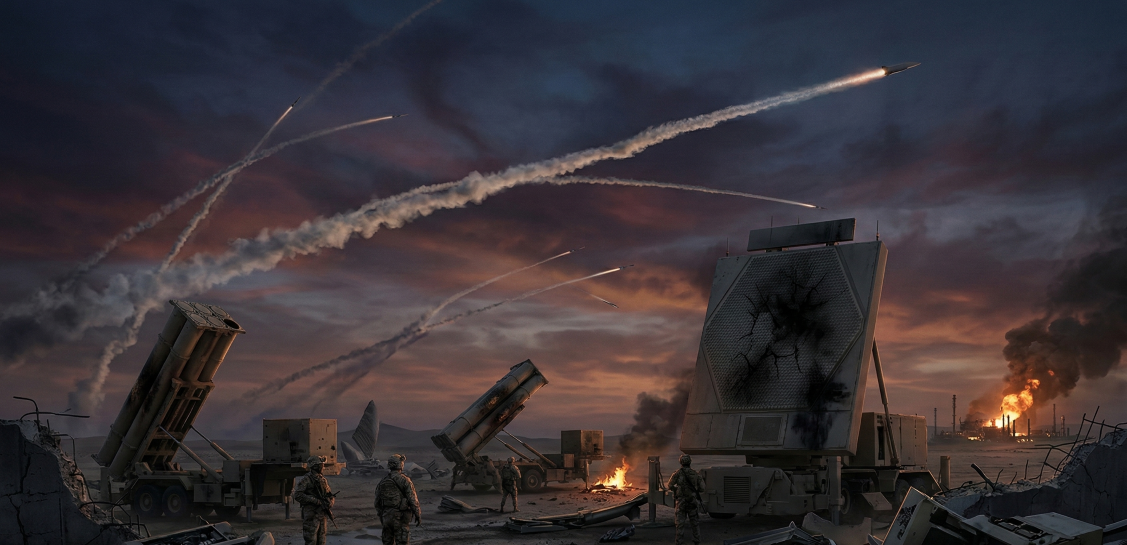
Fattah-2 Hypersonic Missile: The 2026 Collapse of Middle East Security


The Fattah-2 Hypersonic Storm: How the Fattah-2 Shattered the “One-Week War” Illusion
The Middle East has entered a state of “terminal entropy,” a violent realignment sparked by the collapse of traditional military deterrence. What began on February 28, 2026, as Operation Epic Fury—a joint U.S.-Israeli campaign designed to dismantle Iran’s nuclear and missile infrastructure—has instead spiraled into a grueling war of attrition that has redrawn the geopolitical map.
The “Conqueror” Unleashed
At the heart of this shift is the Fattah-2 Hypersonic, a next-generation hypersonic glide vehicle (HGV) whose name, meaning “The Conqueror,” was personally selected by the late Supreme Leader Ayatollah Ali Khamenei. Unlike its predecessor, the Fattah-1, which followed a predictable ballistic arc, the Fattah-2 utilises a liquid-fuel engine to perform unpredictable manoeuvres within the atmosphere at speeds up to Mach 15.
Western intelligence had largely dismissed Iranian hypersonic claims as “hype” or “political bluster” before the conflict. However, the reality of Operation True Promise 4—Iran’s massive retaliatory strike launched on March 1—shattered these assumptions. The Fattah-2 Hypersonic’s ability to change vector in both pitch and yaw while travelling at 18,500 kilometres per hour rendered existing Integrated Air and Missile Defence (IAMD) systems, including Israel’s Arrow-3 and U.S. naval interceptors, effectively defenceless.
The Collapse of the Shield
The kinetic impact on Israeli and American assets has been catastrophic. In Israel, the “impenetrable” airspace was repeatedly breached:
- Nevatim Air Base: Satellite imagery confirmed severe damage to hangars housing the prized F-35I Adir stealth fighter fleet.
- Glilot Camp: The nerve centre of Israeli intelligence, housing Unit 8200 and situated near Mossad HQ, sustained direct impacts.
Simultaneously, Iran executed a sophisticated “counter-sensor” strategy against U.S. forces. In the first four days alone, the U.S. lost nearly $2 billion in high-value assets:
- The AN/FPS-132 Early Warning Radar in Qatar, a $1.1 billion asset, was crippled, creating a massive blind spot in regional detection.
- The AN/TPY-2 THAAD Radar in Jordan was destroyed, leaving U.S. fighter deployments vulnerable.
This “blinding” of the sensor layer led to further tragedy when Kuwaiti air defences, suffering from operational confusion, mistakenly shot down three U.S. F-15E Strike Eagles in a friendly-fire incident.
The End of Arab Neutrality
Perhaps the most significant geopolitical shift occurred when Iran expanded its target matrix to include every nation in the Gulf Cooperation Council (GCC). By striking sovereign territories in Saudi Arabia, the UAE, and Qatar, Tehran intended to force Washington to abandon its campaign. Instead, the gamble backfired.
The Fattah-2 Hypersonic strikes vaporised decades of strategic hedging, fusing the GCC, Israel, and the United States into a cohesive “Abrahamic” security architecture. Landmark 2023 normalisation efforts were scorched as five GCC states joined Jordan and the U.S. in a unified declaration condemning Iran’s “reckless escalation”.
Global Economic Hostage-Taking
The war has triggered a global economic crisis. The de facto closure of the Strait of Hormuz caused a 60% surge in European gas prices within days. Iranian drone debris forced the shutdown of Saudi Arabia’s Ras Tanura Refinery, while QatarEnergy declared force majeure on critical LNG production. Major shipping conglomerates like Maersk have abandoned the region, leaving over 3,000 commercial ships stranded.
A Failed Theory of Victory
The conflict has forced a humiliating re-evaluation in Washington. Operation Epic Fury was built on the “Venezuela Model”—a belief that a rapid “one-week” campaign and the decapitation of Iran’s leadership would trigger a systemic regime collapse.
While coalition forces successfully assassinated Ayatollah Khamenei and top IRGC commanders in the opening hours, the expected internal collapse never came. Instead, the Iranian state demonstrated “institutional resilience,” with the Assembly of Experts quickly consolidating around hardline successors.
As of the second week of March, the U.S. and Israel find themselves locked in a “totalized war of attrition”. While coalition air supremacy has degraded 70% to 85% of Iranian launch sites, Iran’s core “kill chain” remains intact, leaving the coalition to pivot from the illusion of a swift victory to a desperate effort to avoid catastrophic regional losses.
Want to dive deeper into the 2026 Collapse of Middle East Security? Read the full comprehensive research report here
Fattah-2 Hypersonic
Discover more from
Subscribe to get the latest posts sent to your email.