
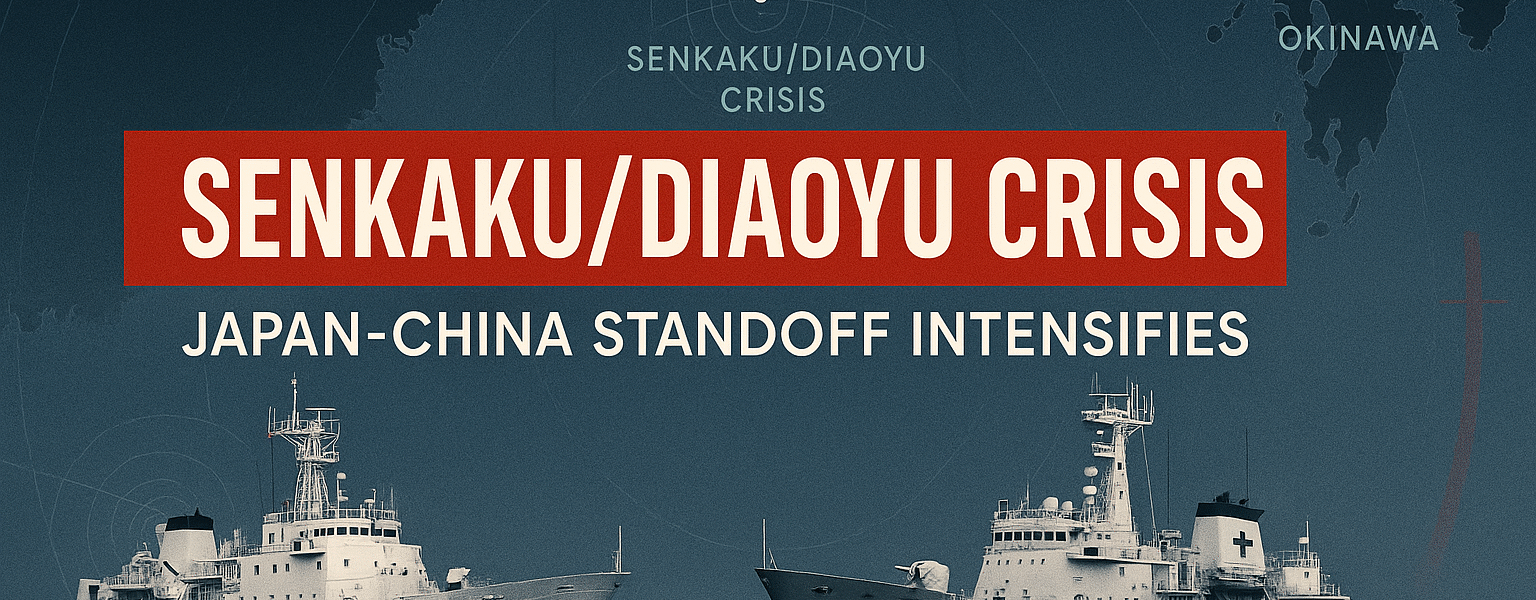
Diaoyu/Senkaku Crisis 2025: Chinese Coast Guard Escalation Sparks Japan–China Standoff and Boosts Takaichi’s Rise


Senkaku crisis /Diaoyu Flashpoint Reignites: Chinese Coast Guard Intrusions Spur Diplomatic Crisis, Boost Japan’s New PM Sanae Takaichi, and Draw Taiwan Into the Fray
Senkaku crisis — December 2025 Begins With the Sharpest Clash in Years
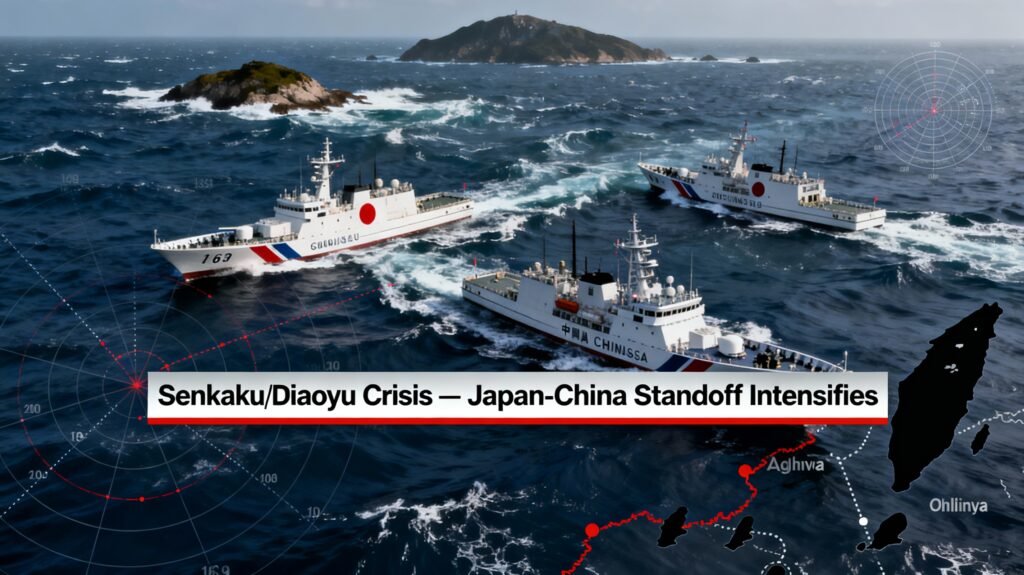
The East China Sea’s most volatile flashpoint erupted once again on 2 December 2025, when Japanese and Chinese coast guard vessels confronted each other in the territorial waters around the Senkaku/Diaoyu Islands, a chain of uninhabited rocks 160 km southwest of Taiwan.
According to a Japan Coast Guard (JCG) incident note, two heavily armed China Coast Guard (CCG) ships were “forcibly expelled” after attempting to shield a Chinese fishing boat operating inside what Japan considers its sovereign waters. Beijing, however, issued the opposite claim, saying its coast guard had “driven out” a Japanese patrol vessel that had “illegally intruded” into what China calls the Diaoyu Islands.
The conflicting narratives underscored just how combustible the dispute has become. Administered by Japan since 1972 as part of Okinawa Prefecture, the islands are also claimed by China (Diaoyu) and Taiwan (Diaoyutai). Though uninhabited, the waters around them are rich in tuna stocks and energy reserves and control access to some of the world’s busiest shipping routes.
The December standoff came after months of steady escalation by China’s coast guard, which has increasingly deployed larger, gun-equipped patrol vessels, part of a grey-zone pressure strategy aimed at normalising Beijing’s presence in waters under Japanese control.
A Season of Escalation — Senkaku crisis, October to November 2025
Tensions did not erupt overnight. According to JCG monthly bulletins and Japan’s Ministry of Foreign Affairs (MOFA):
- 16 October 2025: Four CCG vessels — at least one armed with a 76mm naval gun, per JCG identification logs — entered Japan’s territorial waters near Uotsuri Island. Japan issued multiple warnings, describing the intrusion as “persistent and coercive.”
- 16 November 2025: Another Chinese flotilla conducted a patrol that Japan said lasted more than two hours inside its waters. MOFA filed a formal diplomatic protest in Tokyo and Beijing.
- Late November 2025: Chinese state media amplified criticism of Japanese Prime Minister Sanae Takaichi after she told lawmakers that any Chinese assault on Taiwan “directly threatens Japan’s security.” China subsequently raised the Diaoyu/Senkaku crisis during closed UN Security Council consultations — a rare move signalling Beijing’s heightened irritation.
The 2024–2025 Pattern: A Near-Daily Chinese Presence
Japan’s 2024 monitoring report — widely cited by Reuters and NHK — recorded:
- 355 out of 366 days of Chinese coast guard activity in the surrounding contiguous zone,
- and dozens of direct territorial water breaches, many involving ships equipped with large-calibre deck guns.
The 2025 trend appears even more assertive: the JCG noted a “month-on-month rise” in November, matching the highest frequency since Japan began systematic tracking in 2012.
Japan’s tactical responses included:
- loudspeaker warnings and light-signalling,
- blocking manoeuvres to prevent Chinese vessels from approaching Japanese fishing boats,
- and, on several occasions, coordinated expulsions involving multiple JCG cutters.
Tokyo avoids further escalation by not deploying naval vessels, a strategy it calls “proactive restraint” — asserting control without stepping into a military confrontation China may exploit.
Takaichi’s Defiant Rise — Japan’s New Prime Minister Alters the Political Calculus
Japan’s new prime minister, Sanae Takaichi, who took office in late 2025 as the country’s first female leader, has brought a noticeably sharper tone to Japan’s China and Taiwan policy.
A long-time national-security hawk from the Liberal Democratic Party (LDP), Takaichi has repeatedly stressed:
- The Senkaku Islands are “integral to Japan”,
- Japan will “not tolerate attempts to change the status quo by force”,
- And any Chinese attack on Taiwan — just 110 km from the islands at its closest point — “constitutes a direct threat to Japan’s survival,” invoking the language of Japan’s 2015 security laws, which allow collective self-defence.
Her comments triggered intense backlash from China’s foreign ministry, which accused Tokyo of “distorting historical facts” and “colluding with external forces.” But domestically, the remarks boosted her popularity: a Kyodo-style polling aggregation by multiple Japanese media outlets in November showed her approval soaring to around 70%, one of the highest for a new PM in decades.
Analysts quoted by The Diplomat and Japanese security think tanks argue that Takaichi’s rise is altering Beijing’s calculus: her firmness could deter aggressive actions, but still it might also provoke China to intensify grey-zone manoeuvres to test her resolve early in her tenure.
Taiwan Steps In — Three-Way Competition Over a Small Island Chain
Though Taiwan’s claim receives less global attention than China’s, Taipei officially maintains sovereignty over what it calls the Diaoyutai Islands.
Taiwan’s Ocean Affairs Council has repeatedly reaffirmed its maritime jurisdiction over the area. In November 2025, Taiwanese fishery patrol vessels quietly increased their presence in the surrounding waters, partly to protect local fishing fleets and partly to signal that Taiwan — squeezed between Chinese pressure and Japanese control — will not cede its stake.
Taiwanese officials, when asked by local media, emphasised that the dispute “must be resolved peacefully,” but also stressed the islands’ role in Taiwan’s northern defence perimeter, especially as Chinese naval and air activity surges across the Taiwan Strait.
This triangular dynamic — Japan administering, China contesting, Taiwan asserting its claim — increases the risk of miscalculation if multiple coast guard forces intersect during a crisis.
Why These Islands Matter — The Strategic Logic
1. Military and Geopolitical Importance
The islands sit near the entrance of the Taiwan Strait, a chokepoint vital for Asian energy imports and US–Japan naval coordination. Control over the waters affects:
- submarine transit routes,
- intelligence surveillance positions,
- and maritime access to the Western Pacific.
2. Energy and Resources
Japanese geological surveys since the 1970s have identified potential oil and gas deposits on the seabed of East China, though they have not been fully explored due to tensions. The fishing grounds are among Asia’s most productive, drawing Chinese, Taiwanese, and Japanese fleets.
3. A Testing Ground for China’s “Grey-Zone” Strategy
China increasingly relies on coast guard vessels — now under the command of the Central Military Commission — to challenge Japan without triggering a conventional armed clash. Many CCG ships are larger than Japan’s own cutters and operate even in typhoon-season conditions thanks to modernised hulls and stabilisation systems.
4. The U.S.–Japan Alliance Factor
Washington recognises Japanese administrative control and affirms the Senkaku Islands fall under Article 5 of the U.S.–Japan Security Treaty, obligating the U.S. to defend Japan if attacked. This makes the islands a potential tripwire for great-power confrontation.
Intrusion Tracker on Diaoyu/Senkaku crisis — A Snapshot of 2024–2025 Activity
(Compiled from Japan Coast Guard reports and publicly available MOFA data)
| Month (2025) | CCG in Contiguous Zone | CCG in Japanese Territorial Waters | Notable Details |
|---|---|---|---|
| July | Near-daily presence | 3 incursions | Armed cutter 2305 identified |
| August | Daily presence | 2 incursions | Probing a Japanese fishing boat |
| September | 28 days | 3 incursions | Longest intrusion lasted 80 minutes |
| October | 30 days | 4 incursions | 76mm-armed ship among intruders |
| November | 28 days | 3 incursions | China raised issue to UNSC |
| December (to 2nd) | 2 days | 1 major clash | December 2 confrontation |
Explainer Box: Diaoyu/Senkaku Crisis Basics
- Administered by: Japan (since 1972, post-US occupation of Okinawa)
- Claimants: Japan, China, Taiwan
- Islands: Uotsuri, Kuba, Taisho, and several smaller rocks
- Why contested: strategic location, shipping lanes, potential hydrocarbons, rich fisheries
- Population: Uninhabited
Explainer Box: Takaichi’s Taiwan Stance
Prime Minister Takaichi argues that:
- Taiwan’s security is inseparable from Japan’s,
- Any forced change in Taiwan’s status would endanger Japan’s southwest islands,
- Japan must be prepared to support international deterrence, including U.S. operations.
Her framing aligns Tokyo more openly with the U.S. posture, reducing past ambiguity in Japanese policy.
Explainer Box: Why the Diaoyu/Senkaku crisis for Global Trade
Nearly one-third of global maritime trade passes close to these waters. Any clash that disrupts shipping, military routes, or energy flows could ripple through global supply chains, especially for semiconductors, LNG shipments, and container traffic.
Path to Crisis? What the Next 1–2 Years May Look Like
Regional analysts warn that tensions may intensify through 2026 for several reasons:
- China’s Coast Guard Modernisation
More large cutters and a growing maritime militia fleet mean China can sustain pressure at multiple points simultaneously. - Japan’s Hardened Political Will
Takaichi’s strong mandate could translate into accelerated defence deployments in Okinawa and the Sakishima Islands, including anti-ship missiles and maritime surveillance upgrades. - Taiwan’s Political Transition
With its own elections and the constant threat of Chinese coercion, Taipei may assert its Diaoyutai claim more openly. - U.S.–China Strategic Rivalry
As Washington increases patrols with Japan and allies, China may respond more aggressively, raising risks of tactical collisions. - Diplomatic Channels Are Thinning
Despite hotline arrangements, meaningful dispute-management talks between Tokyo and Beijing have stalled since mid-2024.
Experts emphasise that a major conflict is not imminent, but the accumulation of incidents means “low-level friction with high-level consequences” remains the defining risk.
Conclusion — A Dispute With No Easy Exit
The December 2 confrontation illustrates a troubling pattern: China’s bid to normalise presence, Japan’s resolve under a hawkish new prime minister, and Taiwan’s quiet but firm insistence that it remains a stakeholder. With strategic interests layered over history, nationalism, and great-power rivalry, a diplomatic breakthrough appears unlikely soon.
For the East China Sea — already one of Asia’s tightest military theatres — the Diaoyu/Senkaku crisis is entering a new phase: more assertive, more militarised, and more deeply intertwined with the broader China–Japan–Taiwan–U.S. contest shaping the Indo-Pacific.
Unless channels revive and all sides commit to serious de-escalation, the world should expect at least 1–2 more years of rising friction, with each new intrusion carrying the risk of accidental escalation in one of the world’s most strategically critical waters.
Senkaku crisis 2025, Senkaku Islands dispute, China Japan coast guard clash, Takaichi Taiwan defence, East China Sea tensions, Diaoyu crisis 2025
Discover more from
Subscribe to get the latest posts sent to your email.








1 COMMENTS