
Biohacking Billionaires 2025: Inside Tech Titans’ $100M Race for Immortality, Brain Chips & Anti-Aging Secrets


Biohacking Billionaires: Tech Titans’ $100M Quest for Immortality—From Pill-Popping to Brain Implants, What’s Next?
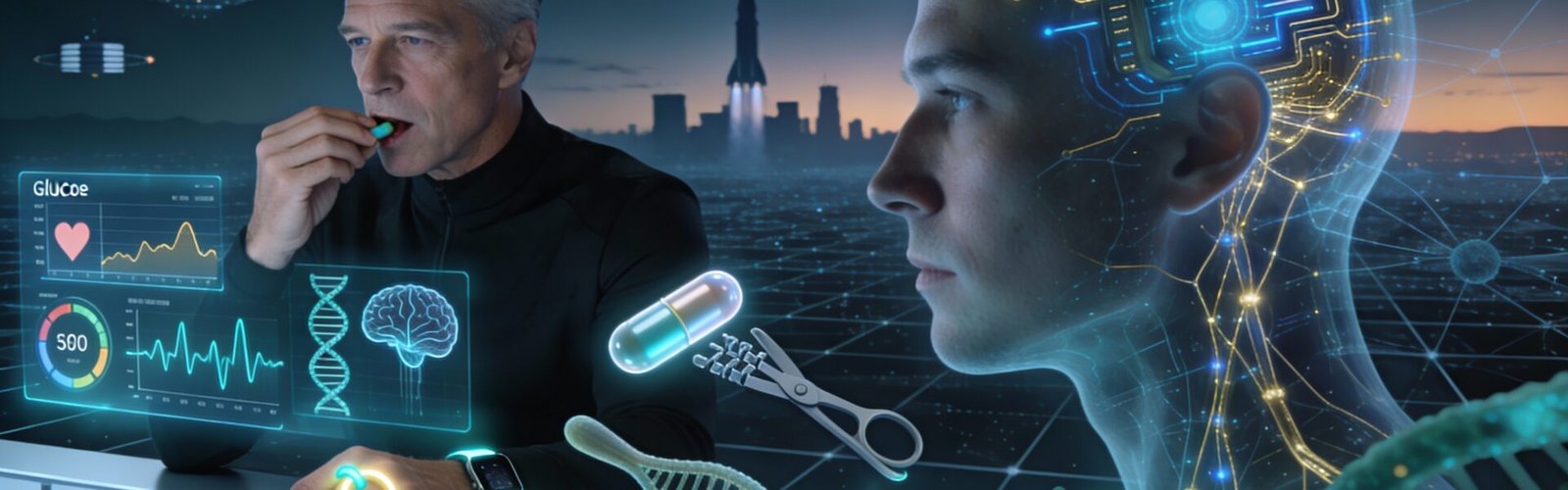
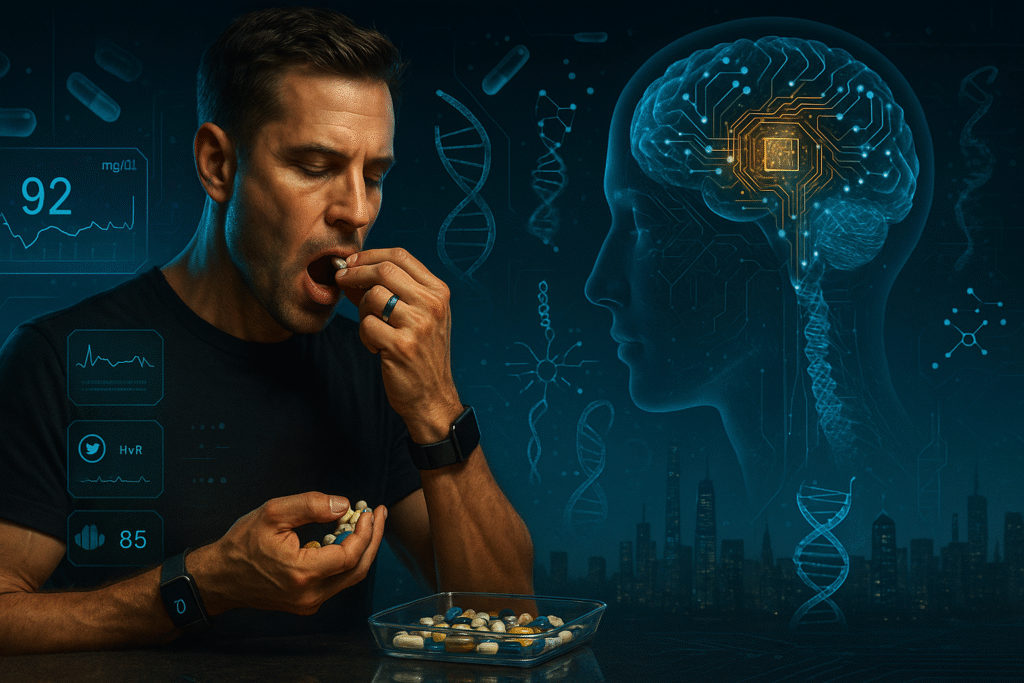
At 6 a.m., a Silicon Valley founder begins his day not with coffee, but with a ritual that looks more like a clinical trial than a morning routine. He swallows over 100 pills—vitamins, peptides, experimental compounds—then checks real-time dashboards tracking his blood glucose, heart-rate variability, sleep architecture, inflammation markers, and even the pace at which his organs are ageing. Every metric is uploaded, graphed, and optimised. His goal is blunt, almost defiant: don’t die.
Welcome to the strange, fast-accelerating world of Biohacking Billionaires, where tech titans are spending tens—sometimes hundreds—of millions of dollars to slow ageing, extend “healthspan,” and, if possible, cheat death itself. In 2025, this is no longer fringe Silicon Valley eccentricity. It is a serious, capital-heavy race shaped by AI, neuroscience, and the fear that while machines may live forever, humans will not.
The Biohacking Billionaires Boom
The modern longevity movement is driven by a simple but unsettling realisation among tech elites: AI systems may soon outlast their creators.
For founders who expect to work into their 70s, 80s, or beyond—running companies, steering civilisation-scale technologies—ageing is no longer just a biological process. It is a professional liability.
No one embodies this more vividly than Bryan Johnson, the entrepreneur behind the now-famous Blueprint Protocol. Johnson reportedly spends close to $2 million per year on his body. His routine includes:
- Over 100 supplements daily
- Strict vegan caloric restriction
- Continuous blood, urine, and imaging tests
- Advanced sleep optimisation
- Plasma-related interventions inspired by controversial parabiosis research
Johnson’s mantra—“Don’t die”—has become a rallying cry for Silicon Valley’s longevity class. He publicly publishes his data, framing ageing as an engineering problem to be solved with iteration and feedback loops.
But Johnson is not alone.
Peter Thiel, PayPal co-founder and long-time transhumanist, has openly discussed interest in parabiosis-style blood-sharing research, based on early animal studies suggesting younger blood may rejuvenate older organisms.
Dave Asprey, the Bulletproof Coffee founder, has spent millions on stem-cell therapies, cryotherapy, infrared saunas, and mitochondrial “upgrades,” marketing longevity as a lifestyle brand long before it became mainstream.
And looming over the sector is Biohacking Billionaires Jeff Bezos, whose company Altos Labs has quietly raised around $3 billion to study cellular reprogramming—specifically how to reverse ageing by resetting cells to a younger state without triggering cancer.
The drivers are clear:
- AI-extended careers that demand long cognitive peaks
- Fear of irrelevance in a world moving faster than biology
- Obsession with healthspan, not just lifespan
- Breakthrough science—from CRISPR to senolytics—that suggests ageing may be modifiable, not inevitable
Key Players and Wild Experiments of Biohacking Billionaires (2025 Edition)
Deepinder Goyal: Brain Optimisation Comes to India’s Tech Elite
In a sign that biohacking is going global, Zomato founder Deepinder Goyal has emerged as a notable adopter of advanced cognitive optimisation tools. Sources in India’s startup ecosystem point to his use of portable EEG and neurofeedback devices designed to improve focus, creativity, and stress resilience.
These systems monitor brain-wave patterns in real time, offering feedback loops to train the brain—an approach increasingly tied to neural-interface research worldwide. While not invasive, such tools represent a stepping stone toward more direct brain-machine integration.
Biohacking Billionaires- Elon Musk: From Cars and Rockets to Brain Chips
If supplements are the soft side of biohacking, Elon Musk’s Neuralink represents its hardest edge.
Neuralink’s implanted brain chips—already tested in human patients for paralysis—are widely viewed as the first serious step toward cognitive enhancement. Musk has openly discussed a future where humans must merge with AI to remain relevant.
In that vision, longevity is not just about living longer—but about thinking faster, learning instantly, and maintaining relevance in an AI-dominated economy.
Sergey Brin & Larry Page: Google’s Quiet War on Ageing
Through Calico Labs, backed by Google and Alphabet’s venture arms, Sergey Brin and Larry Page have spent over a decade funding research into ageing at the molecular level.
Their scientists are investigating:
- Telomere dynamics
- Cellular senescence
- AI-driven drug discovery
- Long-term possibilities like organ printing and replacement
Unlike flashy supplement stacks, Calico’s approach is slow, academic, and deeply scientific—aimed not at Instagram virality, but at foundational breakthroughs.
Others in the Longevity Orbit
- Jack Dorsey: Extreme fasting, daily saunas, ice baths, and meditation
- Sam Altman: Public interest in rapamycin trials, a drug shown in animals to extend lifespan
- Mark Zuckerberg: Exclusive wellness retreats combining martial arts, metabolic testing, and recovery tech
Anti-Ageing Formulae—and Their Failures
The longevity industry thrives on promise. Not all of it survives contact with data.
What’s Hyped
- NAD+ boosters: Popular for cellular energy, but human longevity evidence remains mixed
- Metformin: A diabetes drug widely used off-label for anti-ageing, supported by epidemiological data but still unapproved for longevity
- Yamanaka factors: A genuine scientific breakthrough capable of reprogramming cells—yet extremely risky if misapplied
What Failed
- Unity Biotechnology, once a darling of the senolytics space, saw major clinical trial failures
- Numerous peptides are marketed online with little peer-reviewed evidence
- Overpromised stem-cell clinics shut down by regulators
By 2025, the global longevity market is valued at roughly $25 billion, yet there remains zero FDA-approved drug whose primary indication is “ageing.” Immortality remains theoretical. Biology is stubborn.
Tech vs. Pharma: Two Paths to Longevity
Biohacking Billionaire is splitting into two camps.
The Pill-Swallowers
Bryan Johnson’s extreme supplement regimens represent this school: high-compliance, lifestyle-controlled, data-obsessed, and personalised. Critics argue that such approaches may deliver marginal gains at enormous cost.
The Device Pioneers
Wearables are quietly becoming the most impactful tools:
- Oura Rings for sleep and recovery
- WHOOP bands for strain and heart-rate variability
- Levels CGMs for real-time glucose control
- AI-powered platforms like InsideTracker are analysing blood biomarkers
Venture capital has followed. By conservative estimates, over $500 million has flowed into biohacking and health-optimisation startups in recent years.
Commercial Viability and the Road to 2030
What begins with biohacking billionaires often trickles down.
Experts predict that by 2030:
- Affordable wearables will make personalised biohacking mainstream
- AI will design individualised nutrition and longevity protocols
- Continuous diagnostics will catch disease years earlier
- Longevity gaps between the rich and the poor may widen dramatically
This raises uncomfortable ethical questions. Will extended healthspan become a luxury good? Will unproven interventions harm those chasing elite routines without medical supervision?
There is hope, however, in proven successes.
Drugs like GLP-1 agonists (including Ozempic and successors) have already reshaped obesity treatment and show promise in reducing inflammation, cardiovascular risk, and metabolic ageing—bringing real longevity benefits to millions, not just millionaires.
Hype vs. Science: A Necessary Warning
Doctors and researchers urge caution. Ageing is complex. Interventions like rapamycin, senolytics, and cellular reprogramming carry real risks.
Institutions such as the NIH and journals like Nature consistently emphasise that self-experimentation without medical oversight can backfire, especially when stacking untested compounds.
Longevity is not a hack. It is biology—slow, probabilistic, and unforgiving.
The Final Question: Can Death Be Engineered Away?
For now, the answer remains no.
But the pursuit itself is reshaping medicine, technology, and how society thinks about ageing. Billionaire biohackers may not achieve immortality—but in trying, they are accelerating research that could help millions live longer, healthier, and more productive lives.
The real legacy of this movement may not be eternal life for a few, but a future where ageing is no longer an unavoidable decline, but a manageable condition.
And in Silicon Valley, that may be the ultimate disruption.
biohacking billionaires 2025, tech billionaires anti aging, Bryan Johnson Blueprint protocol, longevity investments Silicon Valley, Neuralink brain chip human trials, billionaire health optimization, immortality technology research, anti aging biohacking trends, AI and longevity science, tech elite wellness routines, biohacking billionaires blueprint
#Biohacking #Longevity #AntiAging #FutureOfHealth #HumanUpgrade #Immortality #HealthTech #biohacking billionaires 2025
Discover more from
Subscribe to get the latest posts sent to your email.









1 COMMENTS