
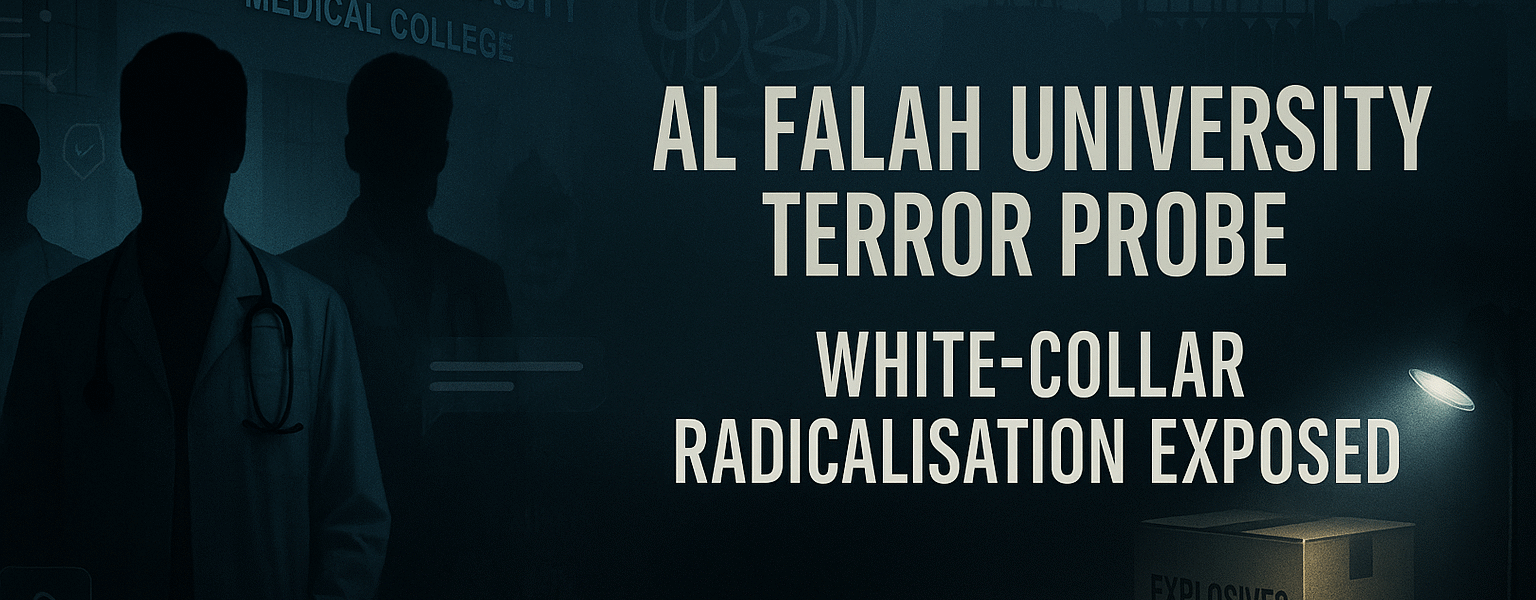
Al Falah University Terror Probe: How a Red Fort Blast Investigation Exposed a White-Collar Radicalisation Network in India


Al Falah University Terror Probe Opens a Pandora’s Box of ‘White-Collar Radicalisation’ in India’s Educated Elite
A Routine Blast Probe That Blew Open a Larger Network
What began as a routine terror investigation into the Red Fort blast in Delhi earlier this month has now spiralled into one of the most disturbing counter-terror revelations India has seen in recent years — the alleged radicalisation of doctors, professors and medical specialists associated with Faridabad-based Al Falah University.
According to investigators, the Red Fort case initially pointed to a familiar terror pattern: a cross-border supply chain of explosives and a digital trail of extremist content. But within weeks, leads converged repeatedly on the Al Falah University medical ecosystem, triggering an unprecedented multi-agency probe.
What has surfaced, officials say, is a “Pandora’s box” of white-collar radicalisation, involving highly educated professionals allegedly groomed through encrypted apps, ideological networks and online handlers tied to Pakistan-based outfits such as Jaish-e-Mohammed (JeM).
Doctors Arrested, Missing — and an Explosives Haul That Raised Red Flags
The turning point came when investigators linked multiple individuals associated with Al Falah University’s medical college and hospital to extremist communication channels uncovered during the Red Fort blast probe.
Over several weeks:
- Multiple doctors were arrested for suspected involvement in extremist activities.
- At least two others reportedly went missing, prompting nationwide alerts.
- Large quantities of explosive precursors, including ammonium nitrate, digital detonator components and encrypted communication devices, were seized from locations linked to the accused.
- Forensic teams recovered radical sermons, jihadist manuals, VPN instructions and foreign cryptocurrency trails from the devices.
Among the arrested was Dr Umar, whose interrogation reportedly revealed an online indoctrination chain dating back to 2019, involving encrypted platforms, ideological mentorship from Pakistan, and recruitment of educated Indian professionals.
Another doctor, previously expelled from a different hospital for behavioural misconduct, was found to have been re-employed at Al Falah University with minimal scrutiny.
A Sophisticated ‘White-Collar’ Module Groomed Since 2019
Investigators now believe that a “white-collar terror ecosystem” took shape around certain individuals within the Al Falah University:
- MBBS graduates and specialists were allegedly radicalised through Telegram channels, private VPN-enabled forums, and invite-only religious study groups.
- A Pakistan-based handler known by an alias — believed to be connected to Jaish-e-Mohammed — reportedly supervised the ideological conditioning.
- Radicalisation was reinforced in professional circles, including WhatsApp groups for medical case discussions where extremist content was quietly embedded.
- Recruitment targeted those with technical expertise, “clean” backgrounds, and the ability to move across academic or medical institutions without suspicion.
Security officials say the case shatters the stereotype that Islamist radicalisation in India is confined to “uneducated or economically vulnerable youth.”
Instead, the probe suggests:
Highly qualified professionals — doctors, lecturers, researchers — are increasingly being targeted because they can operate silently in elite spaces.
This marks a shift similar to global trends seen in the UK, France and Indonesia, where radical outfits have leveraged university environments and medical campuses to blend operatives into the system.
How Institutional Gaps Allowed the Network to Thrive
The investigation has also exposed serious administrative and regulatory lapses inside the Al Falah University and affiliated institutions.
Key failures identified so far:
1. Missing or bypassed NOCs from state medical councils
Several accused doctors allegedly joined Al Falah University without securing mandatory No-Objection Certificates from previous state medical councils — a violation rarely flagged during hiring.
2. Weak internal verification systems
A doctor dismissed by another hospital for “ideological misconduct” was reportedly re-hired at Al Falah University with only basic paperwork checks.
3. No independent background audits
The Al Falah University relied on self-attested documents, without police verification or professional references.
4. Limited monitoring of digital spaces
Internal committees lacked the capacity to identify extremist content circulating within closed academic groups.
5. Land & financial records now under scrutiny
Authorities are now verifying:
- compliance with UGC and state norms
- foreign funding trails
- land ownership records linked to the medical campus
What began as a personnel investigation has now widened to institutional auditing.
The Crackdown: Suspensions, Cancellations, And Agency Coordination
Since the arrests:
- Several doctors have been suspended or terminated.
- State medical councils have initiated the cancellation of medical registrations for those charged.
- Haryana and central agencies have ordered parallel audits of university hiring practices and financial transactions.
- The Ministry of Education has sought responses from accreditation bodies regarding breaches of non-compliance.
- Multiple regulators — NMC, UGC, local health authorities — are coordinating with NIA and Delhi Police.
Officials insist the investigation remains ongoing and that “institutional accountability will be pursued where lapses are proven.”
Experts Warn: India’s Radical Threat Has Shifted to “Elite Spaces”
The revelations have reignited national debate on campus radicalisation and white-collar extremism.
1. Security analysts
Experts interviewed across major TV channels and policy think tanks warn that:
- Radical groups now prefer educated recruits for ideological influence, clean profiles, and professional mobility.
- Encrypted apps have replaced physical meetings, allowing grooming to occur unnoticed.
- Some transnational networks provide legal cover, online propaganda, ideological framing and micro-funding.
2. Academic policy analysts
They highlight that:
- Universities lack standardised digital monitoring mechanisms.
- Institutional autonomy sometimes creates gaps in background verification.
- Campus ecosystems can be exploited for quiet networking and recruitment.
3. Former intelligence officers
Point to a worrying trend:
“Street-corner modules have evolved into doctor-engineer-professor modules — educated, networked and harder to detect.”
This matches patterns seen in terror attacks abroad where medical professionals, engineers and university scholars were used as operatives or facilitators.
A Larger Question: How Did It Happen in an Accredited University?
This case forces uncomfortable questions:
- How could extremist ideology thrive quietly within a regulated medical ecosystem?
- Why did mandatory checks fail repeatedly?
- How far did ideological networks penetrate academic spaces?
- Who provided protection and cover — ideological, political, or financial?
While authorities focus on the individual accused, analysts argue that the network cannot be separated from the ecosystem that enabled it.
What It Means for India’s Security — And Public Trust
The Al Falah University probe has triggered a national introspection far beyond the blast investigation.
1. Strengthen institutional compliance
Experts urge:
- stringent background checks for all faculty and medical hires
- NOC verification via state medical databases
- Annual police clearance rules for sensitive roles
- independent audits of private universities
2. Improve coordination between regulators & security agencies
A missing NOC in one state should immediately trigger an alert in another; currently, most checks are manual and inconsistent.
3. Build community support for counter-radicalisation
The aim, analysts say, must be targeting operatives, not stigmatising communities.
4. Strike a balance between security and academic freedom
As one education expert puts it:
“The fight is against radicalisation, not against classrooms or communities.”
The goal is a safer academic environment — not a climate of suspicion.
Conclusion: A Wake-Up Call for India’s Elite Institutions
The Al Falah University probe is no longer just about a few individuals.
It highlights:
- a strategic shift in extremist recruitment
- vulnerabilities within elite educational and medical institutions
- The urgent need for stronger oversight
- The importance of community-backed deradicalisation
As India confronts this new frontier of terror, authorities say the priority is clear:
crack down on the networks, protect the institutions, and ensure radicalisation cannot take root in the very spaces trusted to educate and heal.
Al Falah University terror probe, Red Fort blast investigation, white-collar radicalisation India, Islamist radicalisation in universities, Al Falah doctors arrested, Jaish-e-Mohammed recruitment India, medical campus radicalisation, Delhi terror case 2025, radicalisation of professionals, India counter-terror investigation
#AlFalahUniversity #TerrorProbe #WhiteCollarTerror #RedFortBlast #CampusRadicalisation #JaishEMohammed #NationalSecurity #InvestigativeReport #IndiaNews #RadicalisationThreat #SecurityWatch #CounterTerror
Discover more from
Subscribe to get the latest posts sent to your email.




1 COMMENTS