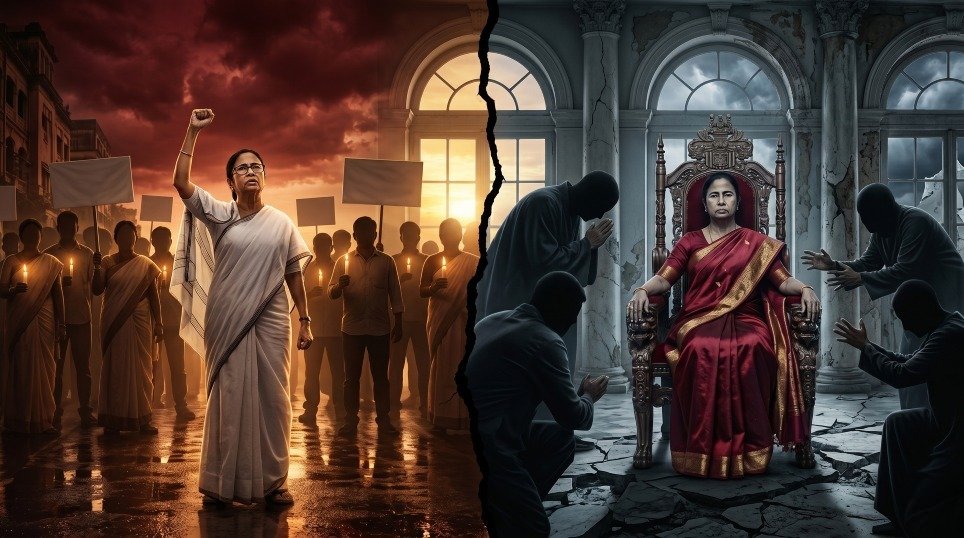


From Glory to Shame:
The Political Unravelling
of Mamata Banerjee
She rose from the streets of Bengal as the voice of the voiceless — beaten, humiliated, and hardened by communist brutality. She fell not because her enemies defeated her, but because she became what she once fought. An unsparing editorial on power, betrayal, and the cost of forgetting the people.
There are few political arcs in modern Indian democracy as tragic — and as instructive — as that of Mamata Banerjee. Hers is not merely a story of a politician losing an election or suffering a dip in popularity. It is the story of a movement betrayed from within; of a woman who once embodied the raw, righteous rage of Bengal’s dispossessed, and who now stands as the symbol of everything she once stood against. The journey from glory to shame rarely happens overnight. In Mamata Banerjee’s case, it took exactly the span of her own power.
To understand the magnitude of the fall, one must first understand the height of the rise. Mamata Banerjee did not enter politics on a silver platter. She earned her place in Bengal’s consciousness through suffering. Through the years of Left Front dominance, when the Communist Party of India (Marxist) ruled Bengal with cadre violence, land intimidation, and institutional stranglehold, Mamata Banerjee was among the very few willing to stand in the line of fire — literally. She was dragged, beaten, and publicly humiliated by communist goons. She sat on dharnas on streets. She went where Congress dared not, where other opposition leaders made only symbolic noises.
The people of Bengal saw in her something rare in Indian politics: a leader who shared their vulnerability. She was not a Lutyens insider. She was not a dynastic heir. She was one of them — stubborn, street-smart, unglamorous, and fierce. When she broke away from Congress to form the Trinamool Congress in 1998, it was not just a political split. It was a declaration that Bengal’s people deserved a voice that was truly their own.
The 2011 Bengal election was more than a victory — it was a catharsis. Over three decades of Left rule ended not with a whimper but with a roar. The mandate was emphatic, emotional, and deeply personal. Bengal had chosen Mamata Banerjee not merely as a Chief Minister but as a symbol of its own liberation.
The people of Bengal did not just vote for Mamata Banerjee in 2011. They voted for themselves — for the belief that the era of fear was finally over.
Editorial Analysis — News24Media.orgWhat follows liberation, when the liberators themselves refuse to be accountable, is a story as old as power itself. The first signs were subtle. Mamata’s administration, from its early days, showed a troubling preference for political loyalty over institutional integrity. The CPI(M) cadre culture — which she had rightly condemned — was not dismantled. It was replaced. Trinamool Congress booth-level muscle became the new enforcement machinery. The violence did not end; it merely changed its colour from red to blue and white.
But the deeper rot came from a more personal source: the narrowing of Mamata’s political universe to her own family and inner circle. What began as a people’s movement gradually contracted into a court of loyalists, nephews, and fixers. Policy became patronage. Governance became gatekeeping. The very institutional capture that the communists had perfected over decades was being replicated under a new flag.
Those who dared to speak — journalists, opposition voices, even old Trinamool loyalists who fell out of favour — discovered that the Bengal of Mamata Banerjee was not fundamentally different from the Bengal of the Left in terms of tolerance for dissent. The geography of fear had merely shifted.
Perhaps the most consequential — and in retrospect, the most self-destructive — strategic choice of Mamata’s tenure was her relentless pursuit of minority vote consolidation as a singular electoral pillar. This is not a communal observation. It is a political one. Every democratic leader builds coalitions. The question is whether those coalitions serve the public interest or merely serve the coalition.
Mamata’s minority appeasement went beyond reasonable minority welfare measures. It became competitive, performative, and — critically — exclusionary. Imams were given stipends. Madrasa infrastructure received generous state support. Administrative appointments, police postings, and institutional appointments developed visible patterns that the Hindu majority of Bengal could not ignore. Electoral calculations required the consolidation of Muslim votes as a monolithic bloc, and the machinery of state was increasingly oriented toward achieving that consolidation.
The strategy worked — electorally — for a season. Muslim voters, constituting roughly 27–28 per cent of Bengal’s population, did vote as a near-solid bloc in favour of TMC through successive cycles. But the cost was catastrophic: the systematic alienation of the Hindu majority, particularly the rural and lower-middle-class Hindus who had once been the backbone of Mamata Banerjee’s original support base.
You cannot win an election by holding one community hostage and ignoring the other. You can only delay the reckoning — and when it comes, it comes as a verdict.
Editorial Analysis — News24Media.orgThe 2024 Lok Sabha results offered a preview. The BJP’s dramatic gains in Bengal — capturing seats in areas that were once considered TMC fortresses — were not the work of Modi’s charisma alone. They were the arithmetic consequence of a Hindu consolidation that Mamata’s own governance had engineered, inadvertently, through years of perceived neglect. Those who feel unseen find a voice eventually.
Indian voters have historically shown a complex relationship with political dynasties. They tolerate them; sometimes they even vote for them. What they do not forgive is when dynastic ambition visibly overrides public interest. In Bengal, the name that came to represent this dysfunction more than any other was Abhishek Banerjee — Mamata Banerjee’s nephew, who rose from being an MP to becoming the de-facto second centre of power in Trinamool Congress, bypassing an entire generation of senior leaders who had sacrificed for the party.
The message this sent to Bengal’s political class — and to Bengal’s people — was unambiguous: the party had become a family enterprise. Governance decisions, party tickets, and ministerial portfolios were filtered through the prism of familial loyalty. Merit became secondary to proximity. The old guard that had actually marched with Mamata against the communists found themselves sidelined, humiliated, or forced to publicly prostrate themselves before a political machinery they barely recognized.
- Cadre Violence: Political murders and booth-level intimidation replaced the very culture of terror that TMC claimed to have ended with the Left’s defeat.
- Syndicate Raj: Construction, sand mining, and real estate came under TMC-linked syndicates that extracted rents from ordinary citizens and contractors alike.
- Saradha & Rose Valley Chit Fund Scams: Hundreds of thousands of small investors — the very poor and lower-middle-class people Mamata Banerjee claimed to champion — lost their life savings. TMC leaders were implicated at multiple levels.
- School Jobs Scam: The Bengal School Service Commission recruitment scandal exposed systematic corruption in teacher and staff appointments, with crores exchanged for government jobs meant for ordinary educated youth.
- Dynastic Consolidation: The rise of Abhishek Banerjee as the party’s shadow power centre institutionalized nepotism and sidelined experienced leaders.
- RG Kar Medical College Horror: The rape and murder of a trainee doctor at RG Kar Medical College in 2024 — followed by the state government’s bungled response and alleged tampering — became a national symbol of governance failure and institutional rot.
- Minority Appeasement at Majority Cost: State policy visibly skewed toward minority welfare in ways that alienated the Hindu majority, politicized religion, and undermined the secular, welfare-neutral mandate of governance.
- Resignation Tamasha: The recent spectacle of Mamata Banerjee announcing her resignation after electoral setbacks — only to refuse to vacate — reduced democratic convention to personal theater, treating the constitutional mandate as a personal bargaining chip.
The recent episode of Mamata Banerjee announcing her intention to resign — and then declining to actually do so — is not merely a political gimmick. It is a window into the philosophical rot at the heart of how she understands democratic accountability. A resignation in a parliamentary democracy is not a press conference moment. It is a constitutional act. When a Chief Minister offers to resign after a lost election and then treats that offer as a theatrical gesture rather than a genuine commitment to the mandate of the people, it is an insult — not to the opposition, but to the voters themselves.
What Mamata Banerjee’s resistance to resignation reveals is a belief, deeply entrenched over fifteen years of power, that Bengal is not a state with a democratic mandate to be respected — it is a personal dominion to be managed. The people did not give their verdict; they merely expressed a preference to be overridden. This is not the language of a leader who once walked barefoot on the streets of Singur and Nandigram for the people’s cause. This is the language of power that has forgotten entirely how it was obtained.
A leader who refuses to resign after losing the people’s mandate is not showing strength. She is showing that she never truly believed the power belonged to the people in the first place.
Editorial Analysis — News24Media.orgBehind every governance failure there is an enabling ecosystem, and Mamata Banerjee’s Bengal built one methodically over fifteen years. The TMC’s grassroots structure, which should have been a network of community service, became a rent-extraction machine. Party workers at every level understood that affiliation with TMC was a license — for construction contracts, for land deals, for police protection, for extortion. The famous “cut money” culture, where a percentage of every government scheme was siphoned by local TMC workers, became so normalized that it generated its own public vocabulary.
This was not a peripheral phenomenon. It was structural. The party’s finances, the state’s contractor ecosystem, and local governance across districts became interlocked in a matrix of corruption that made ordinary governance — getting a ration card, a panchayat scheme, a school job — contingent on party loyalty and payment. Bengal’s poor, who had voted for Mamata to escape the communists’ extortion, found themselves paying a different toll to a different collector on the same road.
What makes Mamata Banerjee’s decline genuinely tragic — rather than merely politically satisfying for her opponents — is what might have been. She had everything a transformational leader needs: a genuine popular mandate born of authentic suffering, a state desperate for change, national attention, and fifteen years to build something lasting. She could have institutionalized Bengal’s governance, built world-class education infrastructure, revived industry, and created a model of secular governance that served all communities without instrumentalizing any.
Instead, the legacy she leaves is one of wasted years, institutional decay, and a political culture that rewarded goons, punished merit, and reduced governance to the management of vote blocs. The tragedy is not that she failed against impossible odds. The tragedy is that the odds were never impossible — and she chose, at every fork in the road, the path of political convenience over public good.
Mamata Banerjee deserved a better legacy than the one she has written for herself. Bengal deserved better than the one she delivered. History will record that she rose as a genuine tribune of the people — and that she fell, not from the arrows of her enemies, but from the weight of her own governance. The shame that now defines her political twilight is not imposed from outside. It was built, brick by brick, through fifteen years of choices. And the people of Bengal, patient and long-suffering as they have always been, have begun — however slowly — to deliver their judgment.
Discover more from
Subscribe to get the latest posts sent to your email.