
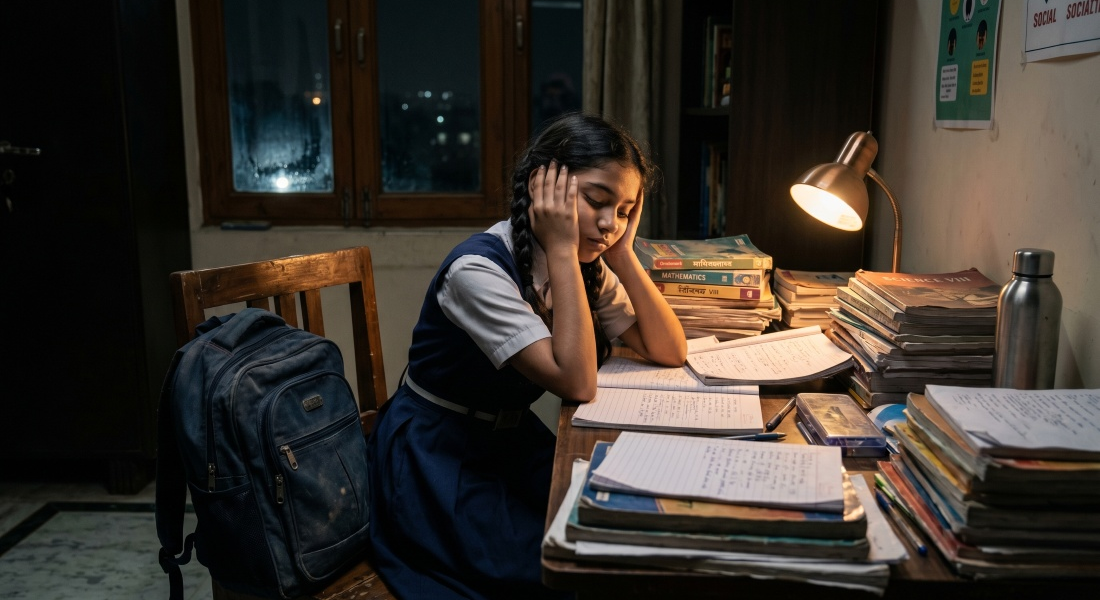
Real Learning vs Traditional Schooling: Why India’s Education System Is Failing Students Today


From Homework to Real Learning: Why Traditional Schooling Needs a Reset
India graduates millions of students who top board exams — and struggle to write a coherent argument, solve an unfamiliar problem, or think independently. The gap between traditional schooling and real learning has become a national emergency.
Every school morning, millions of Indian students pack bags heavier than their own ambitions — filled with textbooks, worksheets, and homework assignments designed to fill every available hour. Parents frame report cards. Schools post rank boards. And the nation runs a ₹5.8 lakh crore coaching industry to help children memorise more efficiently. Yet a quiet, damning truth persists across classrooms, boardrooms, and dinner tables: India is producing exam-toppers who cannot think, communicate, or solve problems they have not been trained to expect.
This is the central tension of traditional schooling vs real learning — and it is no longer an academic debate. It is a structural crisis with measurable, compounding consequences for students, families, and India’s long-term economic ambition.
The Factory Model and Why It Is Failing
India’s modern school system inherited its architecture from 19th-century Prussian models, filtered through British colonial administration: fixed periods, standardised syllabi, and annual examinations designed to produce compliant clerks, not independent thinkers. The homework load that defines the Indian school experience is not a pedagogical tool — it is a legacy of a system built for a world that no longer exists.
The results are now well-documented. The ASER 2024 report reveals that only 23.4% of Class III students in government schools can read a Class II-level text — a foundational failure that makes every subsequent year of schooling less effective. Simultaneously, student burnout has become the defining experience of adolescence, with academic research consistently finding that burnout levels among students reduce average academic performance by up to 25% — a cruel irony in a system that exists to drive performance.
The coaching industry — our national workaround for a broken school system — does not educate; it games examinations. That millions of families see this as the only rational choice is a structural verdict. The grades signal effort; they do not certify understanding.
The Policy Response: NEP 2020 and CBSE Reforms
India’s policymakers have formally acknowledged the crisis. The National Education Policy 2020 — the country’s first comprehensive education overhaul in 34 years — represents a systemic pivot from content delivery to competency development. As of 2025, NEP 2020 is 67% implemented nationwide, introducing the 5+3+3+4 curricular structure, dissolving rigid stream separations, mandating vocational training from Class 6, and pushing competency-based evaluation in place of recall-heavy board exams. Biannual board exams, introduced in 2025, are designed specifically to reduce the single-event stress that has made the Class X and XII years among the most psychologically damaging of Indian students’ lives.
Simultaneously, CBSE’s Competency Based Education (CBE) framework — implemented progressively since the 2019–20 academic year and fully expanded to Classes 9–12 — is redesigning examination questions to require analysis, evaluation, and application rather than pure recall. Case-based questions, assertion-reasoning formats, and scenario-based problems are now standard. The reform is explicit: student real learning habits must shift from passive consumption to active construction of knowledge.
These are significant, meaningful changes. Their gap is execution — NEP’s ambitions require teacher retraining, infrastructure investment, and cultural change at the school level that policy documents alone cannot deliver.
What Real Learning Actually Looks Like
Skill-based real learning is not the absence of rigour — it demands more. Real learning in the 21st century means students can do things with knowledge, not just store it. Critical thinking — the ability to evaluate evidence and reach independent conclusions — is now a survival skill in an era of algorithmic misinformation. Problem-solving means approaching unfamiliar, multi-variable challenges without a textbook template. Communication means writing, speaking, and presenting ideas with clarity. These are not soft skills; they are the hard skills of cognition, and they cannot be developed through homework completion charts.
Forward-looking institutions like Saraswati World School in West Bengal have begun embedding inquiry-based and project-driven pedagogies into their classroom practice — recognising that teachers must evolve from information dispensers into learning architects. The shift is neither easy nor instant, but it is the right direction. At Saraswati World School, continuous professional development for educators has been identified as a non-negotiable investment, because teachers cannot be expected to shift their practice without structural support and institutional permission to experiment.
What Must Change — and Who Must Change It
Reform is not permissiveness. Moving beyond traditional schooling does not mean abandoning accountability — it means redefining what we hold students accountable for. Schools must diversify assessment beyond single-format examinations to include portfolios, presentations, and peer evaluations. Classrooms must make room for productive struggle: students forming hypotheses, testing them, revising their thinking. And parents must stop measuring their children entirely by report card ranks, asking instead: Does my child ask questions? Can they explain their reasoning? Do they approach new problems with curiosity or panic?
The future of education in India is not predetermined. Institutions like Saraswati World School demonstrate that structured, monitored, purposeful pedagogy can hold rigour and creativity in the same room. The demographic dividend economists celebrate — 260 million students enrolled in India’s education system — is either our greatest asset or our greatest liability. The answer depends entirely on whether we teach our children to think, or merely to remember.
The homework was never the education. The education was always in the thinking. It is past time our schools acted like they knew the difference.
NEWS 24 MEDIA Real Learning traditional schooling vs real learning CBSE education reforms 2025Discover more from
Subscribe to get the latest posts sent to your email.





1 COMMENTS