We Will Not Allow Impediment”: In West Bengal SIR Case Supreme Court Cracks Whip on Mamta Govt


West Bengal SIR Case and the Supreme Court
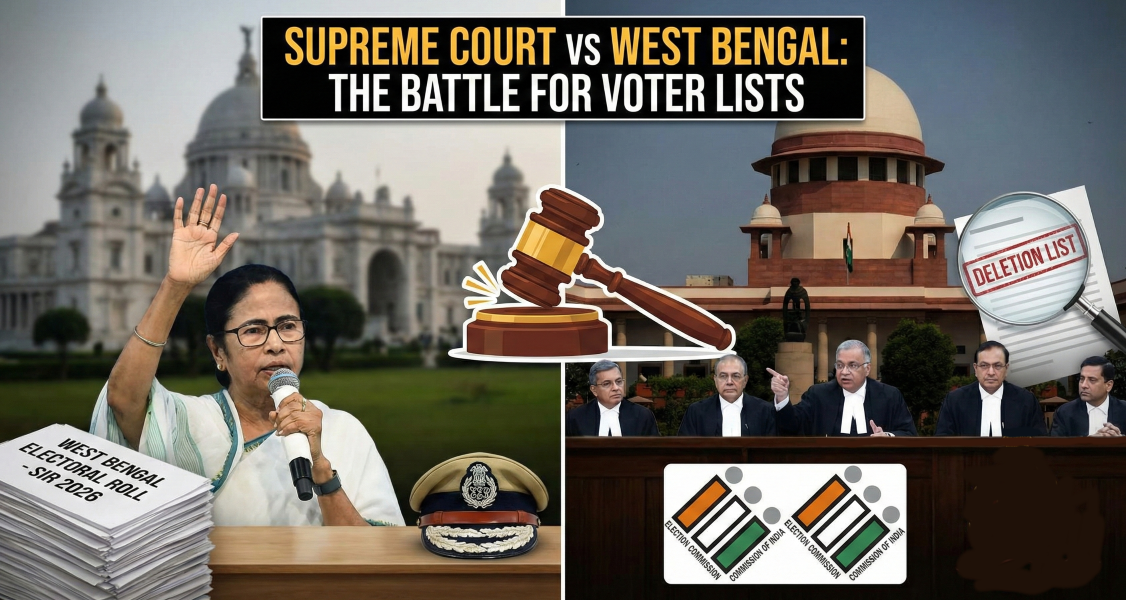
In a significant judicial setback for the West Bengal government, the Supreme Court has firmly refused to halt the Election Commission of India’s (ECI) Special Intensive Revision (SIR) of electoral rolls, just days after Chief Minister Mamata Banerjee personally pleaded before the bench to “save democracy.”
The apex court’s hearings this week have culminated in a series of stern directives that have intensified the ongoing institutional clash between the State of West Bengal and Central agencies.
The “Impediment” Statement
The flashpoint occurred during the hearing on Monday, February 9, when a bench led by Chief Justice of India Surya Kant issued a categorical warning to the State government. Despite the Chief Minister’s earlier impassioned arguments that the SIR process was being used to disenfranchise genuine voters through “logical discrepancies” (such as spelling errors), the Court took a hardline stance.
“We will remove hurdles, but we will not allow any impediment in the completion of SIR. Let us be very clear about it. This must be understood by all states,” the CJI remarked.
This statement effectively dismantled the State’s hope for a stay on the revision exercise. While the Court did grant a minor concession—extending the deadline for claim scrutiny by one week beyond February 14—it ordered the State to immediately depute 8,550 Group B officers to assist the ECI, effectively commandeering the state machinery to complete the very process the State opposed.
Mamata’s Rare Personal Plea for West Bengal SIR Case
The West Bengal SIR Case hearing followed a dramatic session on February 4, when Ms Banerjee became the first serving Chief Minister in recent history to argue personally before the Supreme Court.
Appearing in the courtroom, she contended that the “SIR” was not a revision but a “deletion exercise” targeted at Opposition-ruled states. She highlighted how common Bengali surnames like “Dutta” vs. “Datta” were being flagged as discrepancies to delete voters. “They are bulldozing the people of Bengal,” she had argued. While the CJI had sympathetically remarked that “Tagore is Tagore, no matter how they spell it,” acknowledging the spelling issue, the final order on Monday prioritised the ECI’s timeline over the State’s objections.
Police Leadership in the Dock
The Court’s scrutiny extended heavily to the West Bengal Police. Addressing the “alarmingly” high number of complaints regarding threats and violence against ECI officials (Micro-Observers), the Supreme Court ordered the West Bengal Director General of Police (DGP) to file a personal affidavit.
The Bench questioned why no FIRs had been registered despite the ECI’s repeated complaints of intimidation and the “mass burning of Form 7” (objection forms). The demand for a personal explanation from the police chief signals the Court’s dissatisfaction with the local law enforcement’s neutrality.
Key Takeaways: SC Hearing on West Bengal SIR Case
- SC Refuses Stay: The Supreme Court declined CM Mamata Banerjee’s personal plea to halt the Special Intensive Revision (SIR) of electoral rolls, stating it will “not allow any impediment” to the process.
- Mandatory Staffing: The State Government was ordered to immediately depute 8,550 officers to assist the Election Commission, overriding the State’s earlier refusal to cooperate.
- The “Tagore” Remark: CJI Surya Kant remarked that “Tagore is Tagore” regardless of spelling, acknowledging the issue of name discrepancies but refusing to scrap the verification exercise because of them.
- Police Chief Questioned: The West Bengal DGP was directed to file a personal affidavit explaining why Election Commission officials were allegedly left unprotected facing threats and violence.
- ED Conflict: Simultaneously, the Supreme Court protected Enforcement Directorate (ED) officials from State Police FIRs, warning that obstructing central agencies could lead to “lawlessness.”
The ED Connection: A Multi-Front Battle
Adding to the State’s legal woes, the West Bengal SIR Case hearing unfolded against the backdrop of a parallel conflict involving the Enforcement Directorate (ED). Solicitor General Tushar Mehta, representing the Centre, drew parallels between the obstruction of the SIR process and the recent I-PAC raids, where the ED alleged that State machinery was used to hide evidence and obstruct central investigations.
The Supreme Court had earlier stayed FIRs filed by the Kolkata Police against ED officials, with the bench observing that if state agencies obstruct central probes, “a situation of lawlessness may prevail.” The convergence of these two cases—one on voters (SIR) and one on financial investigation (ED)—has placed the West Bengal administration under immense judicial pressure.
What’s Next?
The State government must now comply with the order to deploy thousands of its officers to report to the ECI by 5:00 PM Tuesday. Meanwhile, the DGP is on the clock to explain the alleged security lapses before the next hearing.
West Bengal SIR Case, Supreme Court SIR Hearing, Mamata Banerjee vs Election Commission, West Bengal Electoral Roll Revision, SIR Process West Bengal 2026, West Bengal SIR Case update,
Discover more from
Subscribe to get the latest posts sent to your email.