
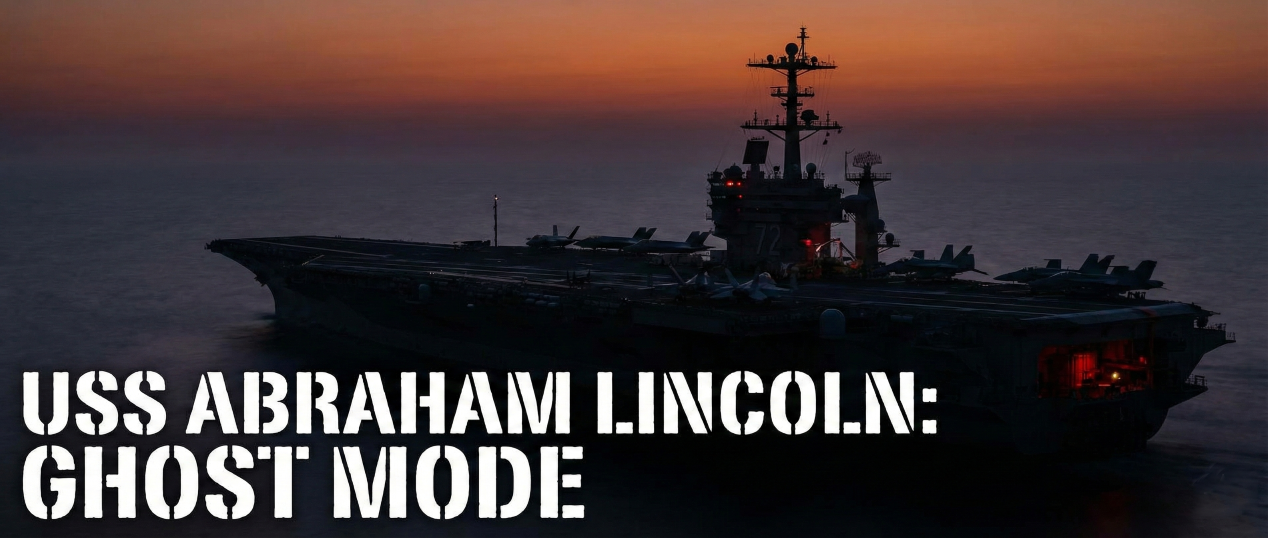
Ghost Mode Activated: Why the USS Abraham Lincoln Deadliest Warship is Now ‘Invisible


The Ghost in the Gulf: Why the USS Abraham Lincoln “Disappeared” on the Edge of War
For the vast community of maritime observers, open-source intelligence (OSINT) analysts, and nervous diplomats in Tehran, the USS Abraham Lincoln (CVN-72) has ceased to exist.
Just 72 hours ago, the 100,000-ton Nimitz-class supercarrier was a visible digital blip on the screens of global tracking systems, steaming steadily westward from the Strait of Malacca. It was the centrepiece of a widely publicised US deployment—dubbed by some administration officials as the “Liberty Armada“—redirected from the South China Sea to the Middle East in a muscular show of force against the Islamic Republic of Iran.
Then, on January 26, the blip vanished.
The Automated Identification System (AIS) transponders fell silent. The chatter on unencrypted radio frequencies ceased. To the digital world, the USS Abraham Lincoln had evaporated into the humid haze of the Indian Ocean. But this was no accident, nor was it a supernatural event. The carrier had entered what military insiders call “EMCON Alpha”—total Emissions Control. It had gone into “Ghost Mode.”
As of this morning, the carrier strike group is operating in total electronic silence somewhere in the North Arabian Sea or the Gulf of Oman, poised within striking distance of the Iranian coast. Its disappearance is not a retreat; it is the loudest signal yet that the United States has moved from a posture of deterrence to a posture of pre-combat readiness.
The Anatomy of Silence: Understanding “Ghost Mode”
To understand the panic rippling through social media—where rumours of “super-cloaking technology” are trending—one must understand the difference between civilian tracking and military reality.
“Ghost Mode” is a colloquialism for a standard, albeit severe, wartime protocol. In peacetime, US warships often broadcast their location via AIS to ensure navigational safety and avoid collisions with commercial tankers. However, in a “threat environment,” broadcasting one’s coordinates is tantamount to painting a bullseye on the hull for enemy cruise missiles.
“When a Carrier Strike Group (CSG) goes EMCON, they aren’t turning invisible to physics; they are turning invisible to mathematics,” explains a naval warfare analyst. “They shut down radars, radios, data links, and transponders. They stop emitting the electromagnetic waves that adversaries use to triangulate their position. They become a black hole in the ocean.”
This tactical silence is defensive, designed to neutralise Iran’s long-range surveillance capabilities. Iran’s military relies heavily on passive sensors—listening for the powerful radar pulses of a US ship to guide their ballistic missiles. By going dark, the USS Abraham Lincoln forces Iran to rely on active measures, such as launching patrol aircraft or activating coastal search radars—actions that would immediately expose those Iranian assets to destruction by the carrier’s combat air patrol.
While the ship is gone from civilian apps like MarineTraffic, it is certainly not invisible to the optical satellites of powers like China or Russia. However, for the tactical commanders in Tehran, the uncertainty is the weapon. A carrier known to be 500 miles away is a political problem; a carrier that could be 200 miles away, or 800 miles away, is a tactical nightmare.
The Pivot: From the Pacific to the Persian Gulf
The arrival of the USS Abraham Lincoln marks a significant strategic pivot. Just two weeks ago, the carrier was navigating the contested waters of the South China Sea, serving as a check against Chinese expansionism. Its rapid transit across the Indian Ocean highlights the Pentagon’s ability to “swing” forces across hemispheres.
This redeployment comes at a flashpoint in US-Iran relations. Following the collapse of the latest round of nuclear proliferation talks in Vienna and a brutal crackdown on anti-government protests within Iran, rhetoric from both Washington and Tehran has reached a boiling point. US officials promised a response of “speed and violence” to any Iranian aggression against commercial shipping, prompting the IRGC to declare all US assets in the region as “legitimate targets.”
The USS Abraham Lincoln did not arrive alone. It is escorted by a phalanx of Ticonderoga-class cruisers and Arleigh Burke-class destroyers, likely including the USS Spruance. These ships provide the “Aegis Shield”—a layered air defence network capable of swatting down ballistic missiles in the upper atmosphere. But the true power lies on the USS Abraham Lincoln’s flight deck, home to Carrier Air Wing 9 (CVW-9).
The Hammer: Fifth-Generation Air Power
The disappearance of the USS Abraham Lincoln is terrifying to military planners because of what it carries. This deployment represents one of the most lethal configurations of naval air power in history, specifically tailored to dismantle the kind of integrated air defence systems (IADS) operated by Iran.
Leading the charge is the Marine Corps squadron VMFA-314, the “Black Knights,” flying the F-35C Lightning II. These are the “door kickers.” In a conflict scenario, while the carrier remains hidden in the Gulf of Oman, these stealth fighters would penetrate Iranian airspace undetected. Their mission would not be to bomb cities, but to blind the enemy—hunting down the Russian-made S-300 and domestic Bavar-373 radar sites that protect Iranian airspace.
“The F-35C changes the calculus completely,” notes former naval aviator Commander. “In previous conflicts, we had to launch massive waves of missiles to suppress defences. Now, a flight of four F-35s can slip inside the enemy’s radar bubble, identify the targets, and either destroy them or pass the data to destroyers hundreds of miles away. Iran has no answer for this.”
Behind the stealth fighters wait the “heavy metal”: squadrons of F/A-18E/F Super Hornets. Known as “bomb trucks,” these non-stealthy jets can carry massive payloads of standoff munitions such as the AGM-158C LRASM. Once the F-35s have shattered the defensive shield, the Super Hornets would systematically dismantle Iranian command and control centres, missile storage facilities, and naval bases.
The Iranian Gambit: Asymmetric Response
Tehran is acutely aware of the threat. The Islamic Revolutionary Guard Corps (IRGC) Navy has long prepared for a conflict where they are outgunned, adopting a doctrine of “swarm” warfare.
Intelligence reports suggest that as the USS Abraham Lincoln went silent, activity along Iran’s southern coast spiked. Satellite imagery has detected the movement of hundreds of fast attack craft—small, nimble speedboats armed with rockets and missiles—being dispersed from central bases to hidden coves along the Strait of Hormuz.
The Iranian strategy is simple: saturation. They hope to overwhelm the technological superiority of the US Navy with sheer numbers. The logic is that while the USS Abraham Lincoln can track and destroy 100 targets, a swarm of 300 explosive-laden speedboats and suicide drones might allow one or two to slip through the net.
“The Iranians call it the ‘Mosquito’ strategy,” says a regional analyst. “They know they can’t sink the carrier in a duel. But if they can score a single hit on the flight deck—killing sailors and grounding the air wing—they claim a victory. They are banking on the fact that the US public has no stomach for casualties.”
Furthermore, Iran maintains a vast arsenal of ballistic missiles and “loitering munitions” (suicide drones) hidden in the Zagros Mountains. The “Ghost Mode” of the USS Abraham Lincoln complicates their targeting, but if the carrier launches strikes, it must emit radar signals, momentarily revealing its location. It is a deadly game of cat and mouse, played with hypersonic speeds and nuclear stakes.
The Geopolitical Aftershocks
The implications of this standoff extend far beyond the military sphere. The USS Abraham Lincoln’s presence in the Gulf of Oman places it near the Strait of Hormuz, the jugular vein of the global economy through which 20% of the world’s oil supply flows.
Diplomatically, the silence of the USS Abraham Lincoln speaks louder than any press conference. It signals to allies in Riyadh, Abu Dhabi, and Jerusalem that the US security guarantee remains intact despite the “pivot to Asia” narrative of recent years. Conversely, it serves as a stark warning to Beijing and Moscow. By moving a capital ship from the South China Sea to the Middle East so rapidly, Washington is demonstrating that it still possesses the logistical capacity to fight on multiple fronts if necessary.
However, the risk of miscalculation is higher than ever. With the carrier running silent and Iranian forces on a hair-trigger alert, an accidental collision, a misunderstood radar contact, or a rogue drone intercept could ignite the powder keg.
Waiting in the Dark
As night falls over the Arabian Sea, the USS Abraham Lincoln remains a ghost. On board, 5,000 sailors are likely living in a surreal state of disconnected readiness—no internet, no calls home, just the hum of the ventilation and the periodic roar of flight operations.
They are the hidden tip of a spear that the world hopes will never be thrown. But for now, their disappearance is the most visible thing on the planet. The carrier is there, somewhere in the dark water, waiting for the order to either break the silence with diplomacy or with thunder.
USS Abraham Lincoln, USS Abraham Lincoln ghost mode,
Discover more from
Subscribe to get the latest posts sent to your email.








4 COMMENTS