
China’s “Justice Mission 2025” Encircles Taiwan: Blockade Drills Signal Escalating Gray-Zone War in Asia


China’s ‘Justice Mission 2025’ Encircles Taiwan: Blockade Drills Signal Escalating Grey-Zone War
Beijing intensifies military pressure with large-scale exercises around Taiwan, simulating encirclement, port blockades, and rapid-strike scenarios — as Taipei and Tokyo ramp up defence readiness
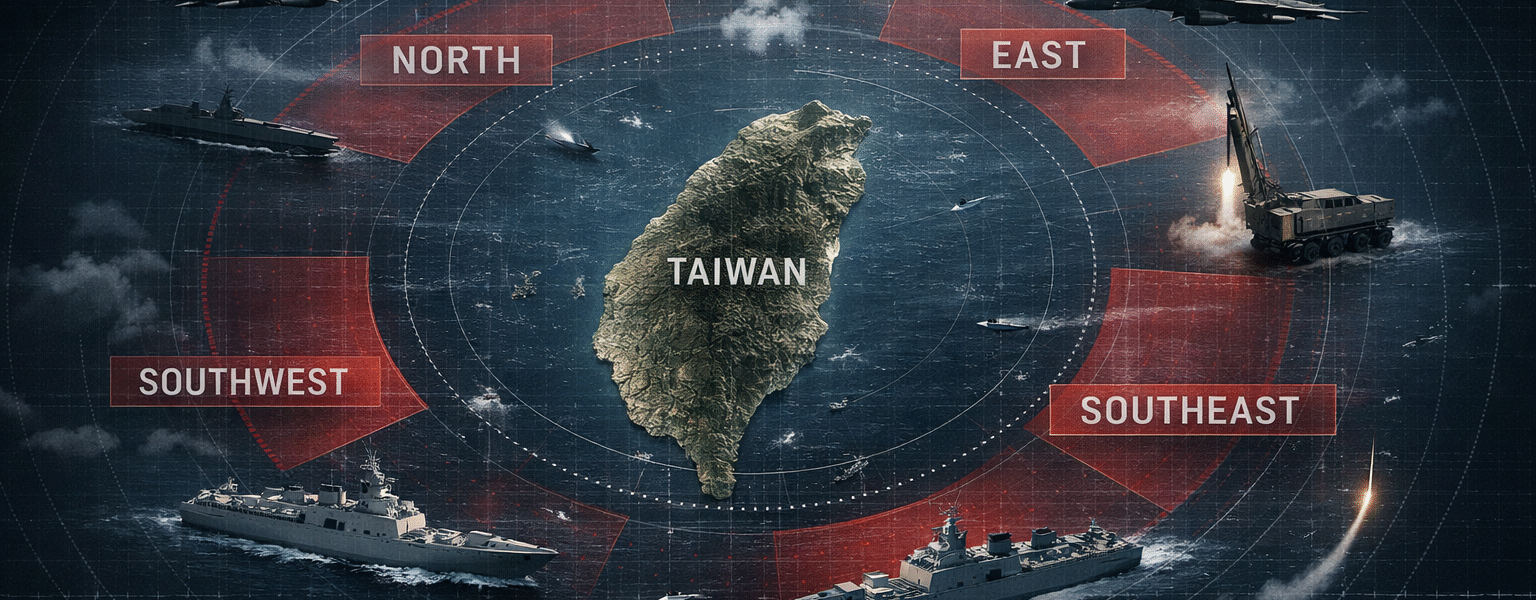
China’s military has launched its largest and most provocative war games to date around Taiwan, under a sweeping operation dubbed Justice Mission 2025. The exercises — involving naval fleets, air force squadrons, rocket units, and ground forces — encircle the self-governed island from the north, east, southeast, southwest and the Taiwan Strait, signalling a marked shift in Beijing’s approach to grey-zone warfare and regional power projection.
The drills come amid rising geopolitical tensions triggered by a recently approved U.S. $11.1 billion arms sale to Taiwan, and heightened rhetoric following Japanese political statements suggesting Tokyo could respond militarily if China attacked the island. Beijing’s latest manoeuvres underscore a strategy of sustained coercive pressure designed to wear down Taipei’s defences and deter external support — without crossing the threshold into full-scale conflict.
Record-Scale Encircling Drills Around Taiwan
On Dec. 29, 2025, the People’s Liberation Army (PLA) kicked off Justice Mission 2025, a complex set of live-fire drills that, for the first time, officially include areas close to Taiwan’s territorial waters and airspace. According to PLA Eastern Theatre Command statements, the exercises involve joint operations by the army, navy, air force, missile units and other branches, conducting patrols, simulated strikes, blockades of key ports and zones, and perimeter deterrence around the island.
State media reports and military briefings indicate fighter jets, bombers, destroyers, missile launchers and unmanned aerial vehicles are operating in five designated zones encompassing Taiwan’s surrounding seas and airspace, marking a significant escalation from prior drills. China has characterised the operation as a “stern warning” to “Taiwan independence” separatist forces and external interference, especially in the wake of the U.S. weapons deal and diplomatic friction with Japan.
The exercises simulate not just combat readiness but also blockade scenarios that would effectively isolate Taiwan from external support — including simulated seizures of strategic sea space and disruptions to port operations near Keelung and Kaohsiung. Analysts say this broad scope suggests Beijing’s intent to refine its ability to cut off Taiwan from allied reinforcement and supplies, an increasingly central feature of grey-zone operations that stop short of open war.
Taiwan Tensions: China’s Military Drills and USS Ronald Reagan’s Vigilance
From Grey-Zone Patrols to Live-Fire Pressure
China’s military activities around Taiwan have been intensifying steadily over the past several years, part of a strategy Taiwan’s defence officials describe as “grey-zone harassment and pressure.” According to Taipei, Beijing’s forces now operate around Taiwan on an almost daily basis, with regular patrols, joint combat readiness operations, and other movements meant to keep Taipei constantly vigilant without triggering conventional conflict.
These grey-zone tactics include coast guard incursions, air sorties near Taiwanese air defence identification zones, and periodic large-scale drills such as Strait Thunder-2025A earlier in the year. But Justice Mission 2025 marks a departure in scale and intent; it formalises blockade simulations and joint assaults across multiple service branches, reflecting an effort to test China’s joint operations capabilities under conditions resembling a real confrontation.
Taiwan’s government has condemned the Justice Mission 2025 drills as provocative and destabilising, accusing Beijing of threatening international peace and violating norms governing cross-strait relations. Taipei’s Defence Ministry confirmed that dozens of Chinese military vessels and aircraft were operating around the island, with some deliberately entering Taiwan’s contiguous zone, and warned that it has rapid-response forces ready to counter any sudden escalation.
Taiwan’s Rapid-Response Readiness Amid Rising Threats
In response to the heightened military activity, Taipei has placed its forces on high alert, conducting its own drills designed to enhance mobility and coordination across naval, air and ground units. Taiwan’s defence leadership has emphasised its capability to respond promptly to any shift from drills to actual conflict, including decentralised command procedures to enable rapid action if necessary.
Taipei has also been advancing its military capabilities in parallel with diplomatic efforts to strengthen international support. In late 2025, Taiwan announced a supplemental $40 billion defence budget aimed at modernising its armed forces and bolstering asymmetric deterrence, including procurement of advanced missile and air defence systems.
Despite the pressure, Taiwan’s financial markets have shown resilience, and civic leadership continues to underscore democratic values in the face of external coercion. Taiwanese officials have repeatedly called on Beijing to cease provocative actions and engage in dialogue, even as they fortify defensive measures.
Japan’s Defence Surge Alters the Regional Security Landscape
The Justice Mission 2025 drills unfold against a backdrop of broader regional recalibration, particularly in Japan, which has been intensifying its own defence posture in response to China’s military assertiveness. In late December 2025, Japan’s cabinet approved a record-high defence budget exceeding ¥9 trillion (about $58 billion) — a significant increase under a five-year plan to raise defence spending to 2 % of GDP.
Japan’s funding boost targets enhanced strike capabilities and long-range missile systems, as well as advanced unmanned platforms and joint development projects with allies such as Australia, the United Kingdom and Italy. Tokyo’s defence strategy is widely interpreted as a direct response to escalating Chinese activities in the region, including frequent naval and aerial manoeuvres near Japanese territory and around Taiwan.
Japan’s growing military capabilities add a layer of unpredictability to cross-strait tensions. Earlier in 2025, incumbent Japanese leadership made remarks suggesting that a Chinese attack on Taiwan could trigger a collective defence response, prompting sharp criticism from Beijing and further complicating the security calculus in East Asia.
The U.S. Factor and International Dynamics
Behind the scenes, the United States remains a central actor in the evolving Taiwan Strait crisis. The recent $11.1 billion arms sale to Taiwan — the largest on record — served as a key trigger for Beijing’s Justice Mission 2025 exercises, drawing vehement protests from China’s Defence Ministry and framing the drills as necessary defensive measures.
U.S. officials have reiterated long-standing support for Taiwan’s self-defence capabilities under the Taiwan Relations Act, while stopping short of explicitly promising direct military intervention. This calibrated approach has drawn scrutiny in Beijing, which views U.S. arms transfers and diplomatic engagement with Taipei as interference in China’s internal affairs.
International responses have varied, with some regional partners expressing concern over rising tensions and calling for restraint from all sides. Analysts warn that persistent grey-zone pressure, coupled with high-profile exercises like Justice Mission 2025, risks normalising an ever-higher baseline of military confrontation that could inadvertently escalate into open conflict.
Conclusion: Between Coercion and Containment
China’s Justice Mission 2025 represents a significant escalation in the use of military force as a tool of geopolitical signalling. By encircling Taiwan in multi-domain drills simulating blockades and coordinated assaults, Beijing is reinforcing its claim over the island while testing allied responses and Taiwan’s resolve. Meanwhile, Taipei’s rapid-response readiness, Japan’s defence modernisation, and sustained U.S. support reflect a regional security environment increasingly shaped by strategic competition and deterrence.
As the grey-zone tactics continue to evolve, policymakers and analysts will be watching closely whether these pressure campaigns remain below the threshold of open conflict — or inadvertently tip the region toward unforeseen crisis.
China Taiwan aggression 2025, Justice Mission 2025, Taiwan encirclement drills, China Taiwan military exercises
Discover more from
Subscribe to get the latest posts sent to your email.








1 COMMENTS