
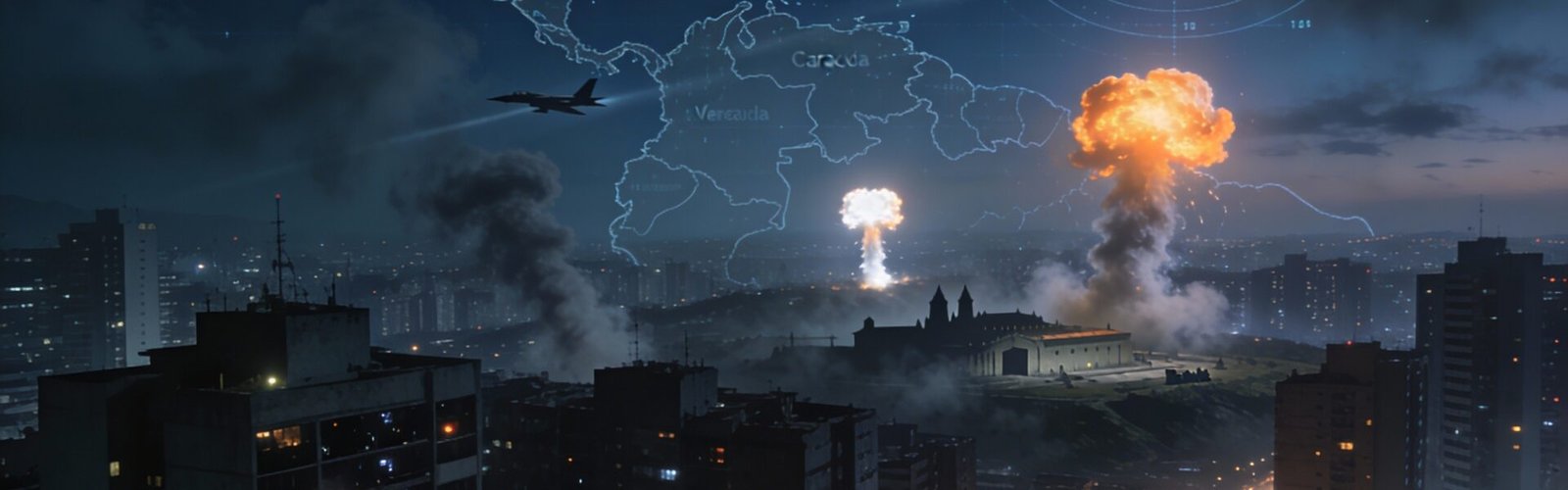
US Strikes Venezuela, Claims Capture of President Nicolás Maduro as Caracas Rocked by Explosions


US Strikes Venezuela- Caracas Under Fire as US Claims Capture of Venezuela’s President
Explosions, a contested arrest, and a sudden escalation reshape Latin America’s geopolitical landscape
In the early hours of 2–3 January 2026, residents of Caracas were jolted awake by a series of powerful explosions that rippled across the Venezuelan capital. Videos posted on social media showed flashes lighting up the night sky, low-flying aircraft roaring overhead, and thick smoke rising from areas near key military installations, including La Carlota Air Base and Fuerte Tiuna, the country’s largest military complex. Power outages were reported in several districts as air-raid sirens wailed and security forces sealed off major roads.
Hours later, the situation escalated dramatically when Donald Trump, now serving again as President of the United States, posted on Truth Social that US forces had carried out a “large-scale strike” against Venezuela and that Nicolás Maduro and his wife, Cilia Flores, had been “captured and flown out of the country” by American special-operations forces.
Within hours of Trump’s statement, Venezuela declared a national emergency. On state television, Vice President Delcy Rodríguez condemned what she called an “imperialist aggression” and demanded “proof of life” for Maduro, saying the government had no verified information on the president’s whereabouts. “Venezuela has not surrendered, and no legitimate change of power has occurred,” she said, as uncertainty spread through the capital.
Is Trump Planning Regime Change in Venezuela? Nicolás Maduro Warns of “Biggest Threat in 100 Years”
What we know of US Strikes Venezuela – and what remains unconfirmed
While the scale of the overnight military action is not in dispute, the political outcome is far less clear.
Confirmed by US officials to major international outlets:
US forces conducted coordinated strikes on Venezuelan military targets and carried out a special operations raid aimed at detaining President Maduro. Officials familiar with the operation said elite US units, identified by several outlets as Delta Force, were involved.
Publicly claimed by President Trump:
Trump has asserted that Maduro and his wife are in US custody and have been flown out of Venezuela. As of the time of writing, no independent visual evidence or third-party confirmation has been released to verify this claim.
Venezuelan authorities’ position:
Caracas has rejected any assertion of a completed transfer of power. Officials insist Maduro’s status is “unclear” and have repeatedly demanded proof that he is alive and safe.
As a result, who is effectively in control in Caracas—and where Maduro is being held—remains contested, with the situation described by diplomats as fluid and highly volatile.
Betrayal, Loyalty & Survival: The Incredible Story of Nicolás Maduro and America’s Failed Plot
From Caribbean build-up to overnight raid

The US Strikes Venezuela follow months of heightened US military activity in the Caribbean throughout 2025. According to defence analysts and US officials, Washington had deployed a substantial force posture around Venezuela, including a US carrier strike group led by the USS Gerald R. Ford, advanced fighter aircraft positioned in Puerto Rico, and an expanded naval presence officially described as “counter-narcotics operations”.
US officials have also acknowledged a covert phase of US Strikes Venezuela, in which intelligence agencies were authorised to intensify clandestine activity inside Venezuela. Senior figures in Washington had repeatedly hinted that the US was entering a “new phase” in its Venezuela policy.
According to early accounts from US sources, the night of the raid (US Strikes Venezuela) involved precision cruise-missile and air strikes targeting air-defence systems and command facilities in and around Caracas. These were followed by a helicopter-borne assault by special operations forces at what was described as a “secure location” linked to Maduro.
Reports suggest limited initial resistance: some Venezuelan air-defence sites were hit before they could engage, and while anti-aircraft fire was reported, there were no confirmed losses of US aircraft. Venezuelan military leadership has not yet provided a detailed account of casualties or damage.
Power vacuum fears inside Venezuela
With Maduro absent from public view, Venezuela faces the prospect of a sudden power vacuum. Analysts say it is unclear whether authority now rests with the vice president, senior figures in the National Assembly, or key military commanders.
There have been scattered reports of sporadic looting in parts of Caracas and other cities, alongside calls by pro-government colectivos—armed civilian groups aligned with Chavista ideology—for “popular resistance”. However, there is no verified evidence so far of a coordinated nationwide counter-offensive.
Experts warn of several possible trajectories:
- A rapid, US-backed transitional authority attempting to stabilise the country.
- Fragmentation into rival political and military factions competing for control.
- The emergence of guerrilla-style resistance, drawing on longstanding Venezuelan contingency plans for prolonged resistance in the event of foreign intervention.
International shockwaves of US Strikes Venezuela
El Gobierno de la República de Colombia observa con profunda preocupación los reportes sobre explosiones y actividad aérea inusual registrados en las últimas horas en la República Bolivariana de Venezuela, así como la consecuente escalada de tensión en la región.
— Gustavo Petro (@petrogustavo) January 3, 2026
Colombia…
The US Strikes Venezuela have triggered immediate diplomatic fallout. Colombian President Gustavo Petro wrote that “Caracas is being bombed right now” and called for an emergency meeting of the UN Security Council, denouncing the operation as a violation of Venezuelan sovereignty.
Latin America appears sharply divided. Some right-leaning governments are reportedly welcoming Maduro’s removal in private, while left-leaning and non-aligned states have condemned what they describe as forced regime change.
Major global powers have also reacted swiftly. Russia and China are expected to push strongly against the operation at the United Nations, warning that unilateral military actions undermine international law. Human-rights organisations and legal scholars have raised urgent questions about the legality of the strikes and the extraterritorial capture of a sitting head of state under the UN Charter.
Why Washington escalated—and what comes next
For Washington, the move represents the culmination of years of pressure on Maduro. The US has long accused him of narco-terrorism, imposed sweeping sanctions on Venezuela’s oil sector, and offered multimillion-dollar rewards for his arrest. Trump has repeatedly framed Maduro as a “narco-dictator” and pledged to use “all instruments of American power” to confront hostile regimes.
But the risks are profound. By intervening directly, the US may now own Venezuela’s transition, inheriting responsibility for preventing civil conflict, delivering humanitarian aid, and stabilising an economy already in deep crisis. Any prolonged disruption to Venezuelan oil production could also reverberate through global energy markets, with implications for OPEC and beyond.
Perhaps most consequentially, analysts say the operation sets a powerful precedent for unilateral regime-change actions, one that rivals such as Russia and China will closely study as they assess their own regional strategies.
A turning point, still unresolved
As dawn breaks over Caracas, the world is left watching a situation defined as much by uncertainty as by shock. The explosions, the contested arrest, and the diplomatic fallout mark a potential turning point in US–Latin America relations, but the outcome remains unwritten.
What is clear is that Venezuela has entered one of the most dangerous and consequential moments in its modern history, with implications that extend far beyond its borders.
US strikes Venezuela, Nicolás Maduro captured, Caracas explosions, Venezuela national emergency, US military operation Venezuela, Delta Force operation Venezuela, US regime change Latin America, Trump Venezuela strike claim, Caracas air base attack, Venezuela power vacuum, US–Venezuela crisis 2026
Discover more from
Subscribe to get the latest posts sent to your email.








1 COMMENTS