
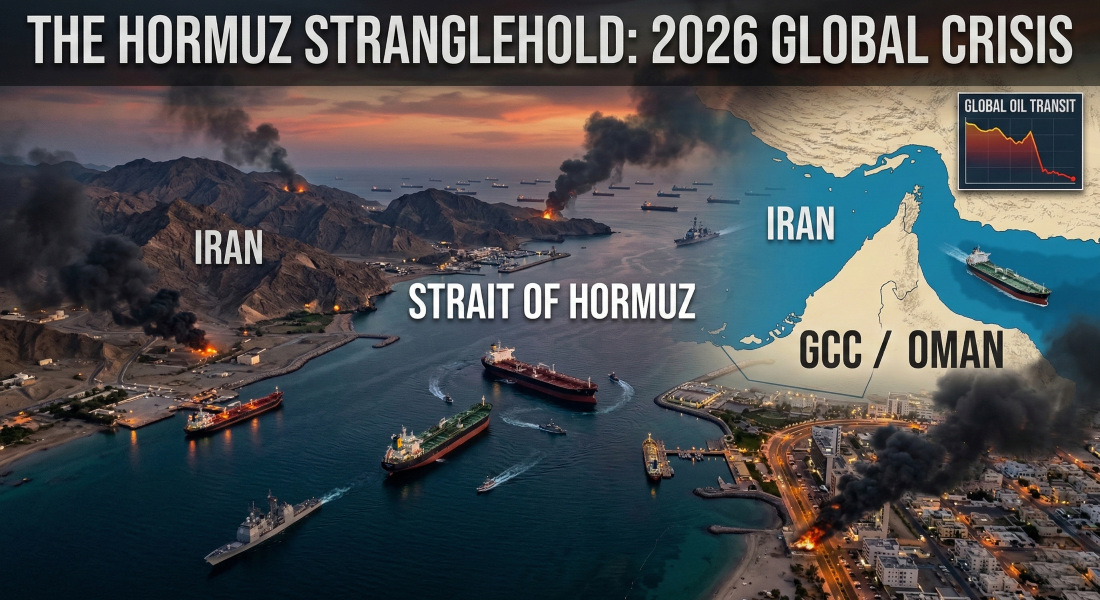


The Global Chokepoint: How the Strait of Hormuz Blockade is Reshaping the 2026 Middle East Conflict
On February 28, 2026, the Middle Eastern geopolitical architecture was fundamentally altered following the collapse of Oman-mediated nuclear negotiations in Geneva. The United States and Israel launched a massive preemptive military campaign against Iran, designated as Operation Epic Fury and Operation Roaring Lion, respectively. However, while aerial bombardments and missile exchanges continue across the region, the strategic centre of gravity has rapidly migrated to a critical maritime chokepoint: the Strait of Hormuz.
The Strategic Geometry of the Strait of Hormuz. Iran’s most potent asymmetric weapon in this escalating conflict has been its threat to close the Strait of Hormuz, a narrow 21-mile-wide passage that serves as the singular maritime egress from the Persian Gulf. The resulting de facto blockade has instantly globalised a regional war, threatening the primary arteries of global hydrocarbon, fertiliser, and base metal supply chains.
Before the hostilities, the Strait of Hormuz handled 20 to 21 million barrels per day of crude oil and condensates, representing 20% to 27% of total global petroleum liquids consumption. Additionally, approximately 20% to 22% of the world’s liquefied natural gas (LNG) trade transits this waterway, predominantly from Qatar and the UAE.
Asymmetric Warfare and the De Facto Blockade
In response to the unprecedented U.S. and Israeli strikes—which achieved total tactical surprise and resulted in the death of Iran’s Supreme Leader, Ayatollah Ali Khamenei—Iran’s newly activated Interim Leadership Council orchestrated massive retaliatory barrages across the region. Concurrently, despite the U.S. coalition severely degrading Iran’s conventional blue-water fleet, Iran established control over the Strait of Hormuz using its “Decentralised Mosaic Defence”.
This naval doctrine relies on a trifecta of asymmetric capabilities:
- The Islamic Revolutionary Guard Corps Navy (IRGCN) operates hundreds of highly manoeuvrable fast attack craft (FAC) designed for swarm tactics.
- Iran has heavily fortified its southern coastline with subterranean “missile cities” and anti-ship cruise missile batteries.
- The regime possesses an estimated stockpile of over 5,000 naval mines, a small fraction of which could paralyse commercial transit.
Traffic through the Strait of Hormuz collapsed by 70% to 80% within hours of the blockade’s enforcement. War-risk underwriters quickly cancelled existing policies, and insurance premiums for the few remaining policies surged by over 1,000%, rendering transit economically unviable for commercial shipping lines.
The Bypass Illusion and Macroeconomic Contagion. While international attention has pivoted to alternative overland pipelines, the global economy faces a severe structural deficit and simply cannot circumvent the Strait of Hormuz in the short to medium term. Even under optimal conditions, the combined unused capacity of alternative routes—such as the Saudi East-West Pipeline and the Abu Dhabi Crude Oil Pipeline—leaves a massive supply deficit of 10 to 14 million barrels per day.
The abrupt removal of these resources has triggered violent repricing across global commodity exchanges:
- Energy Markets: Brent crude prices spiked 10% to over $80 per barrel immediately, with energy analysts warning of a swift breach of the $100 threshold if flows are not restored. Prolonged blockages could theoretically push prices past $200 per barrel. Furthermore, the escalation forced QatarEnergy to halt production at Ras Laffan, instantly removing nearly a fifth of the global LNG supply and forcing European and Asian utilities into aggressive bidding wars.
- Global Food Security: The Strait of Hormuz facilitates the transit of 45% of the global urea supply and 44% of globally traded sulfur. The physical trapping of fertilisers in the Gulf, combined with surging natural gas feedstock costs, has driven up production costs worldwide, posing a systemic threat to global food security right at the start of the Northern Hemisphere’s spring planting season.
- Industrial Metals: With the Gulf Cooperation Council (GCC) accounting for 8.35% of the global primary aluminium supply, the closure of the Strait of Hormuz has caused European and U.S. aluminium premiums to surge dramatically.
U.S. Interventions and Geopolitical Fallout
Recognising that the economic fear of the blockade is enforcing the supply squeeze, the Trump administration initiated aggressive market interventions on March 3, 2026. President Trump announced that the United States would ensure the “free flow of energy” by providing U.S. Navy escorts for commercial tankers transiting the Strait of Hormuz. Furthermore, to counteract the withdrawal of private underwriters, the U.S. International Development Finance Corporation (DFC) was ordered to step in and provide state-backed political risk insurance.
Despite these unprecedented interventions, the theatre of war has expanded to encompass the entire Arabian Peninsula, with Iran launching hundreds of drones and ballistic missiles at military bases and civilian infrastructure in Saudi Arabia, the UAE, Kuwait, Qatar, and Bahrain. This existential threat has fostered sudden solidarity among GCC states, fundamentally altering the region’s security calculus. As the conflict continues to unfold, the stranglehold on the Strait of Hormuz remains the defining feature of a war that has instantly held the global economy hostage.
Want to dive deeper into the tactical and economic breakdown of this crisis? Read the full comprehensive research report here
Discover more from
Subscribe to get the latest posts sent to your email.









4 COMMENTS