Matthew Van Dyke Arrested in India: NIA Uncovers Drone Training Plot Linked to Northeast Insurgency


Inside the Arrest of American Mercenary Matthew Van Dyke: The Northeast Plot That Could Have Shaken India
In what security experts are calling one of the most significant counter-terror interdictions in recent years, Indian authorities have arrested American mercenary Matthew Van Dyke along with six Ukrainian nationals, exposing a chilling transnational plot linked to insurgent destabilisation in India’s Northeast—particularly the volatile state of Manipur.
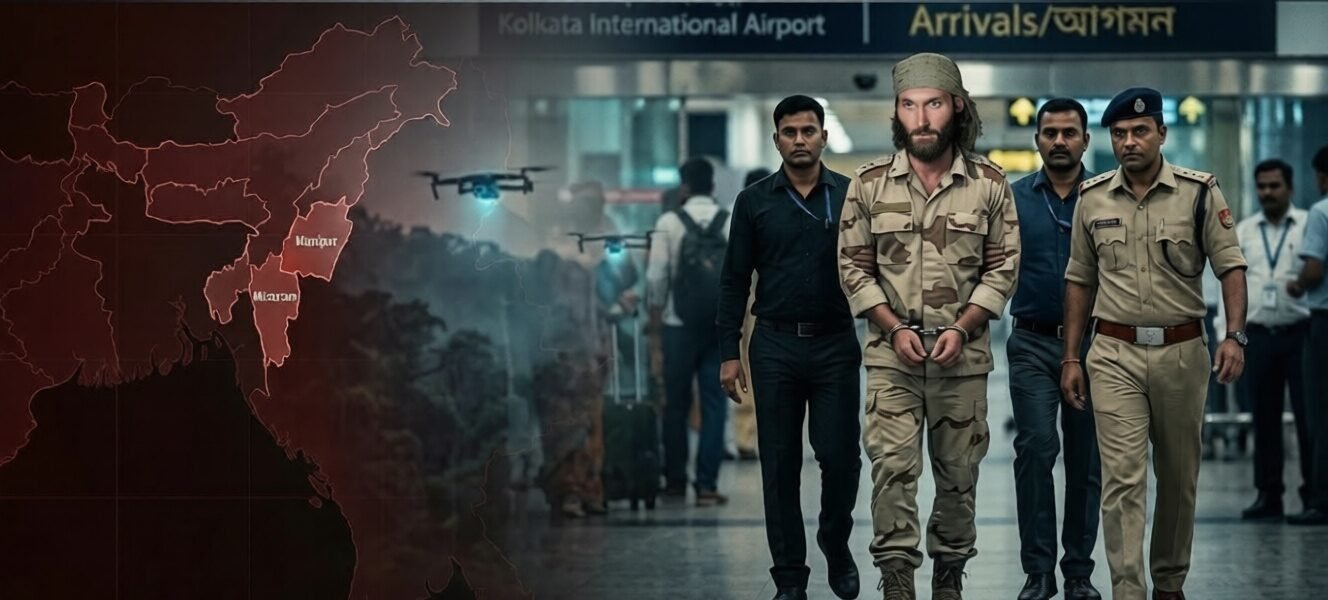
The arrests, carried out on March 13, 2026, were part of a coordinated operation by the National Investigation Agency (NIA) across multiple airports, including Kolkata, Delhi, and Lucknow. Matthew Van Dyke himself was intercepted at Kolkata airport, marking the dramatic end of what investigators describe as a covert, multi-layered operation involving drone warfare training, illegal border crossings, and links to insurgent networks.
A Covert Operation Uncovered
According to court documents and investigative findings, the Matthew Van Dyke’s group allegedly infiltrated India using legitimate tourist visas before quietly moving toward the sensitive Indo-Myanmar border region. From Mizoram, a restricted area requiring special permits, they are accused of illegally crossing into Myanmar’s Chin State, a conflict-ridden zone that has become a sanctuary for ethnic militias.
The objective, as outlined by the NIA, was not ideological propaganda but technical military enablement. The accused allegedly trained armed groups in:
- Drone assembly and operations
- First-person-view (FPV) strike drones
- Electronic warfare and jamming systems
Investigators also claim that European-origin drones were smuggled through India into Myanmar, establishing a potential supply chain that could have sustained long-term insurgent activity.
What makes this case particularly alarming is the alleged nexus between these Myanmar-based ethnic armed groups and proscribed Indian insurgent outfits, suggesting a direct spillover threat into India’s Northeast.
Why the Northeast and Why Now?
India’s Northeast has long been vulnerable to cross-border insurgency dynamics due to its porous borders and complex ethnic landscape. The situation has become even more fragile following the ongoing ethnic conflict in Manipur, which, since 2023, has seen widespread violence, displacement, and the emergence of armed civilian militias.
The region has already witnessed the weaponisation of drones, most notably in the 2024 attacks, where explosives were dropped using UAVs, an unprecedented escalation in insurgent tactics.
Against this backdrop, the alleged training provided by Matthew Van Dyke’s group represents a dangerous leap in capability, potentially transforming insurgent groups from guerrilla fighters into technologically equipped asymmetric warfare units.
Matthew Van Dyke- The Man Behind the Operation
Matthew Van Dyke is no ordinary suspect. A former filmmaker turned combatant, his journey through global conflict zones has been extensively documented.
- He fought alongside rebels in the Libyan Civil War (2011) and was captured as a prisoner of war.
- He later travelled to Syria, engaging with rebel factions.
- In Iraq, he founded Sons of Liberty International (SOLI), a controversial non-profit that provides military training and support to armed groups.
- More recently, he has been active in Ukraine, where he trained forces in drone warfare and electronic systems skills now central to the NIA case.
Experts describe him as a “combat entrepreneur”—an individual operating in the grey zone between ideology, private military contracting, and geopolitical alignment.
The Bigger Question: A Lone Actor or Larger Design?
One of the most debated aspects of the case is whether Matthew Van Dykee was acting independently or as part of a broader geopolitical strategy.
While speculation around intelligence agency involvement, particularly the CIA, has surfaced in public discourse, no concrete evidence has been presented in court to substantiate such claims. Investigations so far have focused on:
- Illegal entry into restricted areas
- Training of armed groups
- Smuggling and the supply of drones
- Conspiracy under the Unlawful Activities (Prevention) Act (UAPA)
The NIA has emphasised that the probe is ongoing, with digital forensics and financial tracking expected to uncover funding sources, collaborators, and possible masterminds.
What Could Have Happened: A Strategic Threat Assessment
Had this network gone undetected, the consequences could have been severe.
1. Drone Warfare in Insurgency
The introduction of FPV drones and jamming technologies could have enabled insurgents to conduct precision strikes on security forces, bypassing traditional defences.
2. Sustained Supply Chains
The alleged Europe–India–Myanmar drone pipeline could have evolved into a permanent logistics corridor, making interdiction increasingly difficult.
3. Escalation of Violence in Manipur
Already fragile, the region could have seen frequent, high-impact attacks, worsening communal tensions and governance breakdown.
4. Strategic Destabilisation
A technologically empowered insurgency could have threatened India’s broader “Act East” policy, which relies on stability in the Northeast as a gateway to Southeast Asia.
Legal Battle and What Lies Ahead
The accused have been booked under Section 18 of the UAPA, which deals with conspiracy and preparation for terrorist acts, carrying penalties ranging from five years to life imprisonment.
A special NIA court has granted 11 days of custody, allowing investigators to interrogate the suspects and map the full extent of the network.
The case is still evolving, and critical questions remain unanswered:
- Who funded the operation?
- Were there local collaborators inside India?
- How extensive is the global network behind this plot?
Conclusion: A Wake-Up Call for India’s Internal Security
The arrest of Matthew Van Dyke and his associates marks a turning point in India’s security landscape. It highlights the emergence of a new threat paradigm: transnational mercenary networks armed with advanced technology and operating across borders.
More importantly, it underscores a stark reality:
Modern conflicts are no longer confined to battlefields. They are networked, deniable, and technologically driven.
For India, particularly in the sensitive Northeast, the challenge now is not just to respond—but to anticipate and neutralise this new age of asymmetric warfare before it takes deeper root.
To read the full report, please visit the link
Recent Posts
- Taiwan Faces a Terrifying Window Opened by the US-Iran Conflict
- Ahmedabad Love Jihad Controversy: Registrar Office Incident Sparks National Debate
- Iranian Girl Shiva Song: Uncovering the Real Truth Behind the Viral Myth
Matthew Van Dyke
Discover more from
Subscribe to get the latest posts sent to your email.