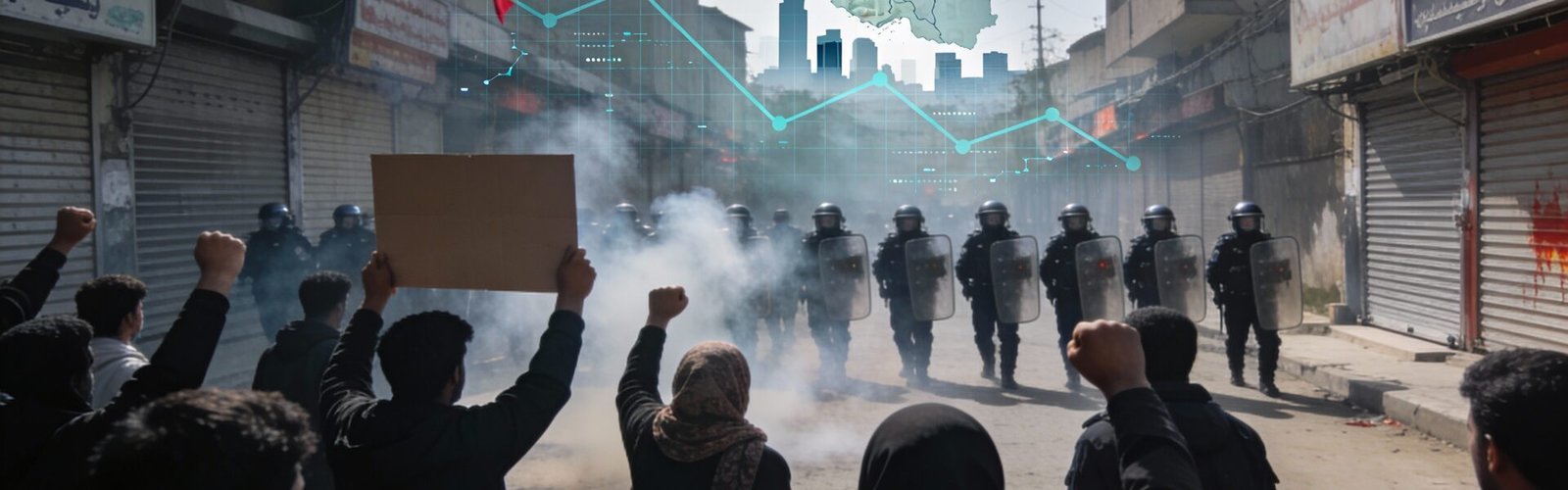
Iran Erupts Again: Mass Protests Put Supreme Leader Khamenei’s System Under Severe Strain


Iran’s Protests Test an Ageing Supreme Leader — Pressure Builds on Ayatollah Ali Khamenei’s System
From the narrow lanes of Tehran’s Grand Bazaar to university campuses and parched provincial towns, Iran has entered another volatile season of unrest. For days at a stretch in late-2025 and into early-2026, crowds have poured into streets protesting runaway inflation, a collapsing currency and deepening water shortages—anger that has quickly broadened into open political dissent. Chants echoing through city centres have not only targeted prices and wages, but the clerical establishment itself, with slogans calling for an end to “dictatorship” and “mullah rule.”
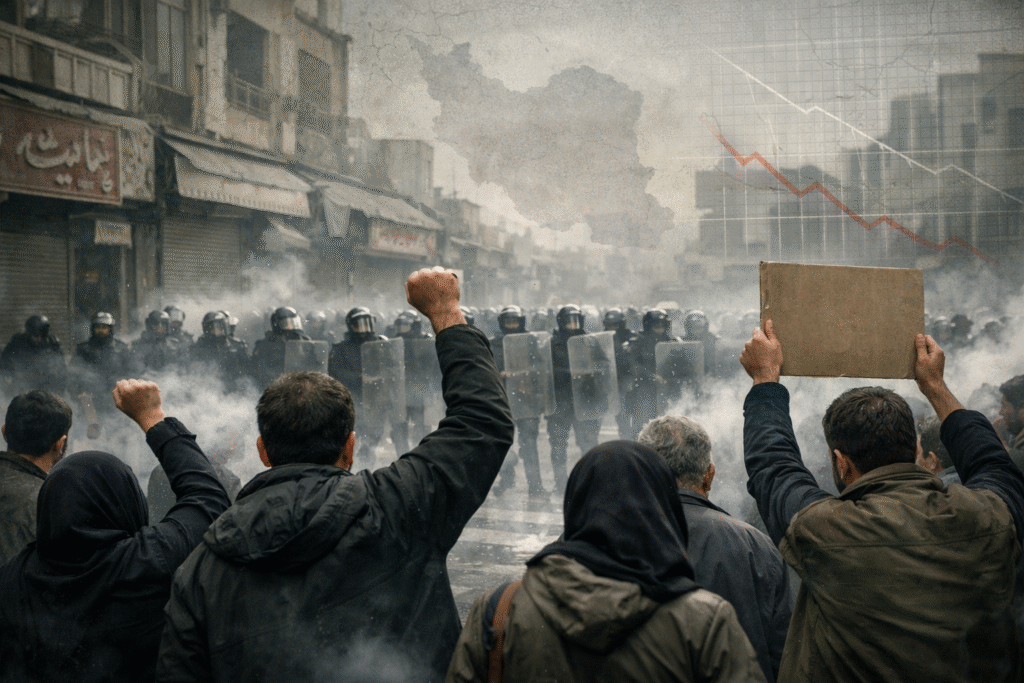
Security forces have responded forcefully. Iranian authorities acknowledge deploying riot police and Basij units using tear gas and water cannons, while rights groups and foreign media report live ammunition in some smaller cities. Officials say several people have been killed and hundreds arrested; at least one member of the security forces has also died, according to Iranian statements. Independent verification remains difficult amid internet disruptions, but the pattern—sporadic lethal force, mass detentions, and tight information control—resembles previous crackdowns.
Yet even as protesters’ rhetoric has sharpened, analysts caution against premature conclusions. There is no verified evidence that the state is on the brink of collapse, or that the Revolutionary Guards or police have stopped obeying orders. What is unfolding instead is a familiar but intensifying contest: a society under severe economic stress testing the resilience of a system that has weathered repeated uprisings for more than four decades.
A Long-Ruling Leader Under Unprecedented Strain
At the centre of this storm stands Ayatollah Ali Khamenei, now 86 and in power since 1989. His authority has been challenged before—most notably during the 2009 Green Movement, the 2019 fuel-price protests and the nationwide demonstrations after 2022—but the current wave combines multiple pressures at once: sanctions-driven economic decline, chronic water scarcity, and a public increasingly sceptical of clerical rule.
For years, foreign media and exiled opposition outlets have circulated reports of Khamenei’s poor health and increasing seclusion. Recent speculation—amplified during the latest unrest—has revived succession talk and fed perceptions of a “leaderless” or paralysed system. Iranian officials dismiss many of these claims as propaganda, and there is no independent confirmation of imminent incapacity. Still, the rumours themselves matter: they underline anxieties within Iranian society about what comes next in a highly centralised system with opaque succession mechanisms.
Khamenei’s own messaging has remained consistent. In speeches and state media commentary, the unrest is blamed on “foreign enemies”—the United States, Israel and exiled opposition networks—accused of exploiting economic grievances to weaken the Islamic Republic. It is a familiar playbook, deployed during past crises, aimed at rallying loyalists and framing dissent as externally engineered rather than domestically rooted.
Who Is Protesting — and What They Want
Unlike single-issue demonstrations, the current protests draw from a broad social base. Bazaar merchants squeezed by inflation, industrial workers unpaid for months, students facing bleak job prospects, and middle-class families watching savings evaporate have all joined rallies. The plunge of the rial, persistent shortages and rising living costs have turned economic despair into political anger.
That anger is increasingly explicit. Alongside demands for lower prices and access to water, chants such as “Death to the dictator” reflect deeper frustration with unaccountable power and limited avenues for reform. This shift mirrors a trend seen since 2019: economic grievances quickly morph into challenges to the system itself.
The state’s response has been two-tracked. On the streets, riot police, Basij militia and other security units have been deployed nationwide, with reports of live fire in certain hotspots. Online, authorities have throttled internet access and restricted social-media platforms to slow mobilisation and limit the spread of images.
Politically, President Masoud Pezeshkian has attempted a softer tone. He and other officials have acknowledged “legitimate demands” over prices and livelihoods, promising dialogue and limited relief measures. But Iran’s power structure constrains such overtures. Ultimate authority over the security apparatus rests not with the presidency but with institutions loyal to the Supreme Leader, limiting the scope for rapid de-escalation.
Despite signs of fatigue and internal debate, the core coercive pillars—the Islamic Revolutionary Guard Corps, Basij and police—still appear to be functioning and enforcing orders. That reality makes scenarios of instant regime collapse speculative at best.
International Warnings and Diplomatic Fallout
The unrest has drawn sharp reactions abroad. The United States, under Donald Trump, has publicly warned Tehran against “violently killing” protesters and threatened to “come to their rescue” if bloodshed escalates. Iranian officials have denounced such statements as blatant interference, accusing Washington of encouraging chaos.
European governments and United Nations officials have taken a more measured line, urging restraint, respect for peaceful protest and renewed attention to Iran’s human-rights record. Behind the scenes, Western capitals are weighing options that range from additional sanctions to diplomatic isolation if repression intensifies.
At the same time, many policymakers fear unintended consequences. Iran’s protests intersect with already fraught nuclear diplomacy, regional proxy conflicts and global energy markets. A violent crackdown risks hardening Western positions; a sudden regime collapse, however unlikely in the short term, could destabilise the Middle East in unpredictable ways.
Pressure Versus Resilience: How This Crisis Compares
Experts are divided on what the current moment signifies. Some see echoes of late-Soviet erosion: prolonged economic deterioration, ideological fatigue and a widening gap between rulers and society that slowly hollows out legitimacy. From this view, each protest wave, even if suppressed, leaves the system weaker.
Others stress Iran’s proven resilience. The Islamic Republic retains powerful coercive tools, loyal security elites and a track record of surviving repeated uprisings. Institutions such as the IRGC have economic as well as political stakes in the system’s survival, reinforcing cohesion in moments of crisis.
Most serious analysis now points to nuanced scenarios rather than dramatic tipping points:
- Short-term survival through force, with protests contained by arrests, internet controls and selective concessions.
- Gradual erosion, as economic pain, sanctions and demographic pressures strain elite unity and public patience over time.
- Long-term attrition, in which frequent uprisings become a chronic feature, steadily weakens the regime even if no single wave proves decisive.
An Unsettled Future
For now, Iran remains far from collapse—but also far from stability. The demonstrations shaking the country highlight a society under immense strain and a leadership facing one of its most complex challenges in decades. Whether the system adapts, represses or slowly erodes will shape not only Iran’s future, but regional power balances, energy security and the fate of long-stalled nuclear diplomacy.
What is clear is that the chants rising from Iran’s streets are no longer only about prices or water. They are about a system whose ability to govern—and to renew itself—is being questioned more openly than at any point in recent memory.
Iran protests 2025, Iran unrest latest news, Ayatollah Khamenei regime crisis, Iran inflation protests, Iran water shortage protests, Is Iran regime collapsing, Supreme Leader Khamenei health rumours,Iran IRGC response to protests, Iran human rights crackdown, Iran nuclear talks impact protests #iranprotest2026
Discover more from
Subscribe to get the latest posts sent to your email.