
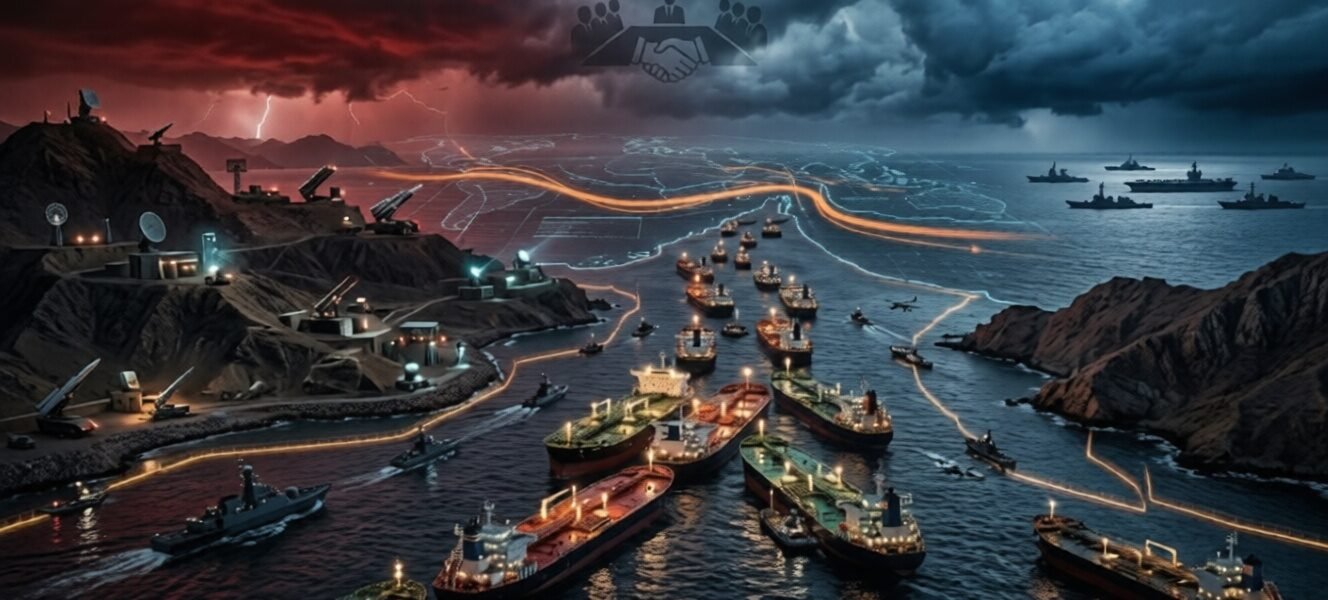
Iran Israel War: Strait of Hormuz Blocks US Victory


Twenty-four days into the war, Iran’s geographical trump card, the world’s most critical oil chokepoint Strait of Hormuz has forced Washington into diplomacy and exposed the limits of overwhelming military power.
By News24Media Geopolitics Desk | Kolkata, March 25, 2026
When the United States and Israel launched what was intended to be a swift, decisive campaign against Iran on February 28, 2026, the operational calculus appeared straightforward: overwhelming air power, precision strikes on nuclear and missile facilities, and a regime brought quickly to the negotiating table. Twenty-four days later, that calculus lies in ruins not because Iran’s military matched the firepower levelled against it, but because it never needed to. Iran has deployed something far more powerful than any ballistic missile: geography.
The Strait of Hormuz, the 33-kilometre-wide waterway separating the Iranian coast from Oman, carries approximately 20% of the world’s oil and liquefied natural gas. Since the war began, shipping traffic through the Strait of Hormuz has all but halted. Global crude prices crossed $104 per barrel this week. Qatar, Iraq, and the UAE have partially suspended export operations. And the International Energy Agency’s emergency release of 400 million barrels from strategic reserves has provided no meaningful relief. Iran, with a single strategic posture, has transformed a regional conflict into a global economic crisis — and that crisis is now the most powerful weapon in its arsenal.
The Kharg Island Gamble
Central to the strategic standoff is Kharg Island, a small but economically critical island in the northern Persian Gulf that handles 90% of Iran’s oil exports. On March 13, the US Air Force conducted a large-scale bombing raid targeting over 90 Iranian military sites on and around the island — but deliberately spared the oil and gas infrastructure. President Trump, asked why, was characteristically blunt: “We have it all locked and loaded and ready to go if we wanna do it. But I chose not to do it yet.”
The hesitation reveals the war’s central paradox. Destroying Kharg Island’s export terminals would remove up to two million barrels of oil per day from global supply, analysts estimate, potentially pushing crude towards $120 per barrel and triggering the kind of economic shock that would devastate Western economies alongside Iran’s. Seizing the island, as some US senators have urged, would give Washington extraordinary leverage — but Iran would still control the Strait of Hormuz from its mainland coast. The two pillars of Tehran’s strategic power are geographically separated and interdependent. You cannot neutralise one without the other becoming more dangerous.
Vance, Pakistan, and the 15-Point Proposal
The diplomatic track has quietly accelerated in parallel with the bombing. US Vice President JD Vance has emerged as the preferred American interlocutor for Iran. Tehran explicitly rejected Trump’s envoys Steve Witkoff and Jared Kushner, with an Iranian diplomatic source stating that “with Witkoff and Kushner, nothing will come out of it.” Pakistan, uniquely positioned as the only Muslim-majority nuclear-armed state without US military bases on its soil, has emerged as the primary mediating channel. Islamabad shares a 900-kilometre border with Iran and maintains deep ties with Saudi Arabia — a rare combination that gives it credibility with all parties.
The United States has transmitted a 15-point proposal to Tehran through Pakistani intermediaries. Iran acknowledged receipt but could not respond within the initial 24-hour deadline — a detail that speaks volumes about the damage US strikes have inflicted on Iran’s command-and-control infrastructure. Senior decision-makers were reportedly unable to gather securely for fear of being targeted. Iranian leadership eventually responded that it would consider the offer, though it emphasised that “some things” remained non-negotiable. Israeli intelligence has assessed that the gap between the sides remains very large.
Trump’s Clock Is Ticking
The pressure bearing down on Washington is, ironically, more acute than that facing Tehran. Republican strategists are watching petrol prices at US pumps climb record levels with November’s midterm elections on the horizon. Trump’s shift in tone from “you don’t do a ceasefire when you’re literally obliterating the other side” to “they want to settle, and we’re going to get it done” occurred within the space of three days, driven not by battlefield developments but by the relentless economic arithmetic of blocked shipping lanes. The President has now granted Iran a five-day window to comply with demands to reopen the Strait of Hormuz, suspending planned strikes on Iranian power plants and energy facilities in the interim.
Israel, for its part, finds itself in an uncomfortable position. The Israeli military has estimated it needs several more weeks to fully achieve its stated war objectives. But Tel Aviv does not know when Trump will declare the war over and fears that Washington may settle for a framework agreement that leaves Iran’s core infrastructure intact, allowing the regime to reconstitute over time. The divergence between the two allies is itself a new fault line in the coalition.
Power as Weakness: The Strategic Paradox
The war has produced a paradox that will be studied in military academies for decades. Iran’s greatest strategic asset, its control over the world’s most vital energy chokepoint, is simultaneously its greatest vulnerability. Tehran cannot permanently close the Strait of Hormuz without inviting escalation from every nation whose economic survival depends on it, including China and India. Yet it does not need to permanently close it. The mere credible threat, sustained over days and weeks, is sufficient to generate the global economic pressure that is now forcing the strongest military alliance in history to the negotiating table.
What Washington and Tel Aviv miscalculated was the nature of victory in a war where the enemy’s most powerful weapon is geography rather than armies. The Strait of Hormuz cannot be bombed into submission. Kharg Island cannot be seized without breaking global energy markets. As Trump himself acknowledged this week, “from a military standpoint, they’re finished” The military victory is real. But the strategic decision remains elusive. And in modern warfare, when the battlefield is the global economy, that distinction is everything.
Iran-Israel War | Strait of Hormuz | Kharg Island | Trump | JD Vance | Pakistan | Ceasefire | Oil Crisis | Middle East | Geopolitics | News24Media
© 2026 News24Media.org — All rights reserved. Reproduction with attribution permitted.
Discover more from
Subscribe to get the latest posts sent to your email.