
Do Blue Light Blocking Glasses Really Work? Science Questions a Booming Digital-Age Health Claim


Blue Light Blocking Glasses: Health Champion or Marketing Myth of the Digital Age?
A tired consumer, a costly promise
It’s nearly 9:30 pm in Bengaluru. An IT professional finally shuts her laptop after a 10–12 hour workday of video calls, spreadsheets and late-night emails. Her eyes feel dry and gritty. There’s a dull headache behind her temples. Sleep, when it comes, is restless.
The next weekend, at an optical store or while scrolling online, she’s offered a solution: premium blue-light blocking glasses. The pitch is confident and reassuring—block harmful blue light, reduce eye strain, protect your vision, and sleep better. The price? Two to three times more than standard lenses.
That raises the real question that millions of Indian consumers are now asking: Is blue light from screens really the villain—and are blue light blocking glasses worth their hefty price tag?
What blue light actually is—and where it comes from
Blue light is a part of the visible light spectrum, with relatively short wavelengths and higher energy than red or yellow light. Crucially, the biggest source of blue light is not your smartphone or laptop—it’s the sun.
Sunlight contains far more blue light than LED screens, televisions or office lighting. Digital devices do emit blue light, but at much lower intensities compared with natural daylight.
Scientifically, concerns around blue light fall into two very different categories:
Blue light and sleep
There is solid evidence that blue light exposure at night can interfere with circadian rhythm by suppressing melatonin, the hormone that signals the body it’s time to sleep. This is why late-night screen use can delay sleep onset.
Blue light and eye damage
This is where marketing often runs ahead of science. According to decades of ophthalmic research, there is no convincing evidence that normal screen use causes permanent retinal damage through blue light exposure. The levels emitted by consumer devices are far below those used in laboratory studies that show retinal harm.
In short, blue light can affect sleep timing at night, but it is not proven to damage eyes under normal digital use.
What the best scientific evidence says about Blue Light Blocking Glasses
Over the past few years, researchers have taken a hard look at Blue Light Blocking Glasses/ lenses. The results are strikingly consistent.
High-quality systematic reviews and meta-analyses published between 2023 and 2024, including Cochrane reviews, conclude that:
Blue-light filtering spectacle lenses probably make little or no difference to digital eye strain, visual performance, or sleep quality when compared with standard lenses over short-term use.
Symptoms commonly blamed on blue light—eye soreness, headaches, blurred vision—are far more strongly linked to how screens are used, not to blue wavelengths themselves.
Professional bodies echo this position. The American Academy of Ophthalmology states that there is no scientific evidence that blue-light blocking glasses protect eyes from disease or are necessary for healthy people using computers.
Several optometry associations globally have issued similar guidance: blue-cut lenses should not be routinely prescribed solely for computer use.
What “digital eye strain” really is
The medical term often used is digital eye strain or computer vision syndrome. It is a recognised condition—but its causes are widely misunderstood.
Common symptoms include:
- Dryness, burning or itching
- Redness and irritation
- Foreign-body sensation
- Blurred or fluctuating vision
- Headaches
- Neck, shoulder and upper-back pain
What causes these symptoms?
1. Reduced blinking
People blink up to 60% less when staring at screens. Incomplete blinks destabilise the tear film, leading to dryness and irritation.
2. Continuous near focus
Sustained accommodation and convergence fatigue the eye muscles, especially during long workdays without breaks.
3. Poor ergonomics
Improper screen height, glare, bad posture and long sitting hours contribute significantly to discomfort and headaches.
Peer-reviewed reviews consistently show that overuse, poor ergonomics and reduced blinking—not blue light itself—are the main drivers of digital eye strain.
The business of blue light: India’s pricing and marketing boom
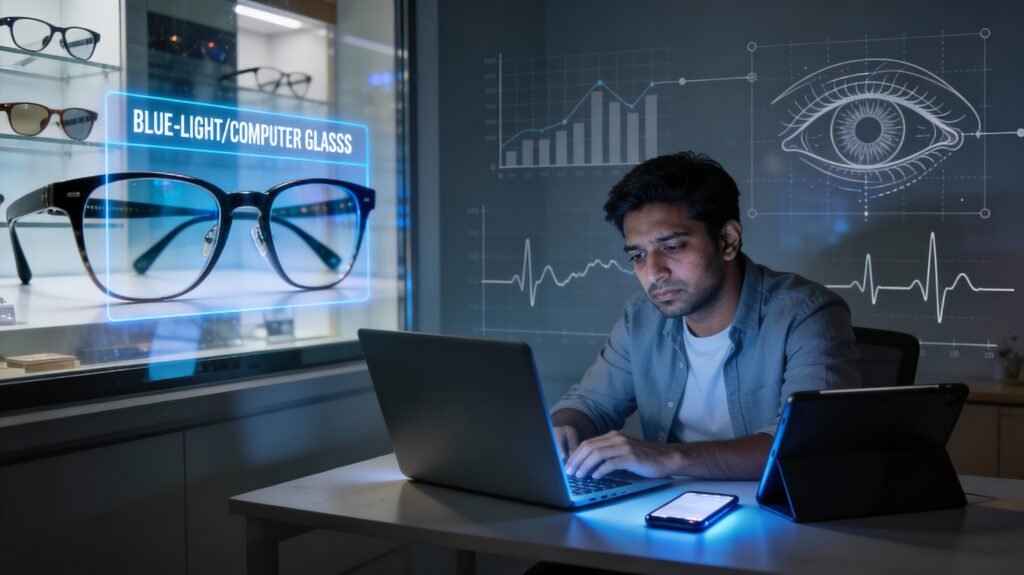
Despite weak medical evidence, blue-light lenses have become a high-margin add-on in the eyewear industry.
Typical pricing in India:
- Standard single-vision lenses: ₹500–₹2,000
- “Blue-cut” / “digital protection” lenses: ₹2,000–₹6,000 or more
That’s often a 2–3x markup, positioned as a health necessity rather than an optional feature.
The narrative is powerful: screens are damaging your eyes, and this lens will protect you. Yet, this claim is not supported by strong clinical evidence for the general population.
Globally, the blue light blocking glasses market is projected to grow into a multi-billion-dollar industry by the mid-2030s, riding on digital lifestyles, remote work and health anxiety. India’s fast-growing eyewear market has become a key growth driver.
What doctors and researchers actually say
Many ophthalmologists and vision scientists are blunt:
“There is hardly any evidence that clear blue light blocking glasses reduce digital eye strain or prevent eye damage from screens in healthy users.”
That said, nuance matters. Some small, controlled studies suggest that strong blue-blocking lenses worn in the evening may help specific groups, such as night-shift workers or people with circadian rhythm sleep disorders.
However, experts stress that:
- These lenses are very different from the lightly tinted “blue-cut” lenses/ blue light blocking glasses sold for daytime office use
- Findings cannot be generalised to the average screen user
Marketing promises vs medical reality
| Marketing Claim | What Evidence Shows |
|---|---|
| “Prevents eye damage” | No proof for normal screen use |
| “Stops digital eye strain” | Little or no difference vs normal lenses |
| “Guarantees better sleep” | Minimal impact for most users |
| “Essential for screen users” | Not supported by medical bodies |
Evidence-based alternatives that actually work
Instead of spending thousands on unproven blue light blocking glasses/lenses, researchers and clinicians recommend simple, low-cost interventions:
- 20-20-20 rule: Every 20 minutes, look 20 feet away for 20 seconds
- Blink consciously and completely
- Maintain proper screen distance and height
- Take regular breaks
- Use lubricating eye drops if advised
- Reduce screen brightness at night and limit late-evening device use
Blue light blocking glasses, experts say, should be viewed as a comfort or style choice—not a medical necessity, unless prescribed for specific clinical reasons.
The bottom line
Blue light blocking glasses are a brilliant marketing success—but a weakly supported medical intervention for everyday digital eye strain.
For most office workers and students, the science is clear: how you use screens matters far more than the colour of the light coming from them.
Before paying a premium for blue light blocking glasses that are “digital protection” lenses, consumers would do well to ask a simple question: Is this evidence-based healthcare, or just clever branding in the digital age?
blue light blocking glasses evidence, do blue light glasses work, digital eye strain causes, blue cut lens price in India, scientific research on blue light glasses, computer vision syndrome, blue light and sleep, eyewear marketing India,
Recent Posts
- Turkey Gen Z Rebels: Viral Namaz Mockery, Rising Atheism and a Generational Revolt Against Political Islam
- India Condemns Demolition of Lord Vishnu Statue Amid Escalating Thailand–Cambodia Border Dispute
Discover more from
Subscribe to get the latest posts sent to your email.








1 COMMENTS